

How to Read a Profit and Loss Statement
A profit and loss statement — also called a P&L or income statement — is the single most useful report for a small business owner. It shows whether you made money over a period, and why. Yet many owners only see one when their accountant files their taxes. Here is how to read a P&L line by line and what to look for every month.
What a P&L shows
A P&L covers a period of time — a month, a quarter or a year — and follows a simple shape:
Revenue − Cost of goods sold = Gross profit Gross profit − Operating expenses = Operating profit Operating profit ± Other items = Net profit
A sample P&L
| Line | October | % of revenue |
|---|---|---|
| Revenue | $12,000 | 100% |
| Cost of goods sold | $4,200 | 35% |
| Gross profit | $7,800 | 65% |
| Advertising | $900 | 7.5% |
| Platform and payment fees | $1,080 | 9% |
| Software and subscriptions | $260 | 2.2% |
| Rent and utilities | $700 | 5.8% |
| Contract labor | $1,200 | 10% |
| Other expenses | $340 | 2.8% |
| Total operating expenses | $4,480 | 37.3% |
| Operating profit | $3,320 | 27.7% |
| Interest expense | $70 | 0.6% |
| Net profit | $3,250 | 27.1% |
Let’s walk through it.
1. Revenue (top line)
All the money earned from sales in the period: product sales, services, shipping you charged. Check two things: is it growing compared with last month and the same month last year, and where does it come from (which products, clients or channels)?
2. Cost of goods sold (COGS)
The direct cost of what you sold: materials, inventory, packaging and sometimes production labor. Service businesses may have little or no COGS. Watch COGS as a percentage of revenue; if it creeps up, your supplier prices rose or your prices are too low. Our guide on how to price handmade products shows how cost feeds into price.
3. Gross profit and gross margin
Revenue minus COGS. Gross margin is gross profit divided by revenue — 65% in the example. It tells you how much of each sales dollar is left to pay for running the business. A falling gross margin is an early warning sign.
4. Operating expenses
Everything it costs to run the business that is not tied directly to a product sold: advertising, fees, software, rent, contractors, travel, office costs. Group them into a manageable number of categories — matching them to Schedule C expense categories makes tax time easier.
Look for the biggest categories and the fastest-growing ones. Small subscriptions add up quietly.
5. Operating profit
Gross profit minus operating expenses: what the business earns from its core activity. It is the number to watch when you make decisions about pricing, spending or hiring.
6. Net profit (bottom line)
Operating profit plus or minus other items such as interest. For most sole proprietors this is close to the profit that flows to Schedule C — before income tax and self-employment tax, which a P&L for a sole proprietorship usually does not include. That is why you still need to set aside money for taxes from your profit.
Five questions to ask every month
- Is revenue up or down compared with last month and last year — and why?
- Did gross margin hold? If not, did costs rise or did discounts eat into prices?
- Which expense grew the most? Was it worth it?
- Is net profit where we planned? Compare with your budget.
- Does the cash match? Profit is not cash — see cash flow vs profit for why the bank balance can tell a different story.
Common mistakes when reading a P&L
- Looking only at the bottom line and ignoring margins.
- Comparing a strong holiday month with a quiet one without context — compare with the same month last year.
- Treating owner withdrawals as expenses (for a sole proprietor, they are not).
- Forgetting that loan principal and large equipment purchases may not show as expenses the same way.
Make it a monthly habit
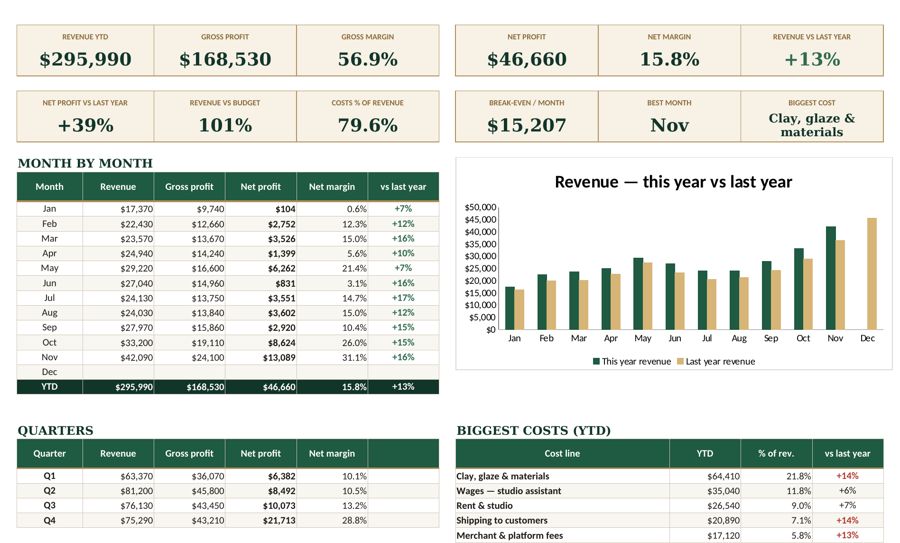
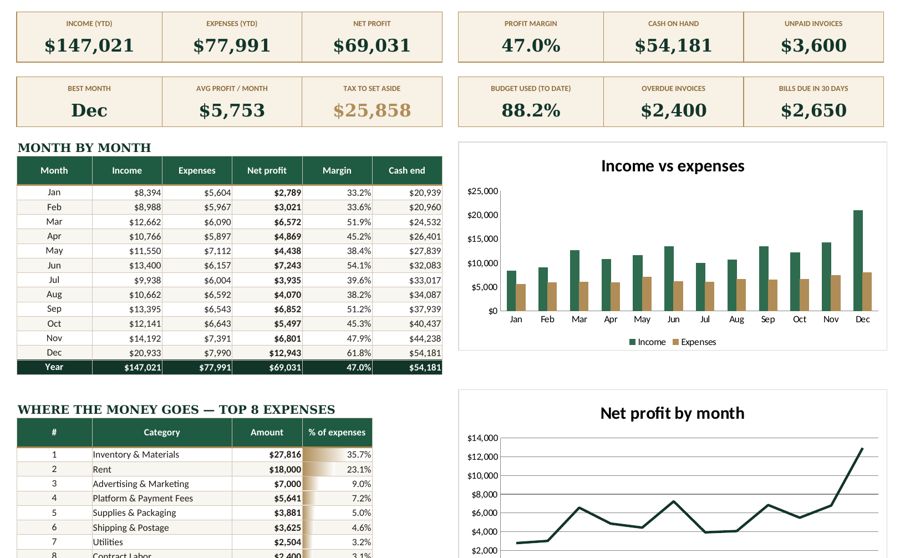
A P&L is only as good as the bookkeeping behind it. Record and reconcile transactions every month — our small business bookkeeping guide shows a simple routine — and your P&L practically builds itself. A P&L analyzer that compares months, last year and budget side by side turns those numbers into decisions in a few minutes.
Tools mentioned in this article
Keep reading

This article is general information for US small businesses, not tax, legal or accounting advice. Check current IRS guidance or ask a qualified professional about your situation.