

How Much Should a Freelancer Set Aside for Taxes?
When you freelance, nobody withholds tax from your payments. That freedom comes with a job: you have to set money aside so a tax bill never catches you off guard. The most common question is simple — how much?
The short answer for many US freelancers is 25% to 30% of profit, plus your state’s share. Below is where that number comes from, how to adjust it for your situation and a worked example.
Why freelancers owe more than they expect
As an employee, your employer pays half of your Social Security and Medicare taxes. As a freelancer, you pay both halves through self-employment tax, on top of regular income tax.
| Tax | What it is | Rate |
|---|---|---|
| Self-employment tax | Social Security (12.4%) + Medicare (2.9%) | 15.3% on 92.35% of net earnings |
| Federal income tax | Same brackets as employees | Depends on total taxable income |
| State income tax | Varies by state (some have none) | 0% to about 13% |
For 2026, the Social Security part applies to net earnings up to $184,500; the Medicare part has no cap. You can deduct half of your self-employment tax when you figure your income tax. The IRS explains the details on its self-employment tax page.
A simple way to estimate your set-aside
- Work from profit, not revenue. Subtract business expenses first. If you invoice $6,000 and spend $1,000 on software, equipment and fees, your profit is $5,000.
- Start at 25%–30% of profit. That usually covers self-employment tax, federal income tax and some state tax for freelancers in middle brackets, with a small cushion.
- Check your state. In a high-tax state, lean toward 30% or more; in a state with no income tax, the lower end may be enough.
- Adjust once a quarter. As the year goes on, compare what you have saved with what you are likely to owe and adjust the percentage.
If your profit is low, the percentage may be lower; if you are in a high bracket or have other income, such as a salary, it may need to be higher.
A worked example
Say you are single, freelancing full time, with no other income and $60,000 of net profit for the 2026 tax year.
- Self-employment tax: $60,000 × 92.35% × 15.3% ≈ $8,478
- Federal income tax: subtract half of the self-employment tax ($4,239) and the $16,100 standard deduction, and many freelancers can also claim the qualified business income deduction. In this example, federal income tax comes out at roughly $3,500–$4,500.
Total federal estimate: about $12,000–$13,000, or 20%–22% of profit. Add state income tax and a small buffer, and setting aside 25%–30% leaves you comfortably covered.
These numbers are illustrative only. Your result depends on your filing status, other income, deductions and credits — a tax professional can give you an exact figure.
Where to keep the money
Open a separate savings account just for taxes. Every time a client pays you, move your set-aside percentage there the same day. Treat it as money that already belongs to the IRS — and enjoy a small refund to yourself if you over-saved.
Do not forget quarterly payments
If you expect to owe at least $1,000 in federal tax for the year, the IRS generally expects quarterly estimated tax payments. For the 2026 tax year, the due dates are April 15, June 15 and September 15, 2026, and January 15, 2027. Paying late can mean a penalty even if you pay in full in April. See the IRS page on estimated taxes.
Lower the bill legally: track deductions
Every legitimate business expense lowers your profit — and with it both self-employment tax and income tax. Common freelancer deductions include software, equipment, a home office, business mileage and professional services. Recording them as you go is easier than reconstructing them in April; see our guide to Schedule C expense categories and our step-by-step small business bookkeeping routine.
Quick checklist
- Set aside 25%–30% of profit from every payment, more in high-tax states.
- Keep it in a separate savings account.
- Make quarterly estimated payments if you will owe $1,000 or more.
- Track expenses all year to reduce your taxable profit.
- Review every quarter and adjust your percentage.
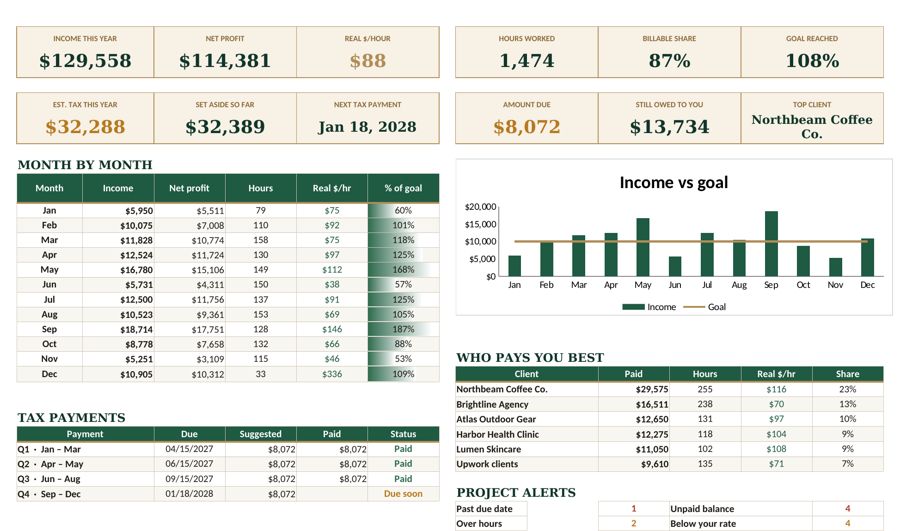
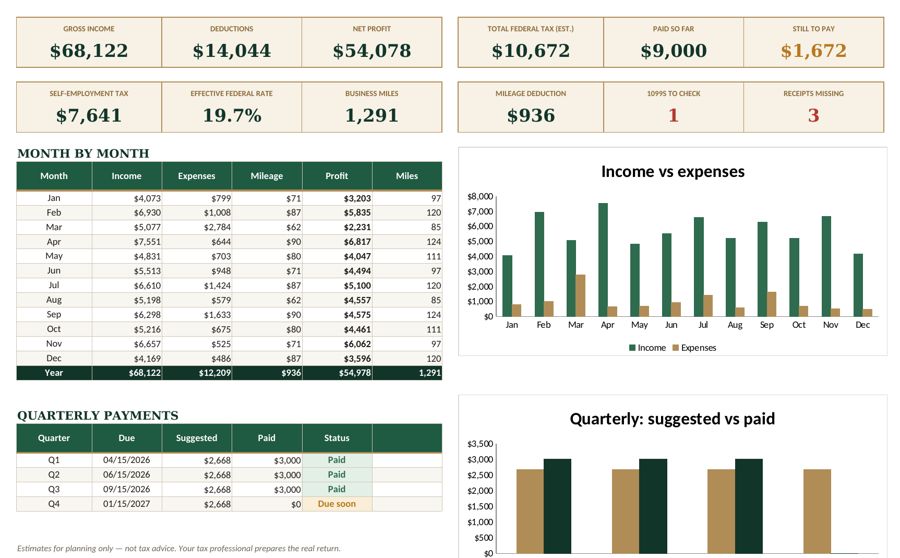
A freelance income tracker that calculates your set-aside automatically makes this almost effortless: log each payment, and it shows what to move to savings and what your next quarterly payment should be.
Tools mentioned in this article
Keep reading

This article is general information for US small businesses, not tax, legal or accounting advice. Check current IRS guidance or ask a qualified professional about your situation.