

How to Do Bookkeeping for a Small Business, Step by Step
Small business bookkeeping sounds technical, but at its core it is one habit: write down every dollar that comes in and goes out, in a consistent way, so you can trust your numbers. Do that, and taxes, pricing and growth decisions get much easier.
This guide walks you through a simple bookkeeping system you can run in about an hour a week — in a spreadsheet or any tool you like.
Why bookkeeping matters (even when you are small)
- Taxes. If you are self-employed in the US, your business profit flows onto Schedule C. Clean books mean you can fill it in quickly and claim every deduction you are entitled to.
- Cash. Bookkeeping shows where money goes before it runs out.
- Pricing. You cannot price for profit if you do not know your real costs.
- Peace of mind. If the IRS, a lender or a partner asks a question, you have the answer.
Step 1: Open a separate business account
Use one checking account (and ideally one card) only for the business. Mixing personal and business spending is the number one reason small business books become a mess. Even a sole proprietor with no LLC benefits from this.
Step 2: Choose cash or accrual
Most small businesses use the cash method: you record income when you receive it and expenses when you pay them. It is simple and matches your bank balance. The accrual method records income when you earn it and costs when you owe them, which is more common in larger or inventory-heavy businesses. If you are unsure, start with cash and ask a tax professional before switching.
Step 3: Set up your categories
Create a short list of income and expense categories. Matching them to the Schedule C lines saves time later — our guide to Schedule C expense categories lists the common ones. A good starting list:
| Type | Example categories |
|---|---|
| Income | Product sales, service income, shipping charged |
| Cost of goods | Materials, packaging, inventory purchases |
| Expenses | Advertising, platform fees, software, office supplies, contract labor, travel, meals, phone and internet |
Keep it short. Ten to fifteen categories are enough for most solo businesses.
Step 4: Record every transaction
For each transaction, capture five things:
- Date
- Description (who and what)
- Category
- Amount (income positive, expenses negative — or separate columns)
- Account (which bank account or card)
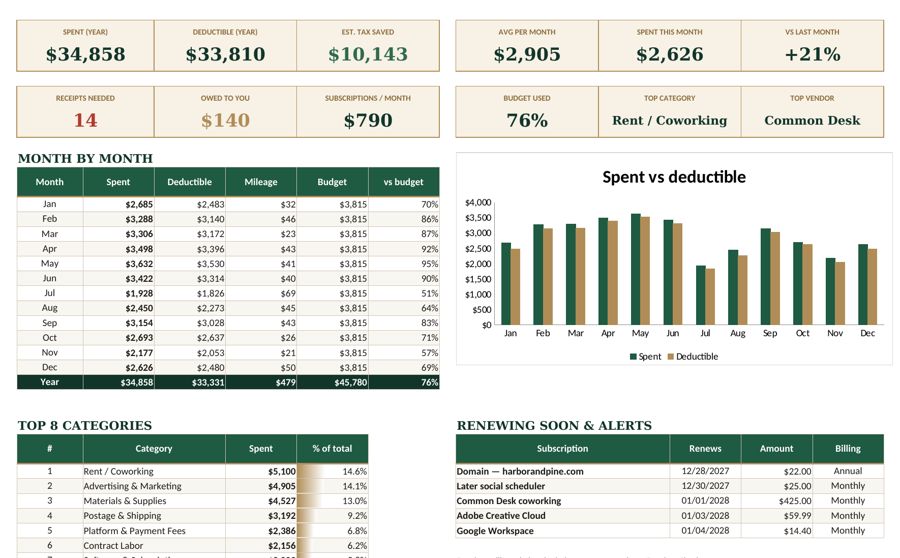
Add a column for the receipt location — a folder, an email label or a photo — so you can find proof later. The IRS expects you to keep records that support your income and deductions; see its recordkeeping guidance.
Step 5: Reconcile every month
Once a month, compare your records with your bank and card statements. The ending balance in your books should match the statement. If it does not, look for:
- transactions you forgot to record,
- duplicates,
- typos in amounts,
- transfers recorded as income or expenses.
Reconciling monthly takes 15 minutes. Reconciling once a year can take a weekend.
Step 6: Review your monthly numbers
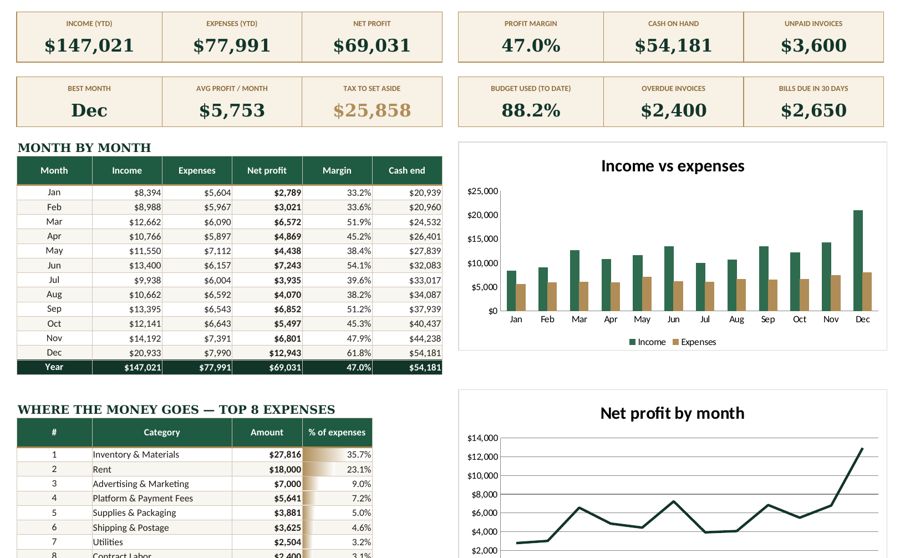
At the end of each month, look at three numbers:
- Revenue — total income for the month.
- Expenses — total spending, by category.
- Net profit — revenue minus expenses.
Compare them with last month and with your budget. Spot a category creeping up? That is your cue to act early.
Step 7: Plan for taxes as you go
Set aside a percentage of every payment for taxes in a separate savings account. If you expect to owe $1,000 or more for the year, you will usually need to make quarterly estimated tax payments. Your bookkeeping gives you the profit number those estimates are based on.
A simple weekly routine
| When | Task | Time |
|---|---|---|
| Weekly | Record transactions, file receipts | 20–30 min |
| Monthly | Reconcile accounts, review profit and expenses | 30–45 min |
| Quarterly | Estimate taxes, check budget vs actual | 30 min |
| Yearly | Year-end summary for your tax return | 1–2 hours |
Spreadsheet or software?
Accounting software is great when you have employees, inventory across many channels or an accountant who works inside it. Many solo businesses do perfectly well with a well-built spreadsheet: no monthly fee, full control and nothing to learn beyond typing in rows. The key is a structure that calculates totals, profit and tax categories for you, so you only enter the basics.
The bottom line
Good small business bookkeeping is not about accounting jargon. It is a separate account, a short category list, a weekly habit of recording transactions and a monthly check against the bank. Start this week, and by year-end you will have clean, trustworthy numbers.
Tools mentioned in this article
Keep reading

This article is general information for US small businesses, not tax, legal or accounting advice. Check current IRS guidance or ask a qualified professional about your situation.