

Small Business Expense Categories: A Practical List
A good set of small business expense categories does three jobs at once: it shows you where your money goes, it makes tax time faster, and it keeps your profit numbers honest. Too few categories (“Misc” for everything) and you learn nothing. Too many and you spend your evenings deciding whether printer ink is “Office” or “Supplies.” This guide gives you a practical starting list, explains how each category lines up with the IRS Schedule C, and walks through a real month of categorized spending.
Why your categories matter
- Decisions: You cannot cut software spending if software is buried inside “Office expense.”
- Taxes: Sole proprietors and single-member LLCs report expenses by category on Schedule C. If your categories already match, filing is mostly copying totals.
- Consistency: Using the same categories every month lets you compare months and years, which is what turns bookkeeping into insight.
If you are setting up your books for the first time, read how to do bookkeeping for a small business first, then come back to choose categories.
A practical list of small business expense categories
Start with the categories below. Delete the ones you will never use and add a sub-category only when a line gets big enough that you want to watch it on its own.
| Category | Typical examples | Schedule C area |
|---|---|---|
| Advertising & marketing | Etsy Ads, social media ads, printed flyers, sponsored posts | Advertising |
| Car & truck | Business mileage (standard rate) or actual vehicle costs | Car and truck expenses |
| Contract labor | Payments to freelancers and independent contractors | Contract labor |
| Insurance | General liability, professional liability, business property | Insurance |
| Interest | Interest on business loans and business credit cards | Interest |
| Legal & professional | Accountant, bookkeeper, attorney fees | Legal and professional services |
| Office expense | Postage for office use, printer ink, small office items | Office expense |
| Software & subscriptions | Design tools, cloud storage, email marketing, website hosting | Often “Other expenses” or office expense; be consistent |
| Rent | Studio, coworking space, equipment rental | Rent or lease |
| Repairs & maintenance | Fixing equipment, servicing machines | Repairs and maintenance |
| Supplies & materials | Craft materials, packaging, consumables used in the business | Supplies (or cost of goods sold for product inventory) |
| Taxes & licenses | Business licenses, permits, the employer share of payroll taxes | Taxes and licenses |
| Travel | Airfare, lodging and transport for business trips away from home | Travel |
| Meals | Business meals with clients or while traveling | Deductible meals (generally 50%) |
| Utilities & phone | Business portion of phone and internet, studio utilities | Utilities |
| Wages | Payroll for employees (not the owner) | Wages |
| Merchant & platform fees | Etsy transaction and processing fees, payment processor fees | Often “Other expenses”; be consistent |
| Shipping & postage | Postage and labels for orders | Often supplies or “Other expenses”; be consistent |
| Education | Courses and books that maintain or improve skills used in your current business | Often “Other expenses” |
Two items have special treatment. Home office is calculated separately rather than entered as a normal expense; see simplified vs regular home office method. Inventory you sell generally flows through cost of goods sold, not supplies, so product sellers should track it separately (see how to track inventory for an Etsy shop).
For a closer look at each Schedule C line, read Schedule C expense categories, explained.
Rules that keep categories useful
- One home per expense. Decide once where a recurring cost goes and write it down. Consistency matters more than the “perfect” category.
- Split mixed charges. A $300 office-store receipt with $240 of packaging and $60 of printer ink becomes two lines.
- Keep personal out. Personal purchases never get a business category. If one slips through on the business card, record it as an owner draw, not an expense.
- Track meals at full cost. Record what you paid and apply the 50% limit at tax time, so your cash records still match the bank.
- Keep mileage in a log, not just a total. The 2026 IRS standard mileage rate for business is 72.5 cents per mile, but the deduction depends on a proper record. See what the IRS expects in a mileage log.
- Avoid a giant “Miscellaneous.” If “Other” is more than about 5% of expenses, it is hiding something worth its own category.
A worked example: one month, categorized
Rosa runs an Etsy shop selling hand-printed tote bags. Here is her October spending after categorizing each transaction:
| Category | Detail | Amount |
|---|---|---|
| Advertising & marketing | Etsy Ads $45.00 + Pinterest promotion $75.00 | $120.00 |
| Software & subscriptions | Design app $34.00 + email platform $52.00 | $86.00 |
| Supplies & materials | Ink, screens, packaging | $214.30 |
| Shipping & postage | Order labels | $162.75 |
| Merchant & platform fees | Etsy transaction and processing fees | $93.40 |
| Meals | Lunch meeting with a wholesale buyer | $64.00 |
| Utilities & phone | Business share of phone plan | $45.00 |
| Total spent | $785.45 |
Check the total: $120.00 + $86.00 + $214.30 + $162.75 + $93.40 + $64.00 + $45.00 = $785.45.
At tax time, the meal is generally only 50% deductible: $64.00 × 50% = $32.00. So the deductible total for the month is $785.45 − $32.00 = $753.45, while her cash records still show the full $785.45 she paid.
What the categories tell her immediately: shipping plus platform fees ($162.75 + $93.40 = $256.15) cost more than all her materials ($214.30). That is a pricing signal, not just a bookkeeping fact.
When to add or merge categories
- Add a category when a recurring cost is large enough to manage on its own, such as splitting “Advertising” into Etsy Ads and social ads once ad spend becomes significant.
- Merge categories you touch once or twice a year into a broader one.
- Review once a year, ideally in December, so a new structure starts cleanly on January 1.
The bottom line
- Start with 12 to 18 categories that match how your business spends money.
- Map each category to a Schedule C line so tax time is mostly totals.
- Split mixed receipts, keep personal spending out, and log mileage properly.
- Record meals at full cost; apply the 50% limit when you file.
- Review the totals monthly: the categories are there to show you where profit leaks.
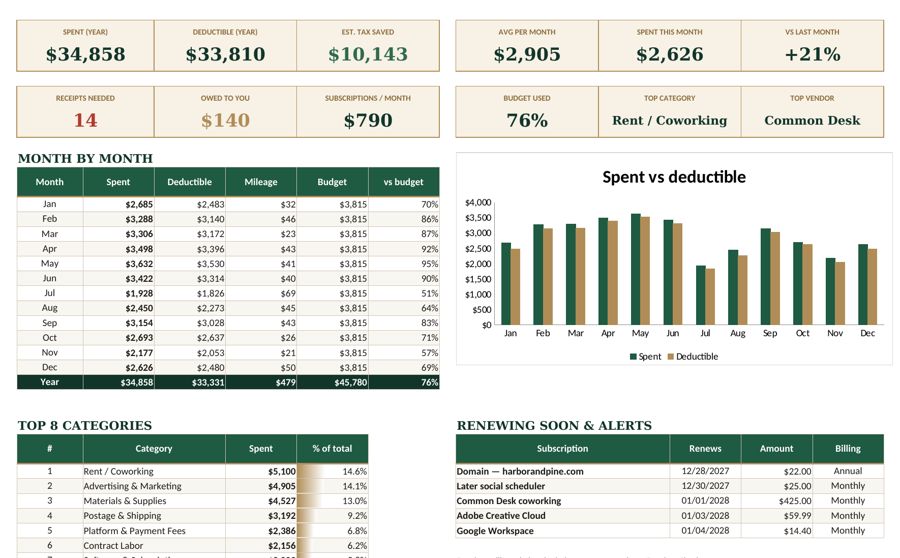
If you prefer a ready structure, the Fyscale expense tracker comes with these categories built in and totals them by month. It helps you organize records; for advice on your specific deductions, check with a tax professional.
Tools mentioned in this article
Keep reading
This article is general information for US small businesses, not tax, legal or accounting advice. Check current IRS guidance or ask a qualified professional about your situation.