

How to Separate Business and Personal Finances

If your Etsy deposits, client payments, grocery runs and Netflix bill all flow through one checking account, you are not alone, and you are not doing anything illegal as a sole proprietor. But it makes everything harder: bookkeeping takes longer, deductions get missed, and you never quite know whether the business is making money. Learning how to separate business and personal finances is one of the cheapest, highest-return fixes a small business owner can make. This guide walks through the setup, a simple money-flow routine, and how to clean up the mixed transactions you already have.
Why mixing money causes real problems
Commingling (the accounting word for mixing funds) creates three practical headaches:
- Slower, messier bookkeeping. Every month you have to sort through personal purchases to find the business ones. That is where hours disappear and where errors creep in.
- Weaker records at tax time. The IRS expects you to keep records that support the income and expenses you report. A dedicated account turns your bank statement into a clean, ready-made record. When every transaction is mixed, you are relying on memory and receipts alone. The IRS overview of recordkeeping for small businesses explains what you should be able to back up.
- No clear picture of profit. If you cannot see business cash on its own, you cannot tell whether a slow month is a business problem or just a heavy personal spending month.
If you operate as an LLC or corporation, separation matters even more, because mixing funds can weaken the legal separation between you and the business. That is a question for an attorney, but the habit described below helps either way.
How to separate business and personal finances: the setup
You do not need an accountant or expensive software to get started. You need four things.
1. Open a dedicated business checking account
A sole proprietor can often open a business account with their Social Security number, although many banks will ask for an EIN, and getting one from the IRS is free. Compare monthly fees, minimum balance rules and whether the account connects easily to the payment platforms you use. Many online banks offer no-fee accounts for small businesses.
2. Route all business income into it
Change your payout destination everywhere money comes in: Etsy Payments, Stripe, PayPal, Square, client bank transfers and any marketplace you sell on. From that day on, business income should land in the business account only.
3. Use one card for business spending
Get a debit card on the business account or a separate credit card used only for the business. Then update every recurring business charge, like software subscriptions, shipping labels, web hosting and ad spend, so it bills that card.
4. Pay yourself on a schedule
As a sole proprietor you do not take a paycheck; you take an owner’s draw. Move a set amount from the business account to your personal account on a fixed schedule, such as every other Friday. This single transfer replaces dozens of random personal purchases on the business account.
A simple money-flow routine (with numbers)
Separation works best when every dollar has a job. Here is a three-bucket routine many solo business owners use. Suppose your business deposits average $6,000 per month.
| Bucket | Share | Monthly amount | Where it lives |
|---|---|---|---|
| Tax savings | 25% | $1,500 | Separate business savings account |
| Operating expenses | 30% | $1,800 | Business checking |
| Owner’s pay | 45% | $2,700 | Transferred to personal checking |
| Total | 100% | $6,000 |
The percentages are an example, not a rule. Your tax share depends on your income, deductions and state. Our guide on how much a freelancer should set aside for taxes shows how to pick a number that fits you. Your operating share should be based on what the business actually spent over the past few months.
The routine:
- When money lands, leave it in business checking.
- Once a week, move the tax share into the tax savings account.
- Twice a month, transfer owner’s pay to your personal account.
- Never pay a personal bill directly from the business account.
The tax savings account makes quarterly estimated payments painless, because the money is already sitting there when a due date arrives.
What to do when something slips
Mistakes will happen. You will grab the wrong card at the post office, or a client will pay you on a personal payment app. The fix is to record it, not to ignore it.
- Business expense paid personally: Record it in your books as a business expense and note that it was paid with personal funds (an owner contribution). If you want, reimburse yourself from the business account with a clear memo.
- Personal expense paid with business funds: Record it as an owner’s draw, not as a business expense. Do not deduct it.
- Business income received personally: Transfer it to the business account and record the income on the date you received it.
The goal is that your books tell the true story, even when the money took a detour.
Cleaning up the transactions you already mixed
If you have months of mixed history, do not panic. Pick a cutoff date, ideally January 1 or the first day of the current quarter, then:
- Download statements for every account the business touched since the cutoff.
- Go line by line and tag each transaction as business income, business expense or personal.
- Assign each business expense to a category. Our walkthrough of Schedule C expense categories lists the common ones.
- Match larger expenses to receipts or invoices, and save digital copies.
- Total business income and expenses by month so you have a clean starting point.
For vehicle use, a mixed account will not show how many miles were for business, so you also need a log. See what the IRS expects in a mileage log.
Weekly and monthly habits that keep it separate
- Weekly (10 minutes): Review new business transactions, categorize them and move the tax share to savings.
- Monthly (30 minutes): Reconcile the business account against your books, review subscriptions, and check owner’s draws against your plan.
- Quarterly: Review your tax savings balance before each estimated payment due date.
If you have not set up a bookkeeping routine yet, start with our step-by-step guide to small business bookkeeping.
Bottom line: your separation checklist
- [ ] Business checking account opened
- [ ] Separate savings account for taxes
- [ ] All payout destinations switched to the business account
- [ ] One card used only for business, with recurring charges moved to it
- [ ] Owner’s draw on a fixed schedule
- [ ] Mixed history cleaned up from a clear cutoff date
- [ ] Weekly 10-minute review on the calendar
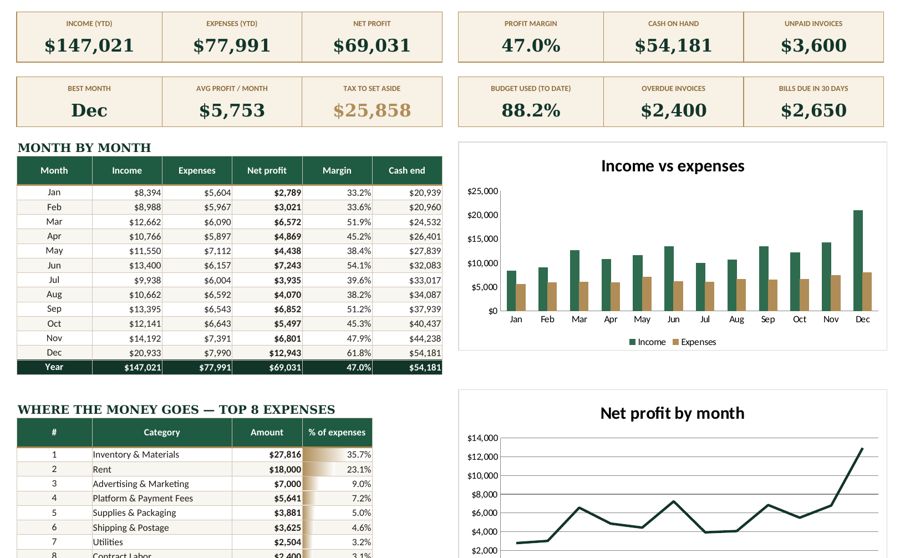
Once the accounts are separate, tracking becomes much easier. A simple ledger, such as the Fyscale bookkeeping spreadsheet, can then mirror your business account category by category. This article is general information, not tax or legal advice; for questions about your situation, talk with a qualified tax professional.
Tools mentioned in this article
Keep reading

This article is general information for US small businesses, not tax, legal or accounting advice. Check current IRS guidance or ask a qualified professional about your situation.