

Bank Reconciliation for Small Business: A Beginner's Guide
Your bank balance and your bookkeeping balance should tell the same story, but they almost never match on the first try. Bank reconciliation for small business owners is the monthly habit of lining the two up, explaining every difference, and fixing what is actually wrong. It takes 20 to 60 minutes a month once you have a routine, and it is the single best way to catch missed expenses, duplicate entries, bank fees and fraud before they snowball into a messy tax season.
What bank reconciliation actually is
A reconciliation compares two records of the same money:
- The bank’s record: your monthly statement, showing what cleared the account.
- Your record: your ledger, spreadsheet or accounting software, showing what you entered.
They differ for two kinds of reasons. Timing differences are normal: a check you wrote on the 29th might not clear until next month, and a deposit you made on the 31st may land on the next statement. Errors and omissions are the ones you need to fix: a fee you never recorded, a subscription that auto-charged, a typo in an amount, or a transaction entered twice.
The goal is not to force the numbers to match. It is to end with an adjusted bank balance and an adjusted book balance that are equal, with every adjustment explained.
Why it matters for a small business
- You catch errors while they are fresh. Finding a $9 typo in October is easy. Finding it in April across twelve months of transactions is not.
- You spot fraud and surprise charges. Unknown card charges, forgotten free trials and double-billed software show up fast.
- Your profit numbers become trustworthy. If your books are missing $60 a month in fees, your profit and loss statement overstates profit every month.
- It supports your records. The IRS expects you to keep records that support the income and expenses you report; its recordkeeping guidance explains what that means. Reconciled books, backed by statements and receipts, are much easier to defend.
Reconciliation is also far simpler if business and personal money live in different accounts. If you are still mixing them, start with how to separate business and personal finances.
What you need before you start
- The bank statement for the month (PDF or downloaded CSV)
- Your ledger or transaction list for the same period
- Last month’s reconciliation, so you know which items were outstanding
- Receipts or invoices for anything you do not recognize
Bank reconciliation step by step
1. Start with the statement ending balance
Write down the ending balance on the bank statement. This is your starting point on the bank side.
2. Add deposits in transit
Deposits you recorded in your books that do not appear on the statement yet. Add them to the bank balance.
3. Subtract outstanding checks and payments
Checks or transfers you recorded that have not cleared. Subtract them from the bank balance. The result is your adjusted bank balance.
4. Start with your book balance
Take the ending cash balance from your ledger for the same date.
5. Adjust for items only the bank knows about
Bank fees, interest earned, automatic charges you forgot to record, and returned deposits. Subtract fees and charges; add interest.
6. Correct errors in your books
Typos, transposed digits, duplicates and wrong signs. Fix each one in the ledger itself, not just on the worksheet.
7. Compare the two adjusted balances
If they match, you are reconciled. If not, the difference is a clue (see the troubleshooting section below).
8. Record and save
Enter the adjustments in your books, mark matched transactions as cleared, and save the worksheet with the statement. Note any outstanding items so you can check them off next month.
A worked example
Maple Street Studio, a one-person design business, reconciles its checking account for September 30.
Bank side
| Item | Amount |
|---|---|
| Statement ending balance | $8,420.50 |
| Add: deposit in transit (client payment deposited Sept 30) | +$1,150.00 |
| Less: outstanding check #1042 | −$650.00 |
| Less: outstanding check #1045 | −$212.40 |
| Adjusted bank balance | $8,708.10 |
Check: $8,420.50 + $1,150.00 = $9,570.50. Then $9,570.50 − $650.00 − $212.40 = $8,708.10.
Book side
| Item | Amount |
|---|---|
| Ledger ending balance | $8,761.60 |
| Less: monthly account fee not recorded | −$15.00 |
| Less: design software auto-charge not recorded | −$49.00 |
| Add: interest earned | +$1.50 |
| Add: check #1039 recorded as $98.00, actually cleared for $89.00 | +$9.00 |
| Adjusted book balance | $8,708.10 |
Check: $8,761.60 − $15.00 − $49.00 + $1.50 + $9.00 = $8,708.10.
Both sides land on $8,708.10, so the account is reconciled. The owner now records the fee, the software charge and the interest in the ledger, corrects check #1039 to $89.00, and carries checks #1042 and #1045 and the $1,150 deposit forward to watch for next month.
Notice the transposition error: $98 entered instead of $89 creates a difference of $9. That pattern is a useful shortcut.
Troubleshooting when the numbers will not match
| Symptom | Likely cause | What to check |
|---|---|---|
| Difference divisible by 9 | Transposed digits (89 vs 98) | Scan amounts with swapped digits |
| Difference equals one transaction | Missing or duplicate entry | Search the ledger for that exact amount |
| Difference is twice a transaction | Entered with the wrong sign | Look for a deposit recorded as a payment, or the reverse |
| Small, odd amounts | Bank fees or interest | Read the statement’s fee section |
| Last month’s items still open | Previous reconciliation not carried forward | Compare with last month’s worksheet |
| Large unknown charge | Fraud or an unrecognized vendor | Contact your bank promptly |
If an outstanding check is more than a few months old, contact the payee. It may have been lost, and you do not want it cashed by surprise later.
Reconciling payment processors and marketplaces
If you sell on Etsy or take card payments, your bank deposit is usually a net payout: sales minus fees, refunds and sometimes ad charges. Record the gross sales and the fees separately, then confirm that gross minus fees equals the deposit. Otherwise your income and expenses are both understated, even though cash matches. Etsy fees explained shows which fees come out of each sale.
How often should you reconcile?
Monthly is the standard for most small businesses, as soon as the statement is available. Weekly makes sense if you have a lot of transactions, tight cash, or you are preparing a 13-week cash flow forecast and need a reliable opening balance. Reconcile every account that holds business money: checking, savings, business credit cards and payment processor balances.
The bottom line
- Reconcile each business account every month.
- Start from the statement balance and adjust for timing: deposits in transit and outstanding checks.
- Adjust your books for fees, interest, auto-charges and errors, and fix them in the ledger.
- Both adjusted balances must match exactly, with every difference explained.
- Use the “divisible by 9” and “equals one transaction” clues when you are stuck.
- Save the worksheet with the statement and carry open items forward.
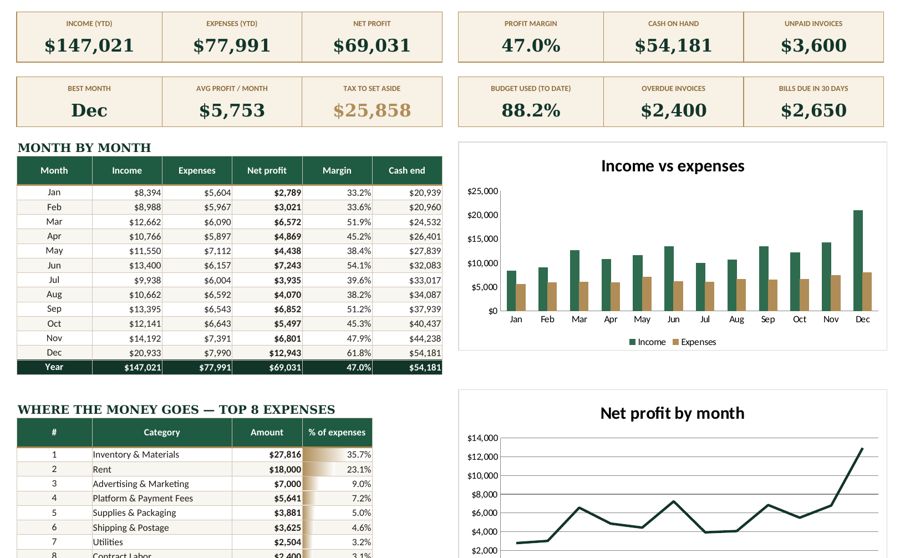
If you keep your books in a spreadsheet, the Fyscale bookkeeping template has a ledger you can mark as cleared each month, which makes this routine much faster. It organizes your numbers; for tax questions specific to your situation, talk to a qualified tax professional.
Tools mentioned in this article
Keep reading


This article is general information for US small businesses, not tax, legal or accounting advice. Check current IRS guidance or ask a qualified professional about your situation.