

Cash Flow vs Profit: Why Profitable Businesses Still Run Out of Cash

“We had our best month ever — so why can’t I pay the bills?” Plenty of small business owners have said those words. The answer is almost always the gap between profit and cash flow. They sound similar, but they measure different things, and confusing them is one of the most common reasons healthy businesses get into trouble.
The simple difference
- Profit answers: did we earn more than we spent over a period? It is revenue minus expenses, usually shown on a profit and loss statement.
- Cash flow answers: how much money actually moved in and out of the bank, and when?
Profit is about earning. Cash flow is about timing.
A quick example
In October, a design studio completes a $10,000 project. Its expenses for the month are $6,000, all paid immediately.
| October | |
|---|---|
| Revenue earned | $10,000 |
| Expenses | $6,000 |
| Profit | $4,000 |
| Cash received (client pays on Net 30) | $0 |
| Cash paid out | $6,000 |
| Cash flow | −$6,000 |
The studio is profitable — and $6,000 poorer in the bank until the client pays in November. If its bank balance was $5,000, it now has a problem.
Five ways profitable businesses run short of cash
1. Slow-paying customers
Every day an invoice sits unpaid, you are financing your client. Long payment terms and late payments are the biggest cash drain for service businesses. Clear invoices with real due dates help — see our checklist on how to create an invoice.
2. Inventory you have paid for but not sold
Product sellers pay for materials and stock weeks or months before a sale. Buying heavily ahead of the holidays can make cash very tight in October and November, even if December will be great.
3. Taxes that come due all at once
Profit creates a tax bill. If you do not set money aside, a quarterly payment can wipe out your balance. Our guide to quarterly estimated taxes explains the dates and amounts.
4. Growth
Growth usually means spending first — more stock, more ads, a new hire — and collecting later. Fast growth can drain cash faster than slow decline.
5. Big one-off purchases and loan payments
Equipment and loan principal payments reduce your cash but may not appear as an expense on your profit and loss statement in the same way. The bank balance feels it immediately.
How to see cash problems coming
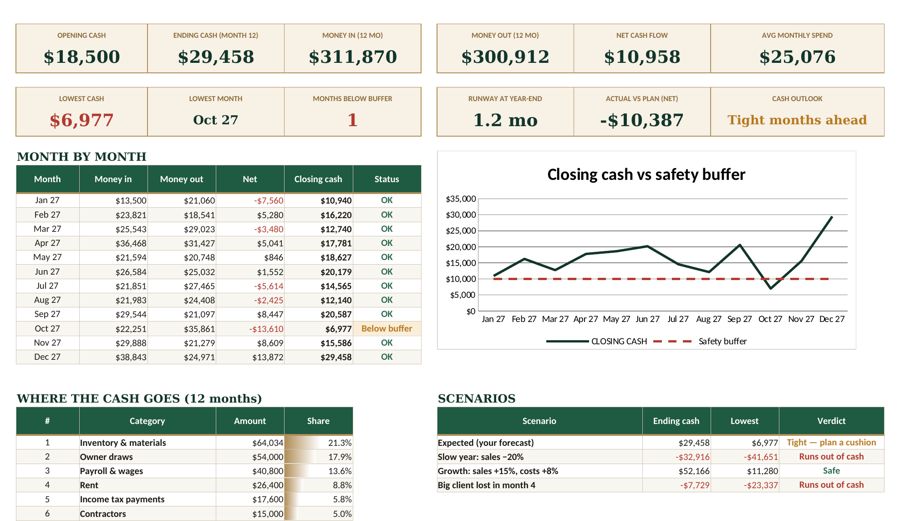
The fix is not complicated: forecast cash, not just profit.
- Start with today’s bank balance.
- List expected cash in by week or month — when customers will actually pay, not when you invoice.
- List expected cash out — rent, software, payroll, stock purchases, loan payments, estimated taxes.
- Calculate the ending balance for each period and carry it forward.
- Mark any period where the balance drops below a safety buffer, such as one month of fixed costs.
A 12-month forecast shows seasonal dips; a weekly view for the next 13 weeks shows near-term pinch points.
Ways to improve cash flow without hurting profit
- Invoice immediately when work is done, and shorten payment terms where you can.
- Ask for deposits on larger projects or custom orders.
- Follow up on overdue invoices the day after they are due.
- Order stock in smaller, more frequent batches for slower-selling items.
- Time big purchases for months when cash is strong.
- Keep a cash buffer in a separate account for slow months and taxes.
Track both every month
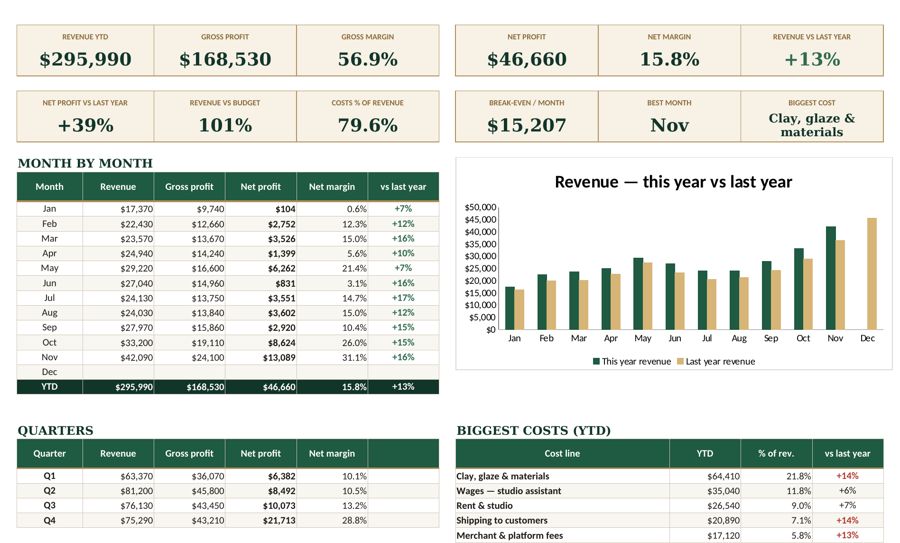
Your small business bookkeeping routine gives you profit. A cash flow forecast gives you timing. Review both at the end of every month: profit tells you whether the business works; cash flow tells you whether it can keep going while it grows.
The bottom line
Profit is the scoreboard; cash is the oxygen. A business can be profitable on paper and still fail because the cash arrives too late. Forecast your cash for the next 12 months, update it monthly and you will see a crunch coming months before it hits.
Tools mentioned in this article
Keep reading


This article is general information for US small businesses, not tax, legal or accounting advice. Check current IRS guidance or ask a qualified professional about your situation.