

How to Price Handmade Products for Profit

Most makers underprice. They add up materials, look at what others charge and pick a number that “feels fair.” Then the sales come in and somehow there is no money left. Pricing handmade products for profit is not guesswork — it is a formula, with one honest look at the market at the end.
Step 1: Add up your true cost per item
Your cost has four parts.
Materials and packaging
Everything that goes into one finished, shipped item: raw materials, labels, boxes, tissue, stickers. Divide bulk purchases by the number of items they make. A $30 pound of wax that fills 12 candles is $2.50 per candle.
Labor
Pay yourself. Decide an hourly rate — $20 to $25 an hour is a common starting point for skilled handmade work — and multiply by the time each item takes, including prep, finishing and packing. Twenty minutes at $24 an hour is $8.
Overhead
Costs that keep the business running but are not tied to one item: software, equipment, studio rent, a share of your phone and internet. Add up a typical month and divide by the number of items you make in a month.
Selling fees
Platforms take a cut of every sale. On Etsy, for example, sellers pay a listing fee, a transaction fee on the item price and shipping, and payment processing fees, plus optional advertising. Estimate fees as a percentage of your price — often around 10% before ads — and include them when you check your margin.
Step 2: Use a simple pricing formula
A widely used formula for makers:
- Cost = materials + labor + overhead
- Wholesale price = cost × 2
- Retail price = wholesale price × 2 (or at least × 1.5–2)
Doubling for wholesale builds in profit for your business. Doubling again for retail leaves room for shops to buy from you, for discounts and for platform fees — and if you only sell retail, the extra margin is yours.
A worked example: a handmade candle
| Item | Amount |
|---|---|
| Materials and packaging | $4.10 |
| Labor (20 min at $24/hr) | $8.00 |
| Overhead per candle | $1.40 |
| Cost | $13.50 |
| Wholesale (× 2) | $27.00 |
| Retail (× 2) | $54.00 |
Now look at the market. If comparable candles sell for $28–$38, $54 is a stretch. You have three honest options:
- Reduce cost — buy materials in bulk, batch-produce to cut labor time.
- Raise perceived value — better packaging, a larger size, a premium scent or a gift set.
- Accept a lower multiplier — for example, cost × 2.5 = $34 retail — and skip wholesale for this product.
What you should not do is price below cost plus fees. Check the profit at your chosen price:
- Price $34 − fees (about 10%, $3.40) − cost $13.50 = $17.10 profit per candle.
Step 3: Check your margin
Profit margin is profit divided by price. In the example, $17.10 ÷ $34 = 50%. Many product businesses aim for a healthy margin after all costs so they can absorb discounts, returns and slow months. If your margin is thin, small surprises — a shipping price increase, a sale — can wipe out your profit.
Pricing mistakes to avoid
- Leaving out your time. If you would not pay someone else to make it at that price, the price is too low.
- Forgetting fees and shipping. Free shipping is not free; it belongs in the price.
- Copying the cheapest competitor. You do not know their costs — or whether they are making money.
- Never revisiting prices. Material costs change. Review your prices at least twice a year.
Track cost and profit per product
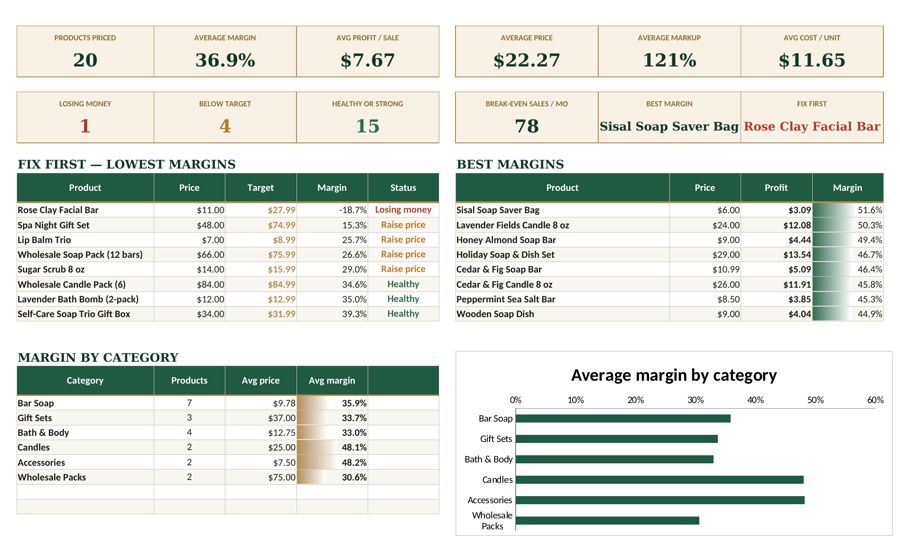
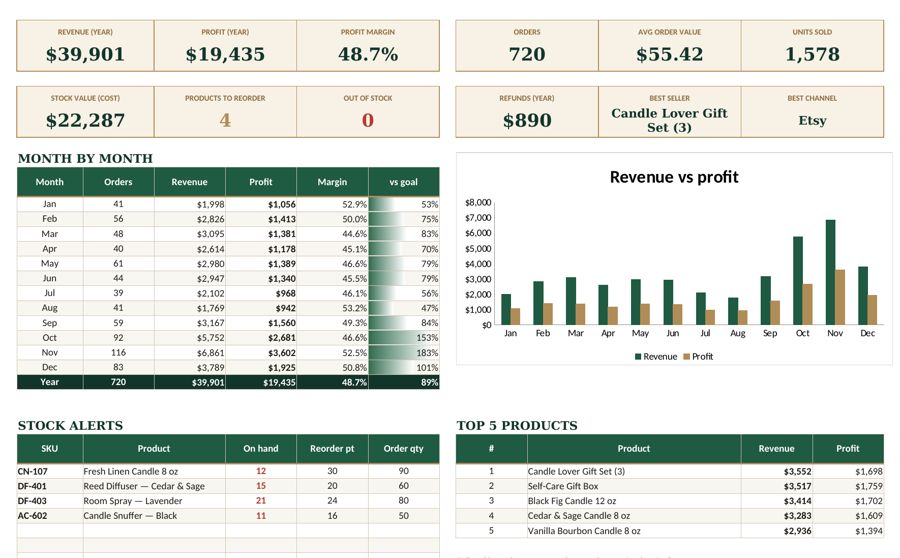
Keep your costs per product in one place, with materials, labor, overhead, fees and the resulting margin calculated for you. When a supplier raises prices, you update one number and immediately see which products need a new price. If you also track stock, our guide to building an Etsy inventory spreadsheet shows how to see profit by product, and cash flow vs profit explains why healthy margins matter for keeping cash in the bank.
The bottom line
Price handmade products from the bottom up — materials, your labor, overhead and fees — then sanity-check against the market. If the numbers do not work, change the product or the process, not your pay. Profit is what lets you keep making things you love.
Tools mentioned in this article
Keep reading


This article is general information for US small businesses, not tax, legal or accounting advice. Check current IRS guidance or ask a qualified professional about your situation.