

Home Office Deduction: Simplified vs Regular Method
If you run your business from a spare room or a corner of your apartment, you may be able to deduct part of your home costs. The IRS gives you two ways to calculate it, and the choice can change your deduction by hundreds of dollars. This guide compares the home office deduction simplified method with the regular method, shows a worked example with real numbers, and explains when each one tends to win.
First: do you qualify at all?
Before choosing a method, the space has to qualify. For most self-employed people that means two tests:
- Regular and exclusive use. You use a specific area of your home only for business, on a regular basis. A desk in the guest room that also hosts visitors on weekends does not pass. A dedicated room, or a clearly separated part of a room used only for work, can.
- Principal place of business. The space is where you do your main business work, or where you handle administrative tasks like billing, bookkeeping and scheduling with no other fixed location for them. Meeting clients there regularly can also qualify it.
There are narrow exceptions to the exclusive-use rule. One that matters to product sellers: if your home is the only fixed location of your business, space you regularly use to store inventory or product samples can qualify even if it is not used exclusively for business.
This deduction is for self-employed people and business owners. W-2 employees who work from home generally cannot claim it on their federal return. The IRS page on the home office deduction covers the full rules.
The home office deduction simplified method
The simplified method skips the paperwork of tracking actual home expenses.
- Rate: $5 per square foot of qualifying space
- Maximum space: 300 square feet
- Maximum deduction: $1,500 per year (300 × $5)
- Depreciation: none, so nothing to recapture when you sell your home
- Mortgage interest and property taxes: if you own and itemize, you deduct them in full on Schedule A as usual
The catch is that the simplified deduction cannot exceed your business’s gross income from the home office minus your other business expenses, and any amount you cannot use is not carried forward to future years.
The regular method
The regular method uses your actual costs. You figure the percentage of your home used for business and apply it to indirect expenses for the whole home. Schedule C filers calculate it on Form 8829.
Business-use percentage = office square feet ÷ total home square feet
Expenses you can include (business portion only):
- Rent, or for owners, mortgage interest, property taxes and depreciation
- Utilities such as electricity, heat and water
- Homeowner’s or renter’s insurance
- Repairs and maintenance for the whole home (repairs only to the office can be deducted in full)
- HOA fees and security systems
Under the regular method, if your deduction is limited because your business income is too low, the unused amount can generally be carried forward to the next year. For homeowners, the depreciation you claim (or could have claimed) may be taxed when you sell the home, which is worth weighing before you choose.
Worked example: simplified vs regular
Maya is a freelance designer who rents a 1,500 sq ft apartment and uses a 150 sq ft spare room only for work.
Business-use percentage: 150 ÷ 1,500 = 10%
Simplified method: 150 sq ft × $5 = $750
Regular method:
| Expense (annual) | Total cost | Business share (10%) |
|---|---|---|
| Rent ($1,800 × 12) | $21,600 | $2,160 |
| Utilities ($250 × 12) | $3,000 | $300 |
| Renter’s insurance | $300 | $30 |
| Total | $24,900 | $2,490 |
The regular method gives Maya $2,490, which is $1,740 more than the simplified method.
What is that worth? Because home office costs reduce her Schedule C profit, they lower both income tax and self-employment tax. As a rough estimate, $1,740 less profit cuts self-employment tax by about $246 ($1,740 × 92.35% × 15.3%), plus income tax at her bracket, for example about $209 at 12%. Exact figures depend on other parts of her return, but the difference is real money. If you want the math behind that 15.3%, see our plain-English guide to self-employment tax.
When the simplified method wins
Now picture Jordan, who owns a small, paid-off home in a low-cost area and works from a 120 sq ft corner. After applying his business-use percentage to utilities, insurance, property taxes and depreciation, his regular-method total comes to about $520. The simplified method gives him 120 × $5 = $600, with no depreciation tracking and no Form 8829. For Jordan, simple is both easier and slightly bigger.
Side-by-side comparison
| Simplified method | Regular method | |
|---|---|---|
| How it is calculated | $5 × sq ft (max 300) | Actual expenses × business-use % |
| Maximum | $1,500 | No set cap (limited by business income) |
| Records needed | Square footage and use | Square footage, plus all home bills |
| Depreciation | None | Yes, for owners |
| Unused deduction | Lost | Generally carried forward |
| Form | Simplified worksheet | Form 8829 for Schedule C filers |
| Best for | Small spaces, low home costs, renters in cheaper areas | Higher rent or home costs, larger offices |
You can choose either method each year. Switching from one to the other is allowed, though moving back to the regular method after using the simplified one can affect how you calculate depreciation, so check the rules or ask a tax professional before switching.
How to decide, step by step
- Measure your office and your total home square footage, and save the numbers.
- Total a year of home costs: rent or mortgage interest, property taxes, utilities, insurance and repairs.
- Calculate both methods using the formulas above.
- Consider hassle and future tax: owners should factor in depreciation recapture when they sell.
- Keep records: a floor sketch or photo of the space, and copies of bills, if you use the regular method.
Home office costs go on Schedule C alongside your other business expenses, which our guide to Schedule C expense categories breaks down. A bigger deduction also means a smaller tax bill to save for, so revisit how much to set aside for taxes once you know which method you will use.
Bottom line
- [ ] Confirm the space is used regularly and exclusively for business
- [ ] Measure office and total home square footage
- [ ] Simplified: $5 × sq ft, up to 300 sq ft ($1,500 max)
- [ ] Regular: business-use % × actual home expenses
- [ ] Compare both every year and keep your records
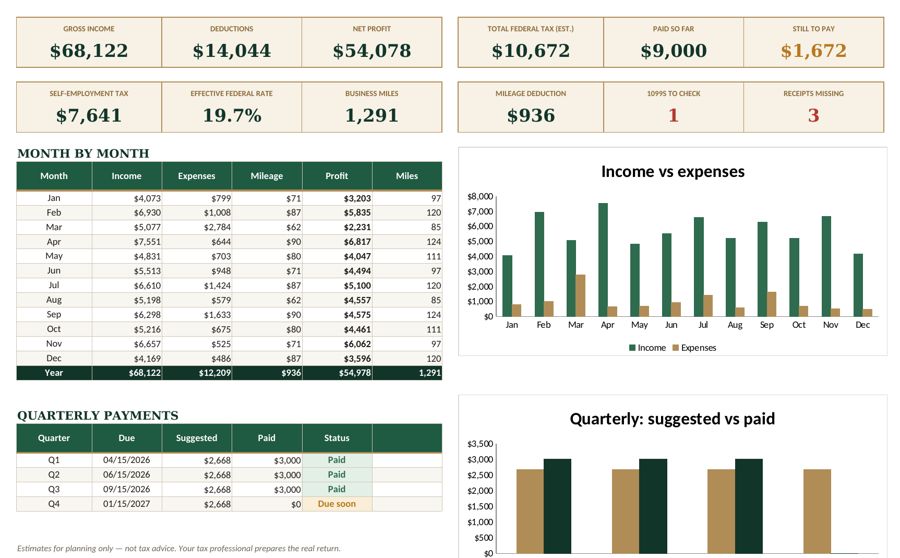
The Fyscale small business tax spreadsheet has room to log your square footage and home expenses so the comparison takes minutes at year-end. This article is general information, not tax advice; a qualified tax professional can confirm what applies to your situation.
Tools mentioned in this article
Keep reading



This article is general information for US small businesses, not tax, legal or accounting advice. Check current IRS guidance or ask a qualified professional about your situation.