

Sales Pipeline Stages for Small Service Businesses
If you run a small service business, your sales process probably lives in your inbox and your head. That works until you get busy, a promising lead goes quiet for three weeks, and you realize nobody followed up. Defining clear sales pipeline stages fixes that. A pipeline shows every potential client, where they are in the buying process, what happens next, and how much revenue is realistically on the way. This guide gives you a simple five-stage pipeline, exit criteria for each stage, and a worked forecast you can build in a spreadsheet.
What a sales pipeline is (and is not)
A sales pipeline is a list of open opportunities grouped by stage. Each opportunity has a name, an estimated value, a stage, a next step and a date.
It is not a list of every contact you have ever met. Contacts and past clients belong in your client list or CRM; the pipeline only holds deals that could close. If you do not have a client list yet, start with our guide to a simple CRM spreadsheet, then add a pipeline tab.
Five sales pipeline stages for service businesses
Large sales teams use eight or ten stages. A freelancer or small agency needs five. The key is that each stage has a clear exit criterion, a specific event that moves the deal forward, so you are not guessing.
| Stage | What it means | Exit criterion (moves to next stage when…) | Typical win probability |
|---|---|---|---|
| 1. New lead | Someone has shown interest | You have booked a discovery call | 10% |
| 2. Discovery | You are learning their problem, budget and timeline | You confirm fit and agree to send a proposal | 25% |
| 3. Proposal sent | They have your scope and price | They respond with a verbal yes or request changes you accept | 50% |
| 4. Verbal yes / contracting | Agreement in principle, paperwork in progress | Contract signed and deposit paid | 80% |
| 5. Won or lost | Decision made | Move won deals to onboarding; record the reason for lost deals | 100% / 0% |
The probabilities are starting assumptions, not facts. Replace them with your own numbers once you have a few months of history.
What to track for every deal
At minimum, one row per opportunity with:
- Client or company name and contact
- Source (referral, website, Etsy, social media, cold outreach)
- Service and estimated value
- Stage and the date it entered that stage
- Next step and next step date
- Probability (from the stage)
- Weighted value (estimated value × probability)
- Outcome and reason when won or lost
The “next step date” is the most important field. A deal without a scheduled next step is a deal you are about to forget.
Worked example: a weighted pipeline forecast
Alex runs a two-person bookkeeping and admin service. Here is the open pipeline at the start of the month:
| Stage | Deals | Avg. value | Total value | Probability | Weighted value |
|---|---|---|---|---|---|
| New lead | 10 | $2,000 | $20,000 | 10% | $2,000 |
| Discovery | 5 | $2,500 | $12,500 | 25% | $3,125 |
| Proposal sent | 4 | $3,000 | $12,000 | 50% | $6,000 |
| Verbal yes | 2 | $3,500 | $7,000 | 80% | $5,600 |
| Total | 21 | $51,500 | $16,725 |
The total pipeline is $51,500, but the weighted forecast is $16,725. That second number is a far more realistic estimate of what will close. If Alex needs $20,000 of new work to hit her goal, she knows she has a gap of about $3,275 and needs more leads or more proposals, not just hope.
Use conversion rates to plan your activity
Once you track stages, you can work backward from a revenue goal. Say over the last quarter Alex had:
- 40 inquiries → 20 discovery calls (50%)
- 20 calls → 10 proposals (50%)
- 10 proposals → 4 wins (40%)
That is a 10% overall conversion (4 ÷ 40). If her average project is $3,000 and she wants six new clients next quarter, she needs about 60 inquiries, or to improve one of the conversion steps. Better discovery calls or tighter proposals often move the number faster than chasing more leads.
Value matters as much as volume. If your projects are priced too low, a full pipeline still will not pay the bills. Our guide on calculating your real hourly rate helps you check that your deal values make sense.
Keep deals moving
- Set a maximum time in each stage. For example, if a proposal has had no response for 10 days, follow up; after 30 days, mark it lost or “nurture” and move on.
- Review the pipeline weekly. Fifteen minutes on Monday: update stages, set next steps, clear dead deals.
- Record lost reasons. Price, timing, scope, chose a competitor or no response. Patterns tell you what to fix.
- Agree on payment before “won.” A deal is not really won until terms and a deposit are settled. Decide in advance whether you use deposits or net 30 payment terms, and put that in the proposal.
And when a won client becomes a paying one, keep the same discipline on the back end with a follow-up routine for unpaid invoices.
Common pipeline mistakes
- Too many stages. If you cannot explain the difference between two stages in one sentence, merge them.
- No exit criteria. Stages based on feelings (“they seemed keen”) make forecasts useless.
- Never closing out lost deals. A pipeline full of stale deals overstates your future revenue.
- Tracking value without probability. Total pipeline is a vanity number; weighted pipeline is the planning number.
Bottom line
- [ ] Use five stages with a clear exit criterion for each.
- [ ] Give every deal a value, a next step and a next step date.
- [ ] Forecast with weighted value, not total value.
- [ ] Track conversion rates between stages and plan activity from your goal.
- [ ] Review weekly and close out stale deals.
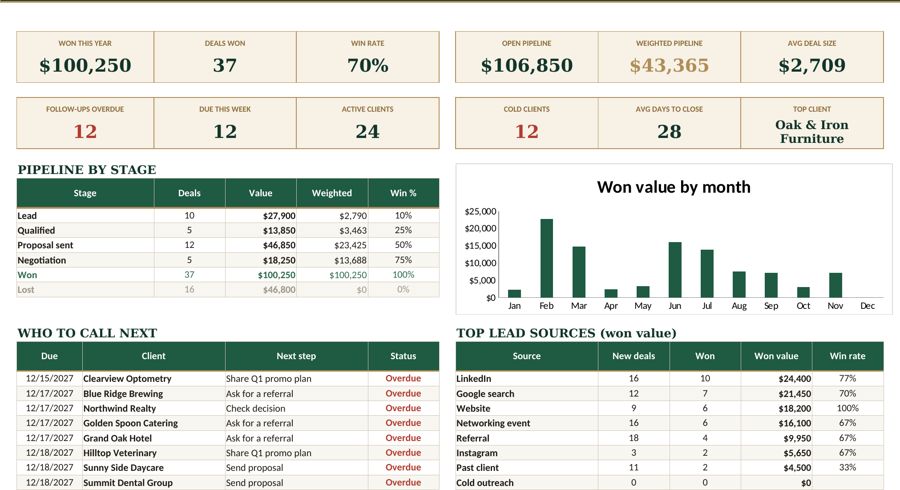
If you want this set up without building formulas, the Fyscale CRM template includes a pipeline tab with stages, weighted forecasting and lost-reason tracking alongside your client list.
Tools mentioned in this article
Keep reading
This article is general information for US small businesses, not tax, legal or accounting advice. Check current IRS guidance or ask a qualified professional about your situation.