

Freelancer Tax Deductions You Might Be Missing
When you work for yourself, every legitimate business expense you record lowers both your income tax and your self-employment tax. Yet many freelancers leave money on the table, not because they cheat themselves on purpose, but because small, recurring costs never make it into their books. This guide walks through freelancer tax deductions that are commonly missed, how they work, and a worked example of what they can be worth. It is general information for US sole proprietors filing Schedule C, not tax advice; check your situation with a tax professional.
How freelancer tax deductions work
As a sole proprietor, you report business income and expenses on Schedule C. Your net profit (income minus deductible expenses) is subject to income tax and to self-employment tax of 15.3% on 92.35% of net earnings. Our explainer on self-employment tax covers that calculation.
Because of that double layer, a $100 business deduction often saves more than a $100 personal deduction would. To qualify, an expense generally needs to be ordinary and necessary for your business, and you need records to back it up.
Deductions freelancers commonly miss
1. The home office
If you use part of your home regularly and exclusively for business, you may deduct a home office. The simplified method is $5 per square foot, up to 300 square feet, so a maximum of $1,500. The regular method uses actual expenses and can be larger, but requires more records. Compare both in our guide to the home office deduction.
2. Business mileage
Driving to clients, the post office, a supplier or a co-working space can be deductible. For 2026, the standard mileage rate is 72.5 cents per business mile. Commuting from home to a regular workplace generally does not count, and you need a log; see what the IRS expects in our mileage log guide.
3. The business share of your phone and internet
If you use your personal phone or home internet for work, the business-use percentage is deductible. Pick a reasonable, supportable percentage (for example from a sample month of usage) and apply it consistently.
4. Software, subscriptions and tools
Design apps, cloud storage, accounting tools, scheduling apps, password managers, website hosting, domain names and email marketing tools all add up. They are easy to miss because they are charged in small amounts, often on a personal card.
5. Platform, payment and bank fees
Marketplace fees, payment processor fees, payout fees and business bank account fees are deductible. If you are paid through a platform, your deposits are usually net of fees, so you must record the gross income and the fees separately or you will understate both.
6. Half of your self-employment tax
You can deduct the employer-equivalent portion (half) of your self-employment tax when figuring adjusted gross income. It is calculated on your return rather than tracked as an expense, but make sure your software or preparer applies it.
7. Self-employed health insurance
If you pay for health insurance for yourself (and your spouse or dependents) and you were not eligible for an employer-subsidized plan, you may be able to deduct the premiums as an adjustment to income. Limits apply, including that the deduction cannot exceed your business’s net profit.
8. Retirement contributions
Contributions to a SEP IRA, solo 401(k) or similar self-employed plan can reduce taxable income while building savings. Contribution limits and deadlines differ by plan type, so check current limits before you contribute.
9. Education and professional development
Courses, books, conferences and professional memberships that maintain or improve skills for your current business are generally deductible. Training for a brand new career usually is not.
10. Business meals and startup costs
Business meals with clients or contacts are generally 50% deductible when you keep notes on who attended and the business purpose. If you started your business recently, up to $5,000 of startup costs may be deductible in the first year (reduced when total startup costs exceed $50,000), with the rest amortized over 180 months.
Worked example: what missing deductions can cost
Priya is a freelance web designer with $60,000 of net profit on her books. At year-end she realizes she never recorded:
| Missed deduction | Calculation | Amount |
|---|---|---|
| Home office (simplified) | 200 sq ft × $5 | $1,000 |
| Business mileage | 1,800 miles × $0.725 | $1,305 |
| Software paid on personal card | 12 months of tools | $640 |
| Phone (50% business use) | $85 × 12 × 50% | $510 |
| Total | $3,455 |
Self-employment tax saved: $3,455 × 92.35% × 15.3% ≈ $488.
Income tax saved: at a 12% marginal federal rate, the reduction in taxable income is about $3,211 (the $3,455, minus the smaller half-SE-tax deduction of about $244). That saves roughly $3,211 × 12% ≈ $385.
Together, that is roughly $870 of federal tax, before any state income tax. Your actual savings depend on your bracket and other parts of your return, but the pattern holds: small recurring expenses are worth tracking.
How to stop missing deductions
- Use one business account and card for business spending, so nothing hides on personal statements.
- Record expenses weekly, not once a year.
- Keep receipts and a note on business purpose, and know how long to keep business records.
- Review recurring charges quarterly to catch subscriptions you forgot to categorize.
- Use consistent categories that match your tax form; our list of Schedule C expense categories helps.
What is not deductible
Personal expenses do not become deductible because you are self-employed. Everyday clothing, commuting, personal meals, gym memberships and family phones are common examples of costs that generally do not qualify. When an expense is mixed, deduct only the business portion and document how you got there.
Bottom line
Check this list before you file:
- [ ] Home office measured and method chosen
- [ ] Mileage log totaled
- [ ] Phone and internet business share calculated
- [ ] Every software subscription and platform fee recorded
- [ ] Health insurance and retirement contributions gathered
- [ ] Meals, education and startup costs documented
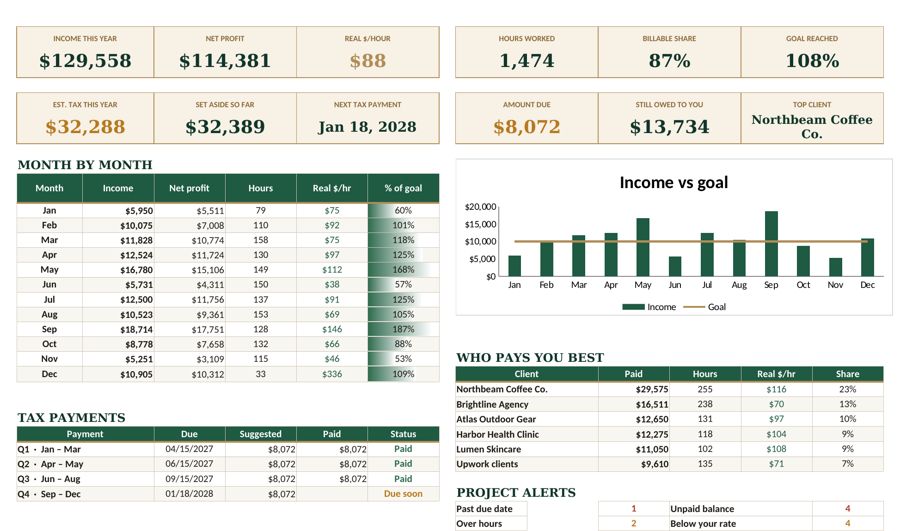
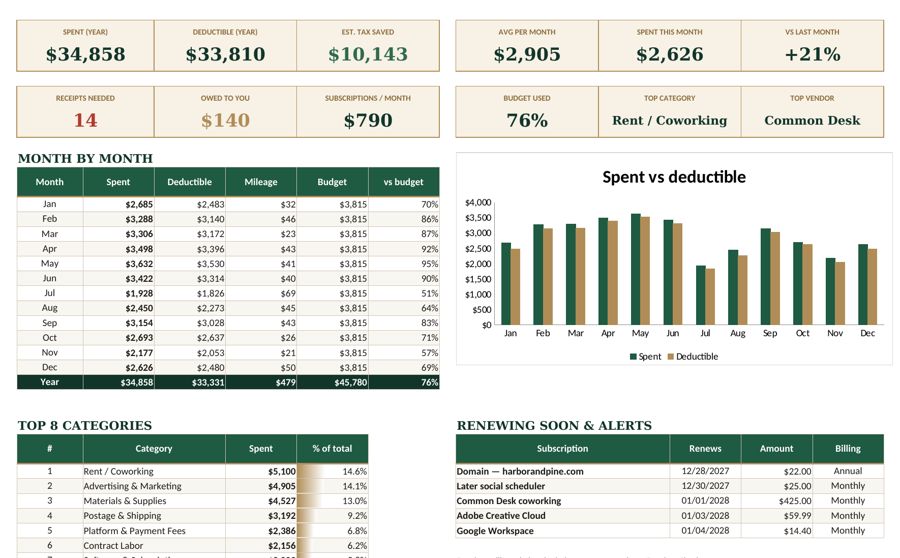
A simple expense tracker that captures each cost as it happens is the easiest way not to miss anything. The Fyscale freelancer finance and expense templates track deductible categories, mileage and estimated tax set-asides in one place.
Tools mentioned in this article
Keep reading


This article is general information for US small businesses, not tax, legal or accounting advice. Check current IRS guidance or ask a qualified professional about your situation.