

Net 30 Payment Terms: What They Mean and When to Use Them

“Net 30” is one of the most common phrases on a business invoice, and one of the most misunderstood. Net 30 payment terms mean the full invoice amount is due 30 calendar days after the invoice date. That sounds simple, but the terms you choose quietly decide how long your money sits in someone else’s bank account. This guide explains what net 30 means, how it compares with other terms, and how to decide whether it is right for your business.
What net 30 payment terms actually mean
“Net” refers to the net amount due, meaning the invoice total after any agreed discounts or credits. “30” is the number of days the customer has to pay. So an invoice dated November 2 with net 30 terms is due December 2.
A few details trip people up:
- The clock usually starts on the invoice date, not the delivery date or the day the client opens the email. If you want a different start, say so on the invoice (“Net 30 from date of delivery”).
- Calendar days, not business days. Weekends and holidays count unless your terms say otherwise.
- Net 30 is a deadline, not a suggestion. Payment on day 31 is late, even if it feels like a technicality.
Common payment terms compared
| Term | What it means | Typical use |
|---|---|---|
| Due on receipt | Pay as soon as the invoice arrives | Small one-off jobs, new clients |
| Net 7 / Net 15 | Pay within 7 or 15 days | Freelancers, small retainers |
| Net 30 | Pay within 30 days | Standard B2B work, established clients |
| Net 60 / Net 90 | Pay within 60 or 90 days | Large companies, wholesale buyers |
| 2/10 net 30 | 2% discount if paid within 10 days, otherwise full amount in 30 | Encouraging early payment |
| 50% upfront | Half before work starts, half on delivery | Projects, custom orders |
If you are not sure what belongs on the invoice itself, our professional invoice checklist covers every field, including where to put the terms.
How net 30 affects your cash flow
Net 30 is normal for business clients, but it has a real cost: you have already paid for your time, materials and software, and you wait a month (or more) to get paid.
Here is a simple way to see the effect. Say you bill $12,000 a month and every client is on net 30 and pays exactly on time. At any moment, roughly one month of revenue, about $12,000, is sitting in receivables rather than in your account. Move those same clients to net 15 and the amount tied up drops to roughly half a month, about $6,000. Nothing about your profit changed, but you have about $6,000 more cash to work with.
That gap is why cash flow and profit are not the same thing. A profitable month on paper can still leave you short when invoices are on long terms. If you use longer terms, a rolling 13-week cash flow forecast helps you see the timing before it becomes a problem.
Early payment discounts: is 2/10 net 30 worth it?
“2/10 net 30” means the client can take 2% off if they pay within 10 days; otherwise the full amount is due on day 30.
Worked example: on a $5,000 invoice, the discount is $100, so the client pays $4,900 if they pay by day 10.
For you, offering that discount is a way to buy 20 days of faster payment for $100. That is more expensive than it looks. Annualized, giving up 2% to be paid 20 days early works out to roughly 37% a year (2/98 × 365/20 ≈ 37.2%). That can still make sense if cash is tight or a client is a known slow payer, but it should be a deliberate choice, not a default.
When net 30 makes sense, and when it does not
Net 30 is a reasonable choice when:
- Your client is a business with an accounts payable process that pays in batches.
- You have a buffer of at least one to two months of expenses.
- The client has a track record of paying on time.
- Longer terms help you win or keep a valuable account.
Shorter terms (due on receipt, net 7 or net 15), deposits or milestone billing are better when:
- The client is new and you have no payment history with them.
- The project needs you to buy materials or pay subcontractors upfront.
- The job is small. Chasing a $300 invoice for 30 days is rarely worth it.
- You are a solo business without much cash cushion.
You do not need one rule for everyone. Many small businesses use deposits for new clients and move trusted repeat clients to net 30.
How to write net 30 terms on an invoice
Be specific. “Net 30” alone is fine, but clear wording prevents arguments later:
- Terms: Net 30 from invoice date
- Due date: December 2, 2026 (always print the actual date, not just the term)
- Payment methods: ACH, card (processing fee may apply), check
- Late payments: state your late fee policy, if any, and make sure it fits your contract and your state’s rules
Agree on terms before work starts, ideally in your contract or proposal. Adding net 30 for the first time on the final invoice is a recipe for confusion.
What to do when a net 30 invoice goes late
Even good clients slip. Set a simple routine:
- Day 25: friendly reminder that the invoice is due in five days.
- Day 31: short, polite note that payment is now past due.
- Day 38 to 45: firmer follow-up with the invoice attached and a request for a payment date.
- Day 60+: phone call, pause new work, and consider your contract’s late fee or collection options.
We have ready-to-use wording for each step in how to follow up on an unpaid invoice.
Bottom line
Net 30 payment terms are standard, but they are a business decision, not a formality. Before you offer them:
- [ ] Confirm you can cover at least a month of expenses while you wait.
- [ ] Put the actual due date on every invoice.
- [ ] Use deposits or shorter terms for new or small jobs.
- [ ] Decide whether an early payment discount is worth its true cost.
- [ ] Track who pays late, and adjust terms for repeat offenders.
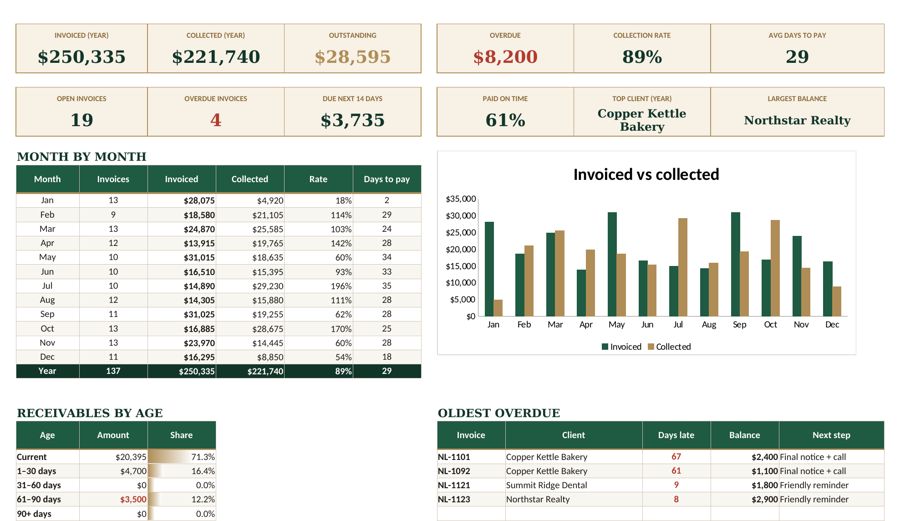
A simple way to keep all of this visible is an invoice tracker that shows each invoice’s terms, due date and days outstanding. The Fyscale invoice template does exactly that, so you can spot slow payers before they become a cash flow problem.
Tools mentioned in this article
Keep reading

This article is general information for US small businesses, not tax, legal or accounting advice. Check current IRS guidance or ask a qualified professional about your situation.