

How to Follow Up on an Unpaid Invoice (With Email Templates)
Most late invoices aren’t the result of a client refusing to pay. They’re stuck in an inbox, waiting on an approval, or missing a purchase order number. A clear, polite unpaid invoice follow up email, sent on a predictable schedule, solves the majority of these cases without damaging the relationship. Below is a simple follow-up sequence, the templates to go with it, and what to do when emails stop working.
Before you follow up: make sure the invoice was easy to pay
A surprising number of “late” payments trace back to the invoice itself. Before sending a reminder, check that your invoice had:
- The right contact (often accounts payable, not the person who hired you)
- A unique invoice number and issue date
- A clear due date, written as a date (“Due November 21, 2026”), not just “Net 30”
- Any PO or project number the client requires
- Simple payment instructions and accepted methods
If something was missing, fix it and resend rather than chasing. Our professional invoice checklist covers every field worth including.
A follow-up schedule that works
Consistency matters more than clever wording. Here’s a timeline you can reuse for every client:
| When | Message | Tone |
|---|---|---|
| 3 days before due | Friendly heads-up | Helpful |
| 1 day after due | Gentle reminder | Neutral |
| 7 days late | Firm reminder, ask for a date | Direct |
| 14 days late | Second firm reminder, mention terms | Firm |
| 30 days late | Final notice before next steps | Formal |
| 45+ days late | Phone call, pause work, consider escalation | Formal |
Put these dates on your calendar the day you send the invoice. If you track invoices in a spreadsheet, add a “next follow-up” column so nothing slips.
Unpaid invoice follow up email templates
Copy these, then adjust names, numbers and tone to fit your relationship. Keep each email short and always attach the invoice again.
1. Before the due date (friendly heads-up)
Subject: Invoice #1042 due Friday, Nov 21
Hi Sam,
Just a quick heads-up that invoice #1042 for $2,400 (October website updates) is due this Friday, November 21. I’ve attached a copy for convenience. You can pay by ACH or card using the link on the invoice.
Thanks, and let me know if you need anything from me to process it.
Alex
2. One day overdue (gentle reminder)
Subject: Reminder: invoice #1042 was due yesterday
Hi Sam,
I wanted to follow up on invoice #1042 for $2,400, which was due yesterday. It’s attached again here. If it’s already in process, please ignore this note. If anything is holding it up, just let me know and I’ll sort it out.
Thanks, Alex
3. One week overdue (ask for a date)
Subject: Invoice #1042 – 7 days past due
Hi Sam,
Invoice #1042 for $2,400 is now 7 days past due. Could you let me know when I can expect payment? If it needs to go to someone else in accounts payable, I’m happy to send it directly.
Best, Alex
Asking a direct question (“when can I expect payment?”) gets more responses than a general reminder because it requires a reply.
4. Two weeks overdue (reference your terms)
Subject: Second reminder: invoice #1042, 14 days overdue
Hi Sam,
I haven’t received payment or an update on invoice #1042 ($2,400), now 14 days overdue. As outlined in our agreement, a late fee of 1.5% per month applies to balances more than 30 days past due. I’d much rather avoid that, so please let me know a payment date by Friday.
Thanks, Alex
Only mention late fees if they’re actually in your contract or on the invoice. Rules on late fees vary by state, so check what applies to you before charging one.
5. Thirty days overdue (final notice)
Subject: Final notice: invoice #1042, 30 days overdue
Hi Sam,
Invoice #1042 for $2,400 is now 30 days past due, and I haven’t been able to reach you about it. Per our agreement, I’ll be pausing work on the project starting [date] until the balance is paid. If payment isn’t received by [date], I’ll need to look at other options to recover it.
I’d prefer to resolve this directly. A quick reply with a payment date is all I need.
Alex
Worked example: what waiting really costs
Say Alex invoices $2,400 on Net 30 terms, and the contract allows a late fee of 1.5% per month on overdue balances. If the client pays 60 days late, that’s roughly two months, so the late fee would be $2,400 × 1.5% × 2 = $72.
But the bigger cost is cash flow. If Alex’s monthly fixed costs are $3,000, a single $2,400 invoice sitting unpaid covers 80% of a month’s bills. This is how a profitable business can still end up short on cash, which we cover in cash flow vs profit. Following up on day one, not day 30, is usually the cheapest fix.
When emails stop working
If a client goes quiet after the final notice:
- Call. A two-minute phone call often resolves what five emails didn’t.
- Offer a payment plan. Two or three installments with set dates beats nothing.
- Pause work. Don’t keep delivering to a client who isn’t paying.
- Send a formal demand letter. State the amount, the due date, and what happens next.
- Consider small claims court or a collections agency. Limits and procedures vary by state; a collections agency typically keeps a percentage of what it recovers.
Keep a record of every email, call and promise. If you ever need to escalate, a clear paper trail makes everything easier.
How to prevent late payments next time
- Ask for a deposit on new or large projects.
- Shorten terms to Net 15 or due on receipt for small jobs.
- Make paying easy with an online payment link.
- Write late fees into your contract before work starts.
- Invoice immediately when a milestone is done.
- Track every invoice in one place with its status and due date.
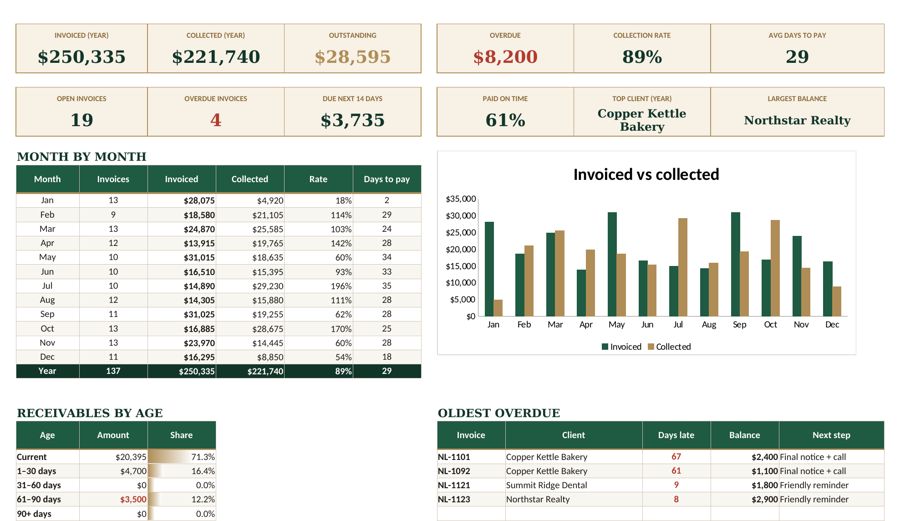
A Fyscale invoice tracker spreadsheet can help here: it lists each invoice with its due date, days overdue and status, so you know exactly who needs a reminder each week.
Bottom line
- Check the invoice first; many late payments are fixable paperwork issues.
- Follow a fixed schedule: before due, day 1, day 7, day 14, day 30.
- Keep emails short, attach the invoice every time, and ask for a payment date.
- Reference late fees only if they’re in your agreement.
- Call, pause work, and escalate only after polite reminders fail.
Tools mentioned in this article
Keep reading

This article is general information for US small businesses, not tax, legal or accounting advice. Check current IRS guidance or ask a qualified professional about your situation.