

How to Calculate Your Real Hourly Rate as a Freelancer

Most freelancers pick a rate by looking at what others charge, then hope it works out. The problem is that a rate that sounds high can still leave you short once you account for unpaid hours, business costs and taxes. This guide works like a freelance hourly rate calculator you can run on paper or in a spreadsheet: start with the income you need, subtract the time you can’t bill, and arrive at the minimum rate that actually supports your business. Then we’ll flip it around and calculate the real hourly rate you’re earning today.
Why your “rate” and your real hourly rate are different
Your quoted rate is what you charge per billable hour. Your real hourly rate is what you keep for every hour you work, billable or not. They diverge for three reasons:
- Non-billable time. Emails, proposals, invoicing, bookkeeping, marketing and learning new tools all take hours no client pays for.
- Business expenses. Software, equipment, insurance and fees come out of your revenue before you see a dime.
- Taxes. As a self-employed person you pay both halves of Social Security and Medicare through self-employment tax, on top of income tax.
An employee earning $40 an hour gets paid for vacation, has equipment provided and splits payroll taxes with an employer. A freelancer charging $40 an hour is usually taking home far less.
Step 1: Decide your target income before taxes
Start with the amount you want your business to earn as profit for the year — what’s left after business expenses but before income tax and self-employment tax. This number has to cover your taxes, your living costs and savings.
A rough way to set it: take the take-home pay you want and add a cushion for taxes. Our guide on how much a freelancer should set aside for taxes walks through how to size that cushion for your situation.
Step 2: Add your annual business costs
List what it costs to run your business for a year. Common items:
- Software subscriptions and cloud storage
- Computer and equipment replacement
- Internet and phone (business share)
- Insurance you pay yourself, such as health or liability coverage
- Professional fees, courses and memberships
- Marketplace or payment processing fees
Add them up. Being honest here matters more than being precise.
Step 3: Count your real billable hours
This is where most rate calculations go wrong. Start with a full year and subtract the time you won’t be working, then the share of working time that isn’t billable.
- 52 weeks in a year
- Minus vacation and holidays
- Minus sick days and slow weeks
- Multiply by the hours you plan to work each week
- Multiply by your billable percentage
Many solo freelancers find that 50% to 70% of their working hours end up billable once admin and sales are counted. Track a few weeks of your own time to find your number instead of guessing.
Step 4: Divide, then add a buffer
The formula is:
Minimum hourly rate = (target income before taxes + annual business costs) ÷ billable hours
Then add a buffer — say 10% — for late-paying clients, scope creep and months that come in light.
Worked example: a freelance designer
Here’s the calculation for a designer who wants $75,000 of pre-tax profit.
| Item | Amount |
|---|---|
| Target income before taxes | $75,000 |
| Software, equipment, phone, fees | $9,000 |
| Health insurance paid personally | $6,000 |
| Revenue needed | $90,000 |
Now the hours:
| Item | Calculation | Result |
|---|---|---|
| Working weeks | 52 − 4 weeks vacation/holidays − 1 week sick | 47 weeks |
| Working hours | 47 × 40 | 1,880 hours |
| Billable hours at 60% | 1,880 × 0.60 | 1,128 hours |
Minimum rate: $90,000 ÷ 1,128 = $79.79 per hour.
Add a 10% buffer: $90,000 × 1.10 = $99,000, and $99,000 ÷ 1,128 = $87.77. Round up to $88 per hour. At that rate, 1,128 billable hours bring in $99,264.
What about taxes on that $75,000 profit? Self-employment tax applies to 92.35% of net earnings at 15.3%: $75,000 × 0.9235 × 0.153 = about $10,597, before any income tax. That’s why the target in Step 1 has to be a pre-tax number. The rates come from the IRS’s self-employment tax page; your actual bill depends on deductions and your full tax picture.
If the designer had used a “40 hours × 52 weeks” shortcut — 2,080 hours — the math would have suggested about $43 an hour. Charging that, they’d fall roughly $41,500 short of the revenue they need over 1,128 billable hours ($90,000 − $43 × 1,128 = $41,496).
Calculate the real hourly rate you earn now
Run the numbers backward on a recent project to see where you stand.
- Take what the client paid.
- Subtract any direct costs for that project (stock assets, subcontractors, fees).
- Divide by all the hours you spent — including calls, revisions, emails and invoicing.
Example: a $2,000 logo package with $100 in stock assets and fees. You logged 30 hours of design, but also 6 hours of calls and emails, 3 hours of revisions beyond scope, and 1 hour on the invoice and follow-up — 40 hours total.
($2,000 − $100) ÷ 40 = $47.50 per hour.
If your minimum rate is $80, that project paid well under it. The fix might be a higher fixed price, a revision limit in your contract, or charging for extra rounds. It might also be getting paid on time — chasing invoices is unbilled work, so a clear process for following up on unpaid invoices protects your effective rate too.
Turning your hourly rate into project prices
You don’t have to bill hourly to use this number. Estimate the hours a project will really take (including communication), multiply by your rate, and quote a flat fee. Track actual hours afterward; if projects keep running long, raise the quote for the next one.
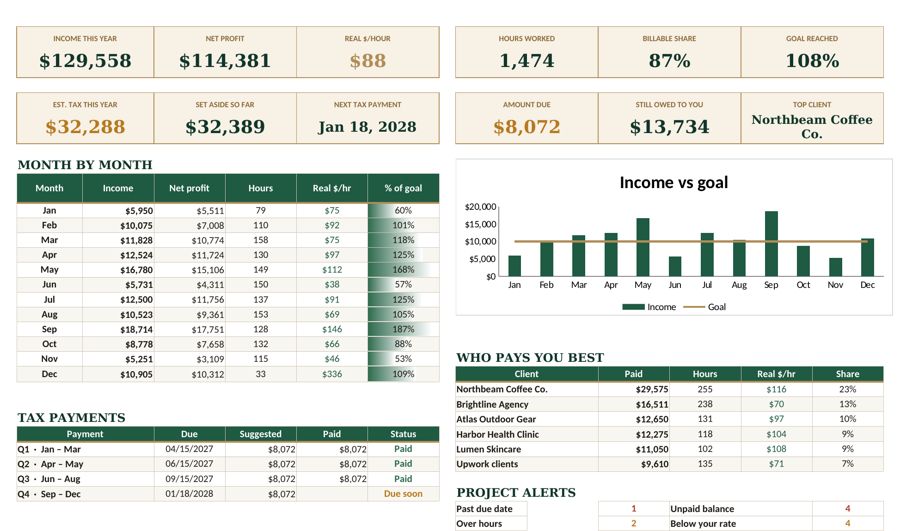
Review your rate at least once a year, and any time your costs or available hours change. A spreadsheet that keeps your income, expenses and hours in one place — like Fyscale’s Freelancer Finance template — makes that review a quick check rather than a weekend project.
Bottom line
- Start from the pre-tax profit you need, not from competitors’ rates.
- Add all business costs, including insurance you pay yourself.
- Use realistic billable hours — often 50–70% of working time.
- Divide, then add a buffer of about 10%.
- Check past projects for your real hourly rate and adjust pricing, scope or payment terms.
Tools mentioned in this article
Keep reading



This article is general information for US small businesses, not tax, legal or accounting advice. Check current IRS guidance or ask a qualified professional about your situation.