

Etsy Seller Quarterly Taxes: A Simple Guide to Estimated Payments
Your Etsy shop just had its best quarter ever. Orders are flowing, the payout landed, and then a quiet thought creeps in: do I owe the IRS something before April? For a lot of sellers, the answer is yes, and it’s due sooner than you think.
This guide explains Etsy seller quarterly taxes in plain English: who has to pay estimated taxes, how to figure the amount from your shop numbers, and the dates to put on your calendar. It’s for US sellers running a shop as a sole proprietor or single-member LLC, whether Etsy is your side hustle or your full-time job.
Think of quarterly payments as a way to keep your shop money yours. Paying as you go means no surprise bill, no penalty, and no panic in spring.
This is general information, not tax advice — confirm with a tax professional.

Why quarterly taxes matter more than you think
When you work a regular job, your employer withholds tax from every paycheck. Etsy doesn’t do that. Your payouts arrive in full, so the IRS expects you to send tax during the year through estimated tax payments.
You generally need to make them if you expect to owe $1,000 or more for the year after withholding and credits. Your shop profit can be taxed two ways:
- Self-employment tax: 15.3% on 92.35% of your net earnings. This covers Social Security and Medicare, the part an employer would normally share. Our self-employment tax guide explains it in detail.
- Income tax: based on your total income and bracket, including any other job.
Note the word profit. You pay tax on what’s left after Etsy fees, materials, shipping and other business costs, not on your gross sales. That’s why clean records matter so much.
Key idea: You don’t pay tax on what Etsy deposits. You pay tax on what your shop actually earns.
The 2026 due dates
| Payment | Covers income earned | Due date |
|---|---|---|
| 1 | Jan 1 – Mar 31, 2026 | April 15, 2026 |
| 2 | Apr 1 – May 31, 2026 | June 15, 2026 |
| 3 | Jun 1 – Aug 31, 2026 | September 15, 2026 |
| 4 | Sep 1 – Dec 31, 2026 | January 15, 2027 |
The periods aren’t equal quarters, which catches many sellers off guard. Holiday sales from September through December all land in the January 15, 2027 payment.
How to calculate Etsy seller quarterly taxes step by step
- Pull your sales for the period. Download your Etsy payments or orders CSV and total your sales, including the shipping you charged buyers.
- Subtract Etsy fees. Transaction fees are 6.5% of the item price plus shipping. US payment processing is 3% + $0.25 per order. Listings are $0.20 each, and Offsite Ads (15%, or 12% if you sold more than $10,000 in the past year) apply only to sales the ads brought in. Our Etsy fees explained guide breaks these down.
- Subtract your other business costs. Materials, packaging, shipping labels, software, a share of your phone, and so on. Use the categories in our Schedule C guide for Etsy sellers.
- Estimate self-employment tax. Net profit × 92.35% × 15.3%.
- Estimate income tax. Use your effective rate from last year’s return as a starting point, or ask your tax pro for a number. Your rate depends on your whole household’s income, so there’s no one-size answer.
- Choose your method. Either pay roughly a quarter of this year’s expected tax each period, or use a safe harbor (see below).
- Pay and record it. Pay through the IRS (the IRS estimated taxes page lists the options), save the confirmation, and log the date and amount in your books.
The safe harbor shortcut
You generally avoid an underpayment penalty if you pay at least 90% of this year’s tax or 100% of last year’s tax (110% if last year’s AGI was over $150,000), spread across the four due dates. For a seller whose income jumps around, paying 100% of last year’s tax in four equal parts is often the calmest option.
If your sales are very seasonal, ask your tax professional about the annualized income method, which can match payments to when you actually earned the money.

Example: estimating the January 15 payment
Take Maya, a jewelry seller and a typical example. From September through December she expects $12,000 in sales (items plus shipping) across 400 orders, and she renews about 400 listings.
| Line | Amount |
|---|---|
| Sales including shipping | $12,000.00 |
| Etsy transaction fees (6.5%) | −$780.00 |
| Payment processing (3% + $0.25 × 400 orders) | −$460.00 |
| Listing fees (400 × $0.20) | −$80.00 |
| Materials | −$2,800.00 |
| Shipping labels | −$1,400.00 |
| Packaging and software | −$300.00 |
| Net profit for the period | $6,180.00 |
Now the tax estimate:
- Self-employment tax: $6,180 × 92.35% × 15.3% = $873.21
- Income tax: assuming a 10% effective rate for illustration, $6,180 × 10% = $618.00
- Estimated total for the period: $1,491.21
So Maya plans to pay about $1,490 by January 15, 2027. If she’d rather use the safe harbor, she can instead take last year’s total tax and divide by four. She checks both and picks the one that fits her cash flow.
Not sure how much to hold back from each payout? Our guide on how much to set aside for taxes gives a simple percentage method.
Common mistakes to avoid
- Paying on gross sales instead of profit. You’d overpay, sometimes by thousands.
- Forgetting the January payment. Holiday profit is often the biggest of the year, and its due date is in the new year.
- Spending the whole payout. Move your tax set-aside to a separate savings account the day each payout lands.
- Ignoring Form 1099-K. For 2026, Etsy generally sends one if you have more than $20,000 in sales and more than 200 transactions. The IRS 1099-K page is clear that all income is reportable either way.
- Forgetting state taxes. Many states have their own estimated payments. Check your state’s revenue department.
- Not recording payments. You’ll need the dates and amounts when you file your return.
Key idea: The best tax habit isn’t a big calculation in April. It’s a small transfer every time Etsy pays you.
Your 15-minute action plan
- [ ] Add January 15, 2027 to your calendar with a one-week reminder.
- [ ] Download your Etsy sales CSV for September through today.
- [ ] Estimate net profit by subtracting fees and costs.
- [ ] Run the self-employment tax formula: profit × 92.35% × 15.3%.
- [ ] Open a separate “tax” savings account if you don’t have one.
- [ ] Look up last year’s total tax so you can compare the safe harbor option.
FAQ
Do Etsy sellers have to pay quarterly taxes?
Many do. If you expect to owe $1,000 or more in federal tax for the year and nothing is withheld from your Etsy income, you’re generally expected to make estimated payments. A small hobby shop may owe less, so run the numbers first.
What happens if I miss a quarterly tax payment?
The IRS may charge an underpayment penalty, which works like interest on the amount that was late. Paying as soon as you can reduces it. Meeting a safe harbor generally avoids it.
Can I pay more in one quarter to catch up?
Yes, you can pay extra in a later period. It can reduce, though not always erase, a penalty for earlier quarters. Paying on time each period is still the simplest route.
Does a W-2 job change my Etsy quarterly taxes?
It can help. You can raise your paycheck withholding to cover your shop’s tax instead of making separate payments. Withholding is treated as paid evenly through the year.
The bottom line
Quarterly taxes feel intimidating until you see they’re just four calendar dates and one simple formula. Know your profit, set money aside with every payout, and pay on time. That’s it.
Start today by putting January 15 on your calendar and estimating your holiday profit. For a deeper look at the general rules, see our guide to quarterly estimated taxes for the self-employed.
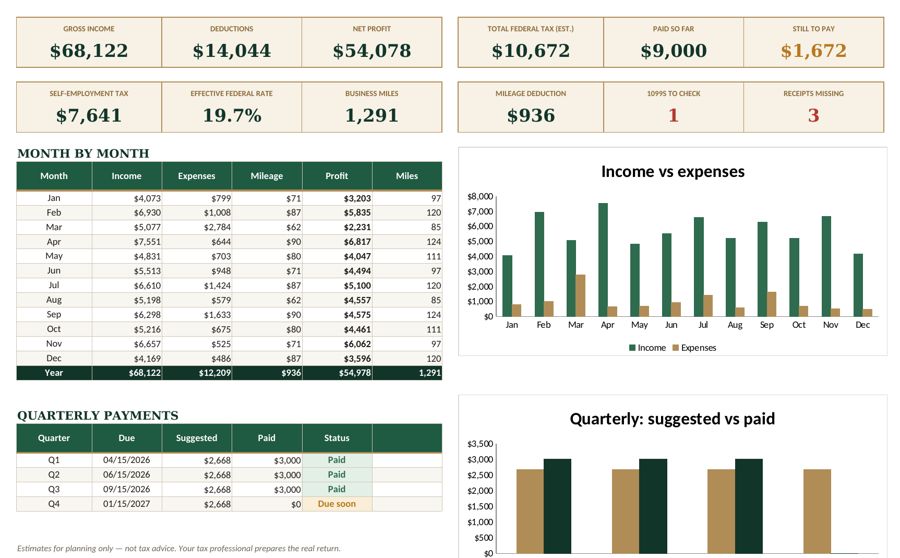
When you’re ready to track it all in one place, the Fyscale Self-Employed Tax Organizer has a quarterly estimate sheet that does the math as you add your numbers.
Tools mentioned in this article
Keep reading
This article is general information for US small businesses, not tax, legal or accounting advice. Check current IRS guidance or ask a qualified professional about your situation.