

Self-Employment Tax Explained in Plain English
When you work for an employer, Social Security and Medicare taxes come out of every paycheck and your employer quietly pays a matching share. When you work for yourself, nobody does that for you. Self employment tax is how freelancers, sole proprietors, Etsy sellers and gig workers pay into those same programs, and because you cover both halves, it often surprises people at tax time. This guide walks through who owes it, how the math works, and how to plan for it so April doesn’t sting.
What self-employment tax actually is
Self-employment tax is simply Social Security and Medicare tax for people who run their own business. It is separate from income tax. You can owe self-employment tax even in a year when your income is low enough that you owe little or no income tax.
The rate is 15.3%, made up of two parts:
| Part | Rate | Applies to |
|---|---|---|
| Social Security | 12.4% | Net earnings up to the annual wage base ($184,500 for 2026) |
| Medicare | 2.9% | All net earnings, no cap |
| Total | 15.3% |
An employee pays 7.65% and the employer pays the other 7.65%. As a self-employed person, you are both, so you pay the full 15.3%.
Who has to pay it
In general, you owe self-employment tax if your net earnings from self-employment are $400 or more for the year. “Net” is the key word: it is what is left after business expenses, not your gross sales. That is one big reason good expense records matter. Every legitimate deduction you claim on Schedule C lowers both your income tax and your self-employment tax.
This usually includes:
- Freelancers and independent contractors paid on a 1099
- Sole proprietors and single-member LLC owners taxed as sole proprietors
- Online sellers with a real business (Etsy, Shopify, Amazon)
- Rideshare and delivery drivers
If you’re not sure which costs count, our guide to Schedule C expense categories breaks them down line by line.
How to calculate self-employment tax, step by step
The calculation has a small twist that trips people up: you don’t apply 15.3% to your full profit. You first multiply your net profit by 92.35%. That adjustment mimics the fact that employees don’t pay Social Security and Medicare on the employer’s half of those taxes.
- Find your net profit. Gross business income minus deductible business expenses (this is the bottom line of Schedule C).
- Multiply by 92.35%. This gives your net earnings from self-employment.
- Apply 12.4% for Social Security on earnings up to the wage base.
- Apply 2.9% for Medicare on all of it.
- Add the two for your total self-employment tax, reported on Schedule SE.
Worked example: a freelance designer
Maya is a freelance designer. In 2026 she bills $78,000 and has $18,000 of business expenses (software, a new laptop, a coworking membership, and so on).
- Net profit: $78,000 − $18,000 = $60,000
- Net earnings from self-employment: $60,000 × 92.35% = $55,410
- Social Security: $55,410 × 12.4% = $6,870.84
- Medicare: $55,410 × 2.9% = $1,606.89
- Total self-employment tax: $8,477.73
That is on top of her federal income tax. Seeing that number early in the year, rather than in March, is the whole point of planning.
If you also have a W-2 job
The Social Security portion stops once your combined wages and self-employment earnings reach the wage base. Say Jordan earns $150,000 in W-2 wages and has $60,000 of net profit from a side business (again $55,410 of net earnings after the 92.35% step).
- Room left under the 2026 wage base: $184,500 − $150,000 = $34,500
- Social Security: $34,500 × 12.4% = $4,278.00
- Medicare: $55,410 × 2.9% = $1,606.89
- Total self-employment tax: $5,884.89
High earners should also know about the 0.9% Additional Medicare Tax, which applies to earnings above $200,000 for single filers. If you’re anywhere near that level, it’s worth having a tax professional run the numbers.
The deduction most people forget
You get to deduct half of your self-employment tax when figuring your adjusted gross income. In Maya’s case, that’s $8,477.73 ÷ 2 = $4,238.87 (rounded), which reduces the income her income tax is based on.
Two things to know about this deduction:
- It lowers income tax, not self-employment tax itself.
- It’s taken as an adjustment to income, so you get it whether or not you itemize.
The IRS overview of self-employment tax covers the rules and the Schedule SE details.
How self-employment tax gets paid
There is no employer withholding, so you pay it through quarterly estimated taxes along with your income tax. For tax year 2026, the due dates are April 15, June 15 and September 15, 2026, and January 15, 2027. Estimated payments are generally required if you expect to owe $1,000 or more when you file.
You can usually avoid an underpayment penalty by paying at least 90% of this year’s tax or 100% of last year’s (110% if last year’s AGI was over $150,000). Our guide to quarterly estimated taxes for the self-employed covers how to pay and what to do if you missed one.
How to plan for it all year
The simplest habit is to move a fixed percentage of every payment you receive into a separate savings account. For self-employment tax alone, a quick rule of thumb is about 14.1% of net profit (15.3% × 92.35%), before income tax. Add your expected income tax rate on top. Our article on how much a freelancer should set aside for taxes shows how to pick a percentage that fits your situation.
A few other habits that help:
- Track expenses as they happen. A deduction you forget to record is a deduction you pay 15.3% plus income tax on.
- Review profit monthly. Your tax bill follows profit, not revenue.
- Recalculate after a big month. One large project can push your quarterly payment up.
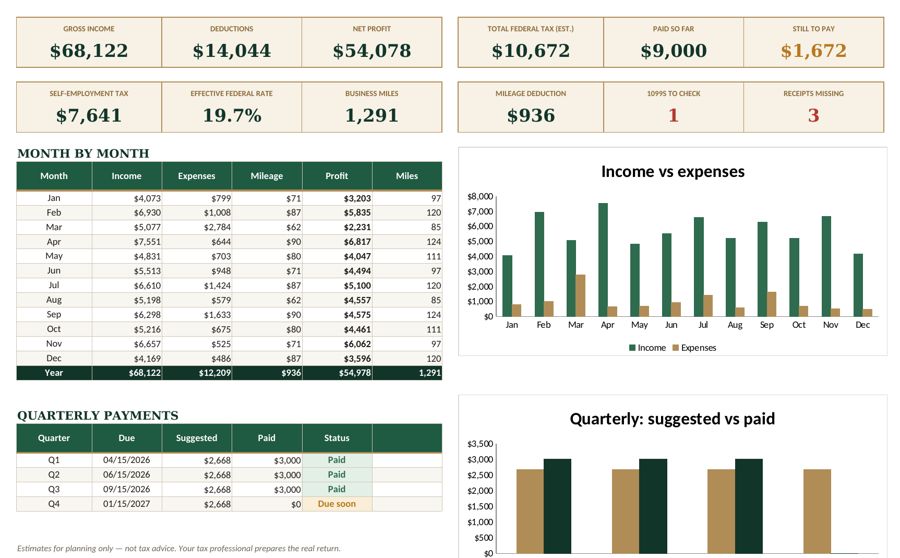
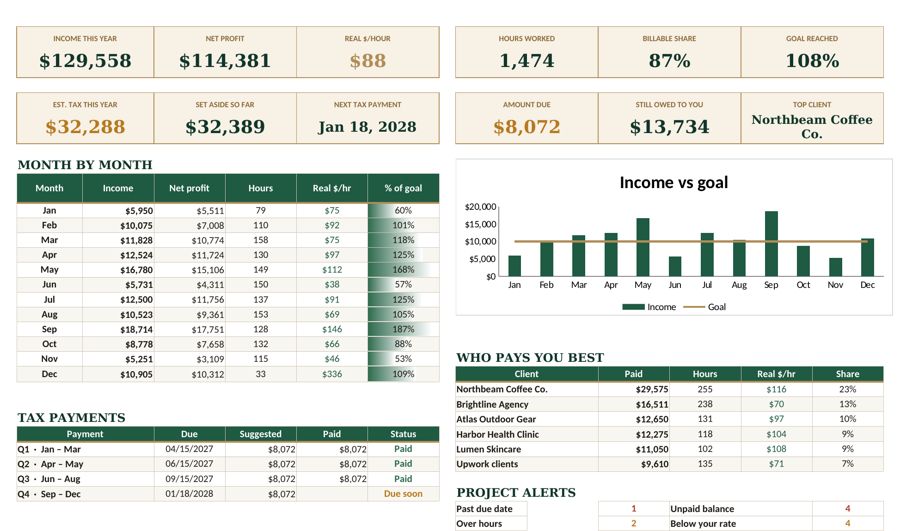
If you want the math done for you, the Fyscale tax and freelance finance spreadsheets calculate estimated self-employment tax from the income and expenses you enter, so you can see a running number all year. They’re planning tools, not tax advice, so confirm final figures with a tax professional.
Bottom line
- Self-employment tax is Social Security (12.4%) plus Medicare (2.9%), 15.3% in total.
- It applies to net profit × 92.35%, and Social Security stops at the $184,500 wage base for 2026.
- You generally owe it once net earnings hit $400.
- Half of it is deductible when figuring your AGI.
- Pay it through quarterly estimates and set money aside from every payment.
Tools mentioned in this article
Keep reading

This article is general information for US small businesses, not tax, legal or accounting advice. Check current IRS guidance or ask a qualified professional about your situation.