

Year-End Tax Checklist for Small Business Owners
The last two months of the year are when small business owners can still change their tax picture, and when a little organization saves weeks of scrambling in March. This year end tax checklist for small business owners covers what to review in November and December, what to prepare for January, and how to hand your accountant (or yourself) a clean set of numbers. It is general information, not tax advice, so confirm anything specific to your situation with a tax professional.
Step 1: Get your books current
Everything else depends on accurate numbers, so start here.
- Categorize every transaction through the end of the most recent month. Use consistent categories that map to your tax form; our list of Schedule C expense categories is a good reference for sole proprietors.
- Reconcile every bank and card account to the statement balance. If you have never done it, follow our bank reconciliation guide.
- Look for personal spending in business accounts, and business spending on personal cards. Move each one to the right category so nothing gets double-counted or missed.
- Match marketplace and processor payouts (Etsy, Shopify, Stripe, PayPal) to gross sales and fees. Payouts are net of fees, and your books should show both sides.
Step 2: Review your estimated taxes
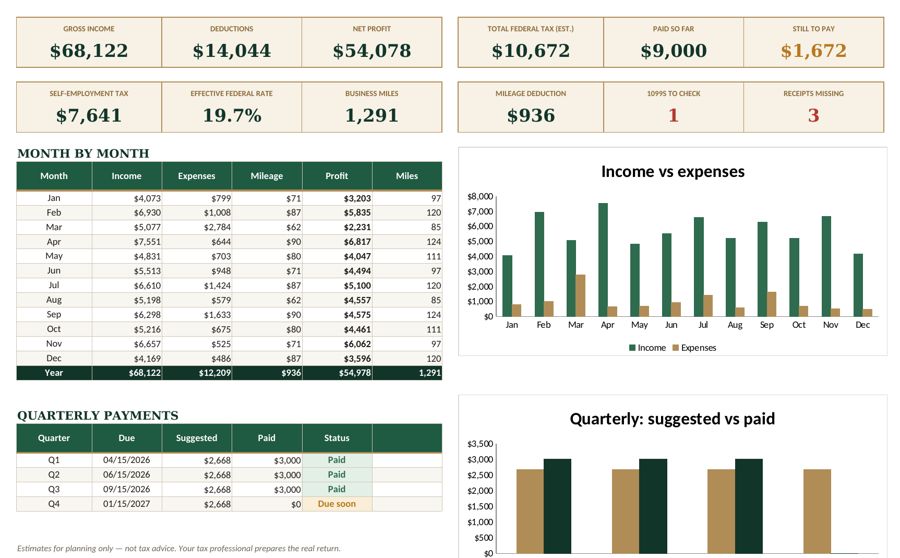
For tax year 2026, the final estimated tax payment is due January 15, 2027. Estimated payments are generally required if you expect to owe $1,000 or more when you file.
To generally avoid an underpayment penalty, your total payments (including withholding) need to reach the smaller of:
- 90% of your 2026 tax, or
- 100% of your 2025 tax (110% if your 2025 adjusted gross income was over $150,000).
Worked example: Jordan’s total 2025 tax was $8,400, and his AGI was under $150,000. To meet the prior-year safe harbor, he needs $8,400 in 2026 payments. He paid $2,100 in April, June and September, for $6,300 so far. A fourth payment of $2,100 by January 15, 2027 brings him to $8,400 and meets the safe harbor, even if his 2026 tax ends up higher.
The IRS explains the rules on its estimated taxes page, and our guide to quarterly estimated taxes for the self-employed walks through how to pay.
Step 3: Think about timing of income and expenses
Most small businesses use the cash method, where income counts when you receive it and expenses count when you pay them. That makes timing matter at year-end:
- Expenses: if you were going to buy needed equipment, software or supplies in January anyway, buying in December moves the deduction into 2026. Do not buy things you do not need just to get a deduction; you still spend the money.
- Income: some owners send December invoices a little later so payment lands in January. This only shifts income one year; it does not eliminate it.
- Equipment purchases can often be deducted in the year placed in service rather than depreciated over several years, but the rules have specific conditions. Ask your tax professional before making a large purchase for tax reasons.
Step 4: Prepare for 1099s and contractor payments
If you paid independent contractors, collect a Form W-9 from each now, before January.
For payments made in 2026, the Form 1099-NEC reporting threshold rises to $2,000 (it was $600). Forms are generally due to recipients and the IRS by January 31; for 2027 that date falls on a Sunday, so the deadline moves to Monday, February 1, 2027. Read more in our article on the 1099-NEC threshold for 2026 and on the IRS Form 1099-NEC page.
If you sell through marketplaces or payment apps, also expect a Form 1099-K if your payments exceeded $20,000 and 200 transactions. Either way, all business income is reportable, whether or not you receive a form.
Step 5: Finish your mileage and home office records
- Mileage: total business miles for the year from your log. For 2026, the standard mileage rate is 72.5 cents per mile. Example: 4,200 business miles × $0.725 = $3,045. Our mileage log guide explains what the log must include.
- Home office: measure the space used regularly and exclusively for business. Under the simplified method, it is $5 per square foot, up to 300 square feet.
Step 6: Inventory and cost of goods sold
If you sell physical products, count your inventory on or near December 31. Your ending inventory directly affects cost of goods sold, and therefore profit. Write off damaged or unsellable stock properly instead of leaving it on the books.
Step 7: Organize records for filing
Create one folder for 2026 with:
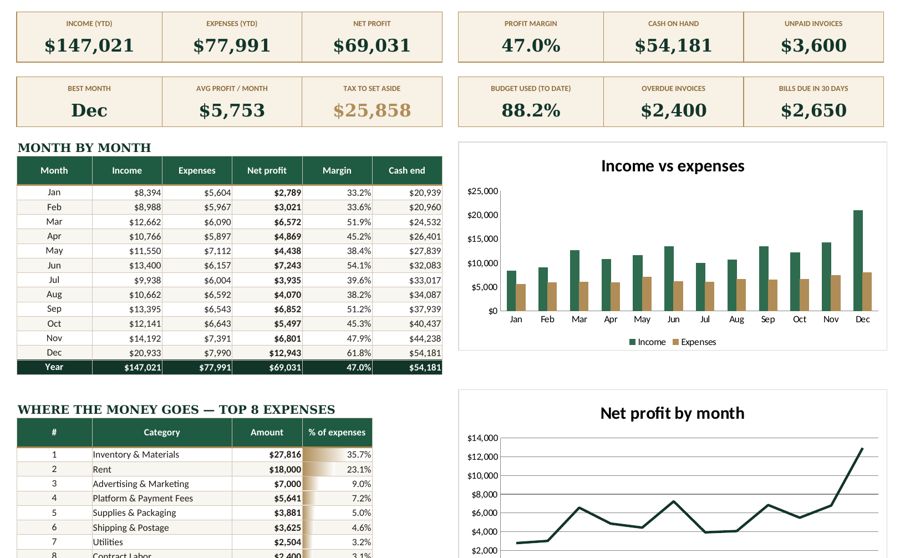
- Year-end P&L and balance sheet (or a simple summary of income and expenses)
- All bank, card and payout statements for January to December
- Receipts for large purchases and equipment
- 1099s you issue and 1099s you receive
- Mileage log and home office measurements
- Estimated tax payment confirmations
- Health insurance and retirement contribution records
The year-end tax checklist at a glance
| When | Task |
|---|---|
| November | Bring books up to date and reconcile all accounts |
| November | Estimate 2026 profit and check estimated payments |
| Early December | Decide on needed purchases and invoice timing |
| December | Collect W-9s from contractors |
| December 31 | Count inventory, total mileage, note odometer reading |
| January 15, 2027 | Pay the fourth-quarter estimated tax |
| February 1, 2027 | Send 1099-NEC forms (January 31 falls on a Sunday) |
| February–March | Deliver your organized folder to your tax preparer |
Bottom line
You do not need to do everything at once. Block one afternoon in November for books and estimates, one in December for purchases and contractors, and one in January for forms and records. If you want a single place to track income, expenses, mileage and estimated payments as the year goes, the Fyscale tax and bookkeeping templates are built for exactly this kind of year-end review.
Tools mentioned in this article
Keep reading
This article is general information for US small businesses, not tax, legal or accounting advice. Check current IRS guidance or ask a qualified professional about your situation.