

Quarterly Estimated Taxes for the Self-Employed: Dates and How to Pay
If you are self-employed, the IRS does not wait until April to collect your taxes. It expects you to pay as you go, in four quarterly estimated tax payments. Miss them and you can owe a penalty — even if you pay everything when you file.
This guide covers who needs to pay, the 2026 due dates, how much to pay and the easiest ways to send the money.
Who needs to pay estimated taxes?
In general, you should make estimated payments if you expect to owe at least $1,000 in federal tax for the year after subtracting withholding and refundable credits. That includes most freelancers, Etsy sellers, consultants and gig workers who earn a meaningful profit.
If you also have a job with withholding, you can sometimes cover your side income by increasing your W-4 withholding instead.
2026 due dates
For income earned in the 2026 tax year:
| Payment | Covers income earned | Due date |
|---|---|---|
| 1 | January 1 – March 31 | April 15, 2026 |
| 2 | April 1 – May 31 | June 15, 2026 |
| 3 | June 1 – August 31 | September 15, 2026 |
| 4 | September 1 – December 31 | January 15, 2027 |
Notice the “quarters” are not equal — the second covers only two months. If a due date falls on a weekend or legal holiday, it moves to the next business day. Many states have their own estimated tax payments with similar dates.
How much should each payment be?
There are two common approaches.
1. The safe harbor method (simplest)
You generally avoid the underpayment penalty if your total payments for the year (estimated payments plus any withholding) are at least:
- 90% of this year’s tax, or
- 100% of last year’s total tax — 110% if last year’s adjusted gross income was over $150,000 ($75,000 if married filing separately).
Many people simply take last year’s total tax, divide by four and pay that each quarter. It is predictable, and any extra you owe is due in April without a penalty.
2. Pay based on this year’s actual profit
If your income is growing fast or dropping, estimate this year’s tax instead:
- Add up your net profit so far (income minus business expenses).
- Project it for the full year.
- Estimate self-employment tax (15.3% on 92.35% of net earnings, with the Social Security part capped at $184,500 for 2026) plus income tax.
- Subtract what you have already paid and divide by the remaining payments.
Our guide on how much a freelancer should set aside for taxes walks through a worked example.
How to pay
- IRS Direct Pay — free bank transfer from irs.gov, no registration.
- Your IRS Online Account — schedule payments and see what you have paid.
- EFTPS — free federal payment system; requires enrollment.
- Debit or credit card through approved processors (they charge a fee).
- Check by mail with a Form 1040-ES voucher.
Whichever method you choose, select estimated tax (1040-ES) and the correct tax year. Keep the confirmation number with your tax records. The IRS lists all options on its estimated taxes page.
What if your income is uneven?
Seasonal businesses — a holiday-heavy Etsy shop, for example — may earn most of their profit in one quarter. The IRS allows the annualized income installment method (Form 2210, Schedule AI), which matches payments to when you actually earned the money. It takes more calculation, so many people use it with a tax professional’s help.
A simple quarterly routine
- Close your books for the period. Make sure income and expenses are recorded and reconciled — see our small business bookkeeping guide.
- Check profit year to date. Compare it with last year.
- Calculate the payment using safe harbor or actual profit.
- Pay online and save the confirmation.
- Move money from your tax savings to cover it.
Set calendar reminders a week before each due date so you are never scrambling.
Common mistakes to avoid
- Paying based on revenue instead of profit.
- Forgetting the June 15 payment, only two months after April.
- Forgetting state estimated taxes.
- Choosing the wrong tax year when paying online.
- Not keeping track of what you paid — you will need the totals for your return.
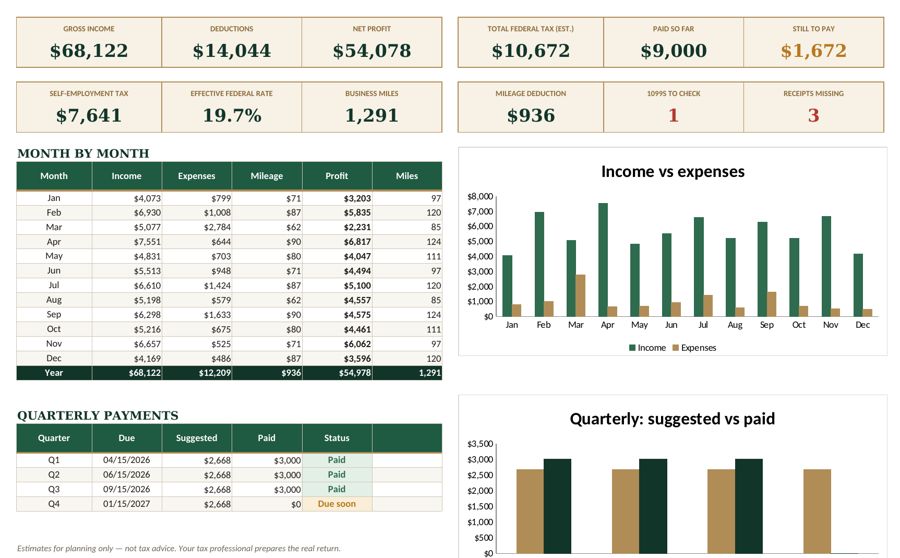
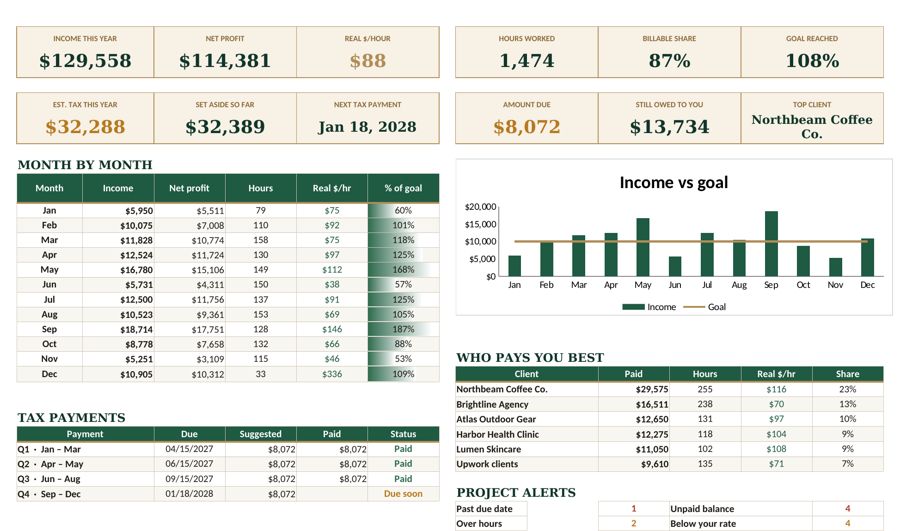
Paying estimated taxes feels like a chore at first, but after one year it becomes routine. A tax organizer that tracks profit and calculates each quarterly payment makes the process take minutes instead of hours.
Tools mentioned in this article
Keep reading
This article is general information for US small businesses, not tax, legal or accounting advice. Check current IRS guidance or ask a qualified professional about your situation.