

Etsy Fees Explained: What You Really Pay on Each Sale
Etsy fees are small one at a time, which is exactly why they’re easy to underestimate. A 20-cent listing fee here and a few percent there can add up to more than 10% of every sale before you’ve paid for materials or shipping. This guide has Etsy fees explained in plain terms for US sellers, with a worked example that shows exactly where the money goes, so you can price with confidence.
The core Etsy fees every US seller pays
Almost every sale on Etsy involves three fees:
| Fee | Amount (US) | Charged on |
|---|---|---|
| Listing fee | $0.20 per listing | Each new listing, each automatic renewal, and each additional quantity sold |
| Transaction fee | 6.5% | Item price plus the shipping you charge (and gift wrap, if offered) |
| Payment processing | 3% + $0.25 | The total order amount |
Listing fee
Each listing costs $0.20 and lasts four months or until it sells. If auto-renew is on, Etsy charges another $0.20 when it renews. If a listing has quantity greater than one, each sale triggers a $0.20 renewal so the listing stays up. Easy to ignore, but on a low-priced item it’s a noticeable slice.
Transaction fee
Etsy takes 6.5% of the item price and the shipping you charge the buyer. That second part catches people off guard: “free shipping” doesn’t avoid the fee, it just moves shipping into the item price, where it’s charged either way.
Payment processing fee
For US shops using Etsy Payments, processing is 3% of the order total plus $0.25 per order. The order total includes shipping and any sales tax collected, so your actual processing fee can be a little higher than a simple estimate.
Offsite Ads: the fee you only pay sometimes
Etsy promotes listings on other sites like Google and social platforms. If a buyer clicks one of those ads and buys from your shop within 30 days, you pay an Offsite Ads fee on that order:
- 15% of the order total for shops with under $10,000 in sales over the past 12 months (these shops can opt out)
- 12% for shops above $10,000 a year (participation is required)
You only pay on attributed sales, but when it hits, it’s often the single biggest fee on the order. Build it into your pricing so an attributed sale is still profitable.
Other costs that show up on your payment account
- Etsy Ads (onsite): optional, you set a daily budget.
- Shipping labels: if you buy labels through Etsy, the cost comes out of your balance.
- Currency conversion: applies if your listings are in a different currency from your payment account.
- Optional subscriptions: Etsy offers a paid plan with extra shop tools. Check Etsy’s current pricing before signing up.
Worked example: a $25 handmade item
A seller lists a candle for $25 and charges $5 shipping, so the buyer pays $30 (ignoring sales tax for simplicity).
| Line | Calculation | Amount |
|---|---|---|
| Listing fee | flat | $0.20 |
| Transaction fee | 6.5% × $30 | $1.95 |
| Payment processing | 3% × $30 + $0.25 | $1.15 |
| Total Etsy fees | $3.30 |
Fees are $3.30 on a $30 order, which is 11% of what the buyer paid. The seller receives $30 − $3.30 = $26.70.
Now subtract real costs:
- Shipping label: $4.50
- Materials and packaging: $6.00
Profit before your time and overhead: $26.70 − $4.50 − $6.00 = $16.20.
If that same sale came through Offsite Ads at 15%, add $30 × 15% = $4.50, and profit drops to $11.70. Same candle, 28% less profit. That’s why you price for the expensive scenario, not the best one.
Example: a $12 digital download
Digital products have no shipping, but the same fees apply:
- Listing fee: $0.20
- Transaction fee: 6.5% × $12 = $0.78
- Processing: 3% × $12 + $0.25 = $0.61
- Total: $1.59, or about 13.3% of the sale
Notice the fixed pieces ($0.20 + $0.25) hit low-priced items harder in percentage terms. On a $5 item, they alone are 9% before any percentage fees. That’s one reason very cheap listings rarely pay off.
How to account for Etsy fees in your prices
- Know your all-in cost per item: materials, packaging, labor at a real hourly rate, and a share of overhead. Our guide to pricing handmade products for profit walks through the full formula.
- Add a fee buffer: plan for about 11–13% in standard fees, and decide whether you’ll also absorb 12–15% Offsite Ads on some orders.
- Price shipping honestly: remember you pay 6.5% on shipping too.
- Check your real numbers monthly: download your Etsy payment account CSV and total fees by type. A profit and loss statement will show whether fees are creeping up as a share of revenue.
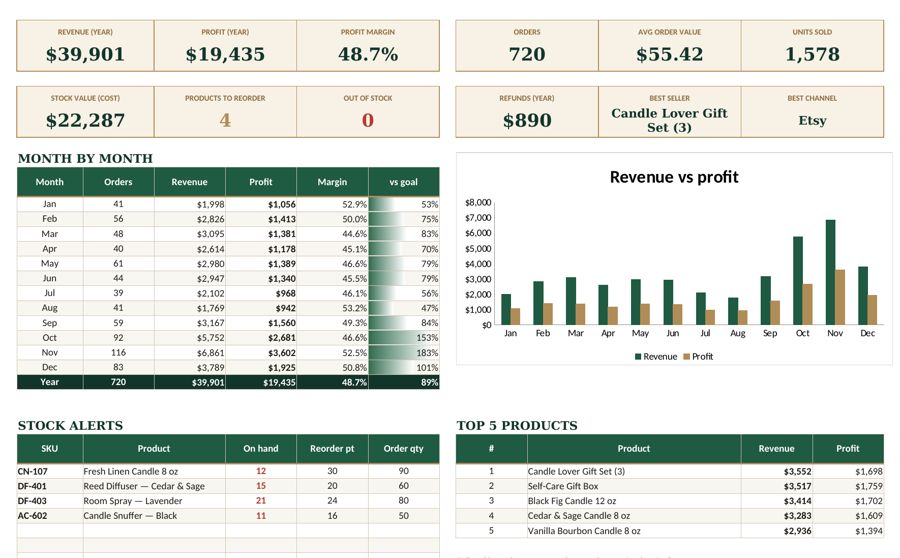
- Track stock and costs per product: an inventory spreadsheet helps you see which products actually earn money after fees.
Fees and taxes
Etsy fees are generally deductible business expenses, which you’d typically report on Schedule C. Keep your monthly statements. Etsy may also send you a Form 1099-K if you cross the federal reporting threshold, currently $20,000 and 200 transactions. You can read more on the IRS page about understanding your Form 1099-K. Not getting a 1099-K doesn’t mean the income isn’t taxable. And because your net profit is subject to self-employment tax, every fee you track properly lowers your tax bill.
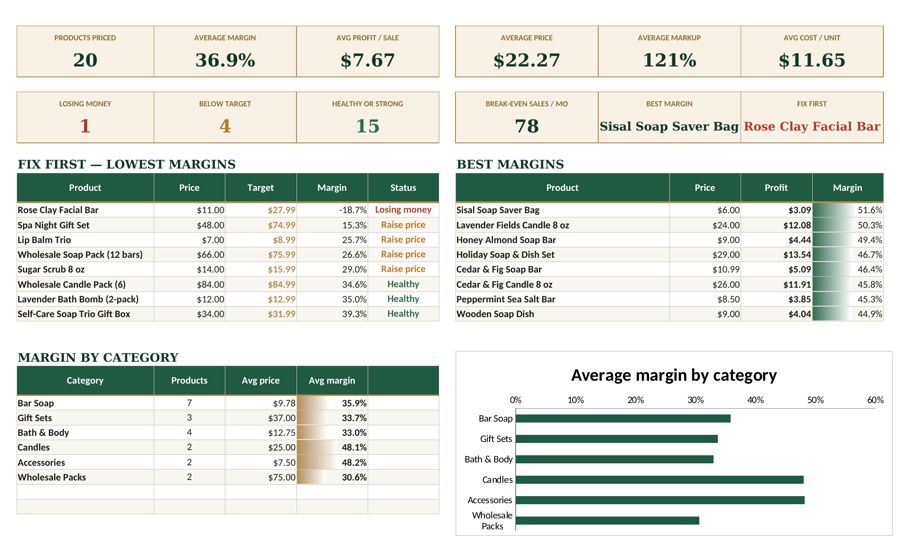
If you’d rather not do the math by hand, the Fyscale pricing calculator and seller inventory spreadsheets build Etsy’s fee structure into each product’s price and margin, so you can test a price before you list it.
Bottom line
- Standard Etsy fees: $0.20 listing, 6.5% transaction (including shipping), 3% + $0.25 processing.
- Expect roughly 11–13% of each order to go to standard fees.
- Offsite Ads add 15% (or 12% for larger shops) on attributed sales only.
- Fixed fees hurt low-priced items most.
- Price for the worst-case fee scenario and review actual fees every month.
Tools mentioned in this article
Keep reading

This article is general information for US small businesses, not tax, legal or accounting advice. Check current IRS guidance or ask a qualified professional about your situation.