

Schedule C for Etsy Sellers: A Line-by-Line Walkthrough
You’ve spent the year making, photographing, packing and shipping. Now a blank tax form is staring back at you, and your Etsy dashboard shows a dozen numbers that don’t obviously match any of its lines. Good news: there’s a clear place for each one, and once you see the map, it stops feeling scary.
If you sell on Etsy as a sole proprietor or single-member LLC, your shop’s results usually land on Schedule C, “Profit or Loss From Business,” attached to your Form 1040. This guide to Schedule C for Etsy sellers walks line by line through the parts that matter most for a typical shop (gross sales, refunds, inventory, Etsy fees, ads and shipping) and finishes with a complete worked example. Get this right once and every future tax season gets easier. This is general information, not tax advice — confirm with a tax professional.

What Schedule C means for Etsy sellers
Schedule C turns your shop’s year into one number: net profit or loss. That number flows to your Form 1040 and to Schedule SE for self-employment tax. Before you start, gather:
- Gross sales for the year, including shipping you charged buyers (from your Etsy sales and payment reports)
- Refunds you issued, and Form 1099-K if you received one
- Etsy fees: listing, transaction, payment processing, Offsite Ads and any subscription
- Etsy Ads and other advertising spend
- Inventory counts and costs: beginning of year, purchases, end of year
- Shipping labels and postage, plus packaging, supplies, software, equipment, home office details and mileage
A clean year of books makes this a one-evening job. If you need a refresher on categories, see Schedule C expense categories explained.
Key idea: Report what buyers paid, then deduct what Etsy kept; never the other way around.
How to fill out Schedule C step by step
Step 1: Part I, income
Line 1 – Gross receipts or sales. Enter your total sales for the year, generally including shipping charged to buyers, before Etsy fees are taken out. Etsy pays you net of fees, but the cleaner approach is to report gross sales here and deduct the fees as an expense. Your Etsy deposits will be lower than this number; that’s expected.
Sales tax Etsy collected and remitted on your behalf as a marketplace facilitator generally isn’t your income. Compare your 1099-K (if you received one) against your own Etsy reports, and keep a note explaining differences such as refunds, shipping or sales tax. For payments in 2026, Etsy and other platforms generally issue a 1099-K when you have more than $20,000 in payments and more than 200 transactions. You must report your income whether or not you receive one. The IRS explains the form on its Understanding your Form 1099-K page.
Line 2 – Returns and allowances: refunds and partial refunds. Line 3 = Line 1 − Line 2. Line 4 – Cost of goods sold comes from Part III. Line 5 – Gross profit = Line 3 − Line 4, and Line 7 – Gross income adds any other business income from line 6.
Step 2: Part III, cost of goods sold (lines 33–42)
If you sell physical products you make or buy, Part III is where your product costs go:
- Line 35: Inventory at the beginning of the year
- Line 36: Purchases (for example, finished goods you resell)
- Line 38: Materials and supplies used to make products
- Line 39: Other direct costs (some sellers include product packaging here)
- Line 41: Inventory at the end of the year
- Line 42: Cost of goods sold = lines 35 through 39 minus line 41
Year-end inventory counts matter. An Etsy inventory spreadsheet that tracks quantity and unit cost makes lines 35 and 41 easy. Digital-only sellers often have little or no cost of goods sold.
Step 3: Part II, expenses
| Etsy expense | Typical Schedule C line |
|---|---|
| Etsy Ads, Pinterest ads, promoted posts | Line 8 – Advertising |
| Mileage to the post office or supplier (business share) | Line 9 – Car and truck expenses |
| Etsy listing, transaction, processing and Offsite Ads fees | Line 10 – Commissions and fees |
| Freelance photographer, designer or VA | Line 11 – Contract labor |
| Business equipment, such as a printer or heat press, if depreciated | Line 13 – Depreciation |
| Software, office supplies | Line 18 – Office expense |
| Packaging and shop supplies not in COGS | Line 22 – Supplies |
| Business licenses, some state fees | Line 23 – Taxes and licenses |
| Shipping labels and postage | Line 27a – Other expenses (listed in Part V), unless already in COGS |
| Home office | Line 30 – Business use of home |
Pick one place for each cost and stay consistent. Don’t put packaging in both COGS and supplies, and don’t deduct Etsy fees if you already reported only your net deposits on line 1. For mileage, the 2026 IRS standard rate is 72.5 cents per business mile; see the IRS standard mileage rates page.
Step 4: Lines 28–31, the finish line
Line 28 totals your expenses. Line 29 is your tentative profit. Line 30 is the home office deduction: with the simplified method it’s $5 per square foot of space used regularly and exclusively for business, up to 300 square feet. Line 31 is your net profit or loss.

Example: a small handmade shop
Picture Lena, a typical Etsy seller of handmade ceramics. Her year:
| Line | Item | Amount |
|---|---|---|
| 1 | Gross sales including shipping charged | $30,000 |
| 2 | Refunds | $600 |
| 3 | Line 1 − Line 2 | $29,400 |
| 35 | Beginning inventory | $2,000 |
| 36 | Purchases | $8,000 |
| 38 | Materials and supplies | $1,500 |
| 41 | Ending inventory | ($2,500) |
| 42 / 4 | Cost of goods sold | $9,000 |
| 5 | Gross profit ($29,400 − $9,000) | $20,400 |
| 8 | Etsy Ads | $900 |
| 10 | Etsy fees | $3,100 |
| 18 | Software and office | $400 |
| 22 | Packaging supplies | $500 |
| 27a | Shipping labels (other expenses) | $3,200 |
| 28 | Total expenses | $8,100 |
Line 29 tentative profit = $20,400 − $8,100 = $12,300. Lena uses a 120 sq ft studio corner regularly and exclusively for her shop, so her simplified home office deduction is 120 × $5 = $600 (line 30). Line 31 net profit = $12,300 − $600 = $11,700.
That $11,700 flows to her Form 1040 and to Schedule SE. Self-employment tax generally applies when net earnings are $400 or more: roughly $11,700 × 92.35% × 15.3% ≈ $1,653, before income tax. The IRS About Schedule C page has the current form and instructions.
Common mistakes to avoid
- Reporting net deposits as income and then deducting fees again, which double-counts fees.
- Ignoring the 1099-K mismatch instead of reconciling and keeping a note.
- Skipping inventory counts, which distorts cost of goods sold.
- Forgetting shipping labels, often one of the biggest expenses for product sellers.
- Not paying estimated taxes during the year. See our guide to quarterly estimated taxes for the self-employed.
Your 15-minute action plan
- [ ] Download your year-to-date Etsy sales and payment reports
- [ ] Write down gross sales (with shipping charged) and total refunds
- [ ] Total your Etsy fees and Etsy Ads separately
- [ ] Put a date on your calendar for a December 31 inventory count
- [ ] List any home office space and its square footage
- [ ] Note questions for your tax professional as you go
FAQ
Do Etsy sellers have to file Schedule C?
If you run your Etsy shop as a sole proprietor or single-member LLC with business income, you generally report it on Schedule C. Hobby sellers and other entity types follow different rules, so ask a tax professional if you’re unsure.
Do I report Etsy gross sales or my deposits?
Report gross sales on line 1, including shipping charged to buyers, then deduct Etsy fees as expenses. Reporting deposits and also deducting fees would count the fees twice.
Where do Etsy fees go on Schedule C?
Listing, transaction, payment processing and Offsite Ads fees typically go on line 10, Commissions and fees. Etsy Ads usually go on line 8, Advertising.
The bottom line
Schedule C isn’t a test you pass once a year; it’s a summary of habits you build all year. Start today by pulling one report and writing down three numbers. Each small step now turns next spring’s tax night into a calm evening with a cup of tea.
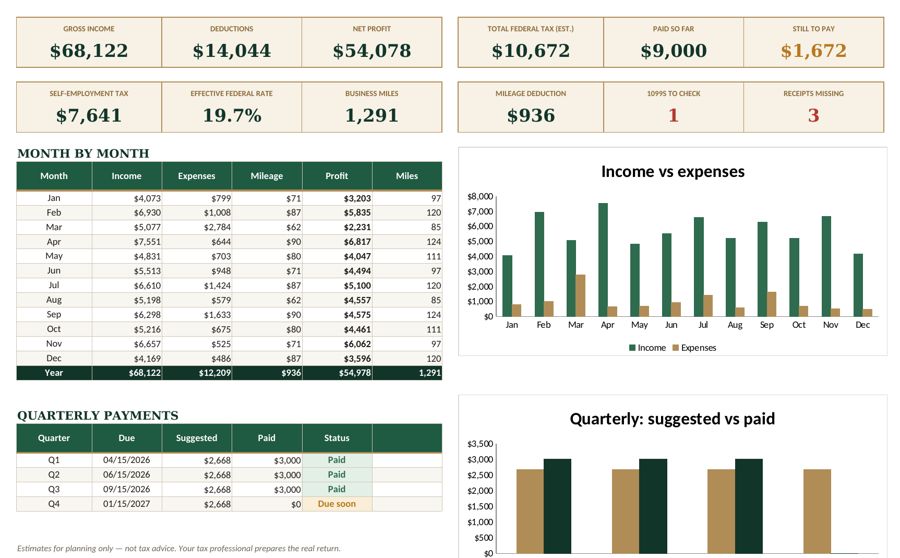
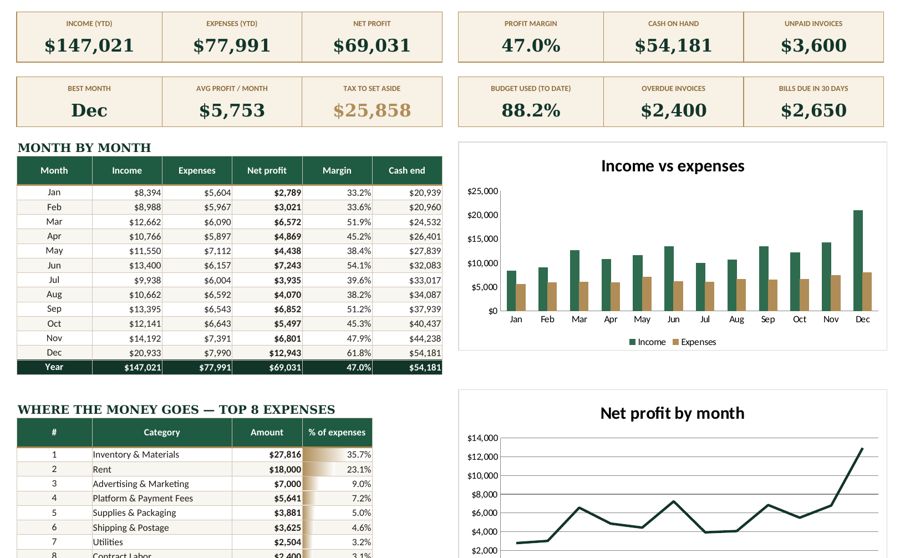
To keep these numbers ready all year, the Fyscale tax organizer and bookkeeping templates group your income and expenses into Schedule C-style categories, so year-end is a matter of copying totals rather than digging through statements.
Tools mentioned in this article
Keep reading
This article is general information for US small businesses, not tax, legal or accounting advice. Check current IRS guidance or ask a qualified professional about your situation.