

Form 1099-NEC: Who Gets One and the New $2,000 Threshold

If you pay freelancers or contractors, January brings a familiar chore: deciding who gets a Form 1099-NEC. For payments you make during 2026, that decision changes. Here’s the short version of the 1099-NEC threshold 2026 update: the reporting trigger rises from $600 to $2,000 per payee for the year. Fewer small payments will need a form, but the rest of the rules — who counts, what payment methods count, and when forms are due — work much the same way. This guide walks through all of it with a worked example.
What Form 1099-NEC is for
Form 1099-NEC (“Nonemployee Compensation”) reports payments a business makes to people who are not its employees for services performed in the course of the business. Think freelance designers, bookkeepers, photographers, virtual assistants, or a handyman who repairs your studio.
The form does two jobs. It gives the contractor a record of what you paid them, and it tells the IRS the same number so it can match it against the contractor’s tax return. The IRS overview is on its About Form 1099-NEC page.
A few things it is not for:
- Employees. Wages go on Form W-2, not a 1099.
- Personal payments. Paying someone to paint your own home is not a business payment.
- Goods only. Buying inventory or supplies from a vendor is not nonemployee compensation.
The 1099-NEC threshold 2026 change: $600 becomes $2,000
For years, the rule was simple: if you paid a non-employee $600 or more for services during the year, you issued a 1099-NEC. Under the 2025 tax law, that threshold rises to $2,000 for payments made in 2026, and the same $2,000 figure applies to most Form 1099-MISC payments such as rent. The law also calls for inflation adjustments in later years, so check the current figure each January.
Timing matters here. The new threshold is tied to when you make the payment:
| Payments made in | Forms filed in early | Threshold per payee |
|---|---|---|
| 2025 | 2026 | $600 |
| 2026 | 2027 | $2,000 |
So the forms you send in January 2026 (for 2025 payments) still use $600. The $2,000 rule first shows up on the forms you prepare in January 2027.
Who gets a 1099-NEC
Run each payee through four questions:
- Did you pay them for services in the course of your business? If yes, continue.
- Are they a non-employee? Independent contractors, sole proprietors and single-member LLCs that are taxed as sole proprietors generally count.
- Are they a corporation? Payments to C or S corporations are generally exempt. The big exception is attorneys: legal fees are generally reportable even if the law firm is incorporated.
- Did your total payments to them for the year reach the threshold — $2,000 for 2026?
If the answers line up, that payee gets a 1099-NEC.
How you paid matters
This is the rule many small business owners miss. If you paid a contractor by credit card, debit card or a payment app’s goods-and-services option (a third-party payment network), you generally do not issue a 1099-NEC for those payments. The payment processor handles reporting on Form 1099-K instead, subject to its own thresholds. The IRS explains this on its Understanding your Form 1099-K page.
Payments by check, cash, direct deposit or ACH transfer from your bank are the ones that count toward your 1099-NEC total.
A worked example
Maya runs a small Etsy shop and a custom-print business as a sole proprietor. In 2026 she paid four people:
| Payee | What for | Paid by | 2026 total | 1099-NEC? |
|---|---|---|---|---|
| Jordan (freelance photographer) | Product photos | Bank transfer | $2,400 | Yes — over $2,000, non-employee |
| Priya (virtual assistant) | Customer messages | Check | $1,800 | No — under $2,000 |
| Lee Design Inc. (S corporation) | Logo refresh | Check | $3,500 | No — corporation |
| Sam (copywriter) | Listing descriptions | Credit card | $2,600 | No — card payments go on 1099-K |
Total contractor spending: $2,400 + $1,800 + $3,500 + $2,600 = $10,300. Only one form is needed — Jordan’s, for $2,400.
Under the old $600 rule, Priya would also have needed a form. The change saves Maya a little paperwork, but notice that all $10,300 is still a deductible business expense on her Schedule C (contract labor), whether or not a form was issued. If you’re not sure where contractor costs go, see our guide to Schedule C expense categories.
Deadlines and the W-9 habit
Form 1099-NEC is due to both the contractor and the IRS by January 31 of the following year (moved to the next business day when it falls on a weekend or holiday). There is no automatic extension for this form the way there is for many others, so it pays to be ready early.
The easiest way to be ready is to collect a Form W-9 before you pay anyone new. The W-9 gives you the payee’s legal name, business type (which tells you whether they’re a corporation) and taxpayer identification number. If a payee won’t provide a TIN, you may be required to apply backup withholding, currently 24%, to reportable payments. Getting the W-9 up front avoids that conversation entirely.
If you’re the one receiving 1099s
The higher threshold changes what forms you receive, not what income you report. A client who pays you $1,500 in 2026 may not send a 1099-NEC, but that $1,500 is still taxable income and still subject to self-employment tax.
That means freelancers should never rely on 1099s as their income record. Track every payment as it arrives, then reconcile against any forms that show up in January. If a form doesn’t match your records, contact the client before you file. Keeping a running total also makes it far easier to work out your quarterly estimated taxes during the year instead of guessing.
Keep a contractor payment log
Whichever side you’re on, a simple log solves most 1099 headaches. Track these columns for every payment:
- Date paid
- Payee legal name (from the W-9)
- Entity type (individual, LLC, corporation, attorney)
- Payment method (check, ACH, card, app)
- Amount
- Running year-to-date total for that payee, counting only check/cash/ACH payments
- W-9 on file (yes/no)
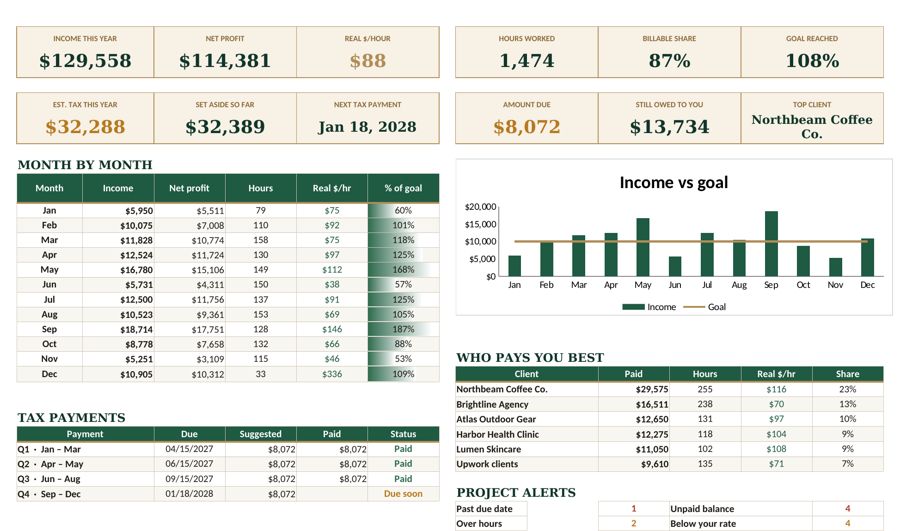
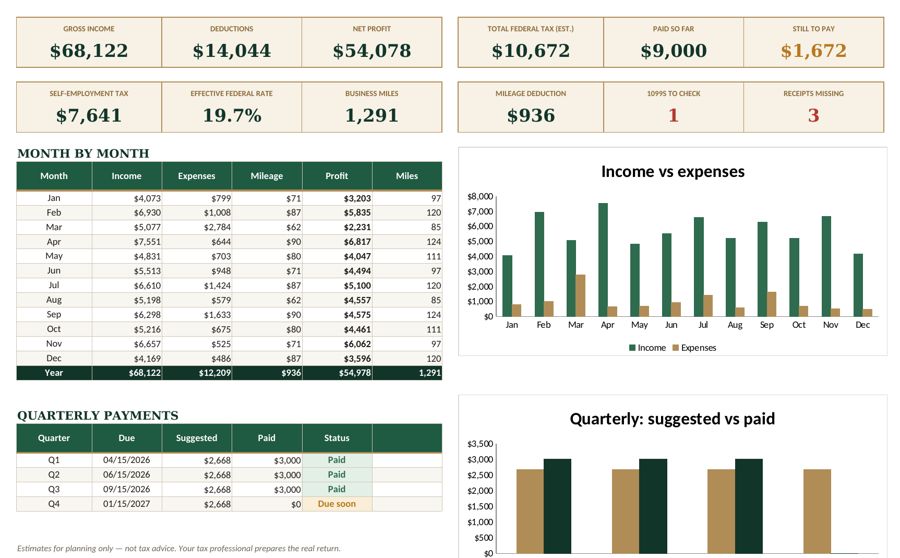
Add a simple flag column — for example, =IF(AND(F2>=2000, C2<>"Corporation"),"1099 needed","") where column F is the year-to-date total and column C is entity type — and the January question answers itself. If you’d rather not build one from scratch, Fyscale’s Freelancer Finance and Tax templates give you a ready-made place to log payments and income. As always, a spreadsheet organizes your records; it doesn’t replace advice from a tax professional for your situation.
Bottom line
- For payments made in 2026, the 1099-NEC threshold is $2,000 per payee (up from $600).
- Forms filed in early 2026 for 2025 payments still use $600.
- Payments to corporations are generally exempt, except attorneys.
- Card and payment-app payments are reported on Form 1099-K, not 1099-NEC.
- Collect a W-9 before the first payment and file by January 31.
- Recipients: all income is taxable, with or without a form — track it yourself.
Tools mentioned in this article
Keep reading


This article is general information for US small businesses, not tax, legal or accounting advice. Check current IRS guidance or ask a qualified professional about your situation.