

How to Pay Yourself as a Sole Proprietor (and How Often)

It’s payday for everyone except you. Your clients’ teams got paid, your contractor got paid, the software companies got paid. You glance at the business account, move a random amount to personal, and hope it doesn’t leave you short next week.
If you’ve ever wondered how to pay yourself as a sole proprietor, the honest answer is: on purpose, on a schedule, and from a system instead of a feeling. As a sole proprietor you don’t get a W-2 salary from your own business; you transfer money from the business to yourself. The real questions are how much and how often. This guide is for freelancers, makers and solo owners with income that moves around. You’ll learn a simple percent system, how to build a buffer that smooths slow months, and how to give yourself a steady paycheck. Paying yourself well isn’t selfish; it’s what keeps the business sustainable.

Why paying yourself on a system matters more than you think
When you pay yourself “whatever’s left,” three things happen. You undercharge, because you never see what the business truly owes you. You overspend in good months and panic in slow ones. And tax time surprises you, because profit and paychecks got mixed together.
A system fixes all three. It turns irregular income into a predictable personal paycheck, and it shows you, in plain numbers, whether your prices actually support the life you want.
Key idea: A steady paycheck doesn’t need steady income; it needs a buffer and a rule you follow every time.
One tax point to keep in mind: as a sole proprietor, you’re generally taxed on your business profit, not on the amount you transfer to yourself. Taking less money out doesn’t lower your tax bill, and taking more doesn’t raise it. The IRS self-employed individuals tax center explains the basics. This is general information, not tax advice — confirm with a tax professional.
How to pay yourself as a sole proprietor step by step
Step 1: Separate the money
Before any percentages work, you need a business account that only holds business money. If your income and personal spending share one account, start with how to separate business and personal finances.
Step 2: Find your average monthly revenue and expenses
Look at the last 6 months (or 3 if you’re new). Add up revenue and business expenses, then divide by the number of months. Averages matter because one great or terrible month will mislead you.
Step 3: Set your percentages
Split every deposit into four buckets. Here’s a practical starting mix for a service business or low-inventory shop:
| Bucket | Share of each deposit | What it’s for |
|---|---|---|
| Business expenses | 25% | Software, supplies, fees, ads, materials |
| Taxes | 20% | Income tax and self-employment tax set-aside |
| Owner pay | 45% | Your personal paycheck |
| Buffer and growth | 10% | Emergencies, equipment, slow-season cushion |
Adjust the expense share to match your real numbers: a product business with higher material costs might need 40% or more. For the tax share, our guide on how much to set aside for taxes as a freelancer helps you pick a percentage that fits your situation. Remember that self-employment tax alone is 15.3% on 92.35% of net earnings, before income tax.
Step 4: Choose a fixed paycheck and schedule
Here’s the secret to steady pay: the 45% goes into an owner pay holding pot (a separate savings account works well), and you pay yourself a fixed amount from it on a fixed schedule. Twice a month, such as the 1st and 15th, feels most like a regular job. Monthly works too.
Set your fixed paycheck at your average monthly owner pay share. Before you start, fill the pot with one month of pay so slow months don’t empty it.
Step 5: Review every quarter
At the end of each quarter, check the pot. If it holds more than two months of pay, take the extra as a bonus or give yourself a raise. If it keeps shrinking, lower the paycheck or, better, look at your pricing.

Example: a steady paycheck from uneven months
Take Alex, a typical freelance photographer. Over the last six months Alex earned $36,000 in revenue, or $6,000 a month on average. Using the percent system on that average:
- Business expenses (25%): $1,500
- Taxes (20%): $1,200
- Owner pay (45%): $2,700
- Buffer and growth (10%): $600
Alex sets a fixed paycheck of $2,700 a month, paid as $1,350 on the 1st and $1,350 on the 15th, and starts the owner pay pot with $2,700. Here’s the next quarter:
| Month | Revenue | 45% into pay pot | Paycheck out | Pot balance |
|---|---|---|---|---|
| Start | $2,700 | |||
| January | $7,500 | $3,375 | $2,700 | $3,375 |
| February | $4,000 | $1,800 | $2,700 | $2,475 |
| March | $6,500 | $2,925 | $2,700 | $2,700 |
February was slow, but Alex still got the same $2,700, because January’s extra $675 sat in the pot. By the end of March the pot is back at $2,700. Same paycheck, three very different months, zero panic. Meanwhile the 10% buffer grew by $750 + $400 + $650 = $1,800 for emergencies and equipment.
Common mistakes to avoid
- Paying yourself last, with whatever’s left. Owner pay is a real cost of running the business; give it a percentage.
- Spending the tax money. If tax set-asides live in the same account as everything else, they disappear. Move them on the day money arrives, and pay quarterly estimated taxes from that account.
- Setting the paycheck from your best month. Use a 3- to 6-month average, then let the pot handle the swings.
- Never giving yourself a raise. Review quarterly. If the pot keeps growing, you’ve earned it.
- Confusing cash with profit. A big deposit might be a deposit for work you haven’t done yet. Our guide to cash flow vs profit explains why that matters.
Your 15-minute action plan
- [ ] Open (or label) a separate savings account as your owner pay pot
- [ ] Add up the last 6 months of revenue and business expenses
- [ ] Pick your four percentages and write them down
- [ ] Calculate your fixed paycheck from the average
- [ ] Set two recurring transfers, for example the 1st and the 15th
- [ ] Put a quarterly pay review on your calendar
FAQ
How much should I pay myself as a sole proprietor?
Start from your average monthly profit, set aside taxes and a small buffer, and pay yourself a fixed share of the rest. Many solo owners begin with a percentage of every deposit, such as 40–50% for owner pay, then adjust based on their actual expenses and tax needs.
How often should a sole proprietor pay themselves?
A fixed schedule works best: twice a month or monthly. Regular, predictable transfers make personal budgeting easier and stop you from pulling money whenever the account looks full.
Do I pay taxes on what I pay myself as a sole proprietor?
Generally, you’re taxed on the business’s profit, not on the transfers you make to yourself. That’s why setting aside a tax percentage from every deposit, and making estimated payments, is so important.
The bottom line
You started your business to build a better life, so make sure the business pays you like it means it. Pick four percentages, set one fixed paycheck and let a small buffer carry you through the slow months. Your first transfer can happen this week, and it will feel very different when it’s planned.
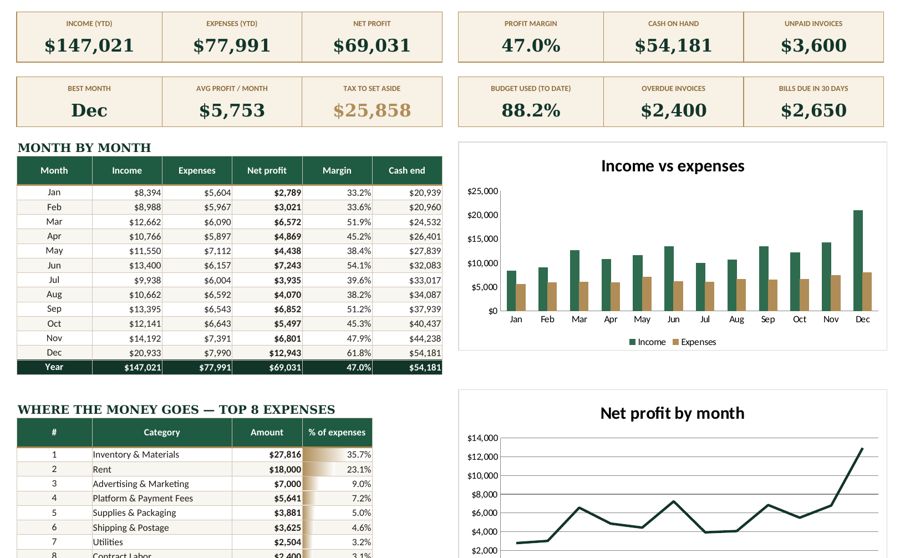
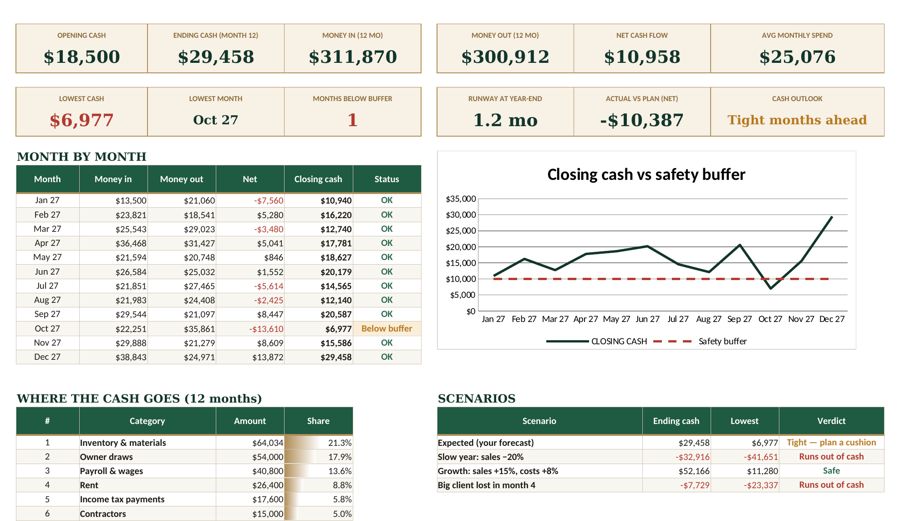
To see your average revenue, expenses and owner pay side by side, the Fyscale bookkeeping and cash flow templates track deposits by month and show how much you can safely pay yourself.
Tools mentioned in this article
Keep reading


This article is general information for US small businesses, not tax, legal or accounting advice. Check current IRS guidance or ask a qualified professional about your situation.