

Cash vs Accrual Accounting for Small Businesses
The choice between cash vs accrual accounting decides when a sale or a bill shows up in your books. It sounds like a technicality, but it changes what your monthly profit looks like, how you read your numbers, and how you report income on your tax return. Most freelancers and small shops start on the cash method without ever deciding to. This guide explains both methods in plain English, walks through one month recorded both ways, and helps you decide which one fits your business.
The core difference in one sentence
- Cash method: you record income when money arrives and expenses when money leaves.
- Accrual method: you record income when you earn it (usually when you deliver work or ship an order) and expenses when you incur them (when you receive the bill), no matter when cash moves.
Everything else follows from that timing difference.
How the cash method works
Under the cash method, your books mirror your bank account. A client pays you on January 10 for work done in December, so that income belongs to January. You pay a contractor’s December invoice on January 5, so that expense belongs to January too.
Why people like it:
- It’s simple. If you can read a bank statement, you can keep cash books.
- Your profit roughly matches the money you actually have.
- It’s easy to reconcile against your bank, which we cover in our bank reconciliation guide.
Where it falls short:
- It can hide problems. A month with a big unpaid invoice looks weak even if you did great work; a month where a client paid three old invoices looks amazing.
- It doesn’t show what you owe or what you’re owed unless you track those separately.
How the accrual method works
Under accrual, your books show the economic activity of the period. You finished and invoiced a $6,000 project in December, so December gets the $6,000 of revenue, even though the client pays in January. Until they pay, that $6,000 sits in accounts receivable. Bills you’ve received but not paid sit in accounts payable.
Why people like it:
- It matches revenue to the costs of earning it, so monthly profit is more meaningful.
- It shows what customers owe you and what you owe suppliers at any moment.
- Lenders, investors and buyers of a business generally expect accrual statements.
Where it falls short:
- More bookkeeping: you track receivables, payables and sometimes prepaid expenses.
- You can show a profit while your bank account is empty. That gap is exactly why we wrote cash flow vs profit.
Worked example: one month, two methods
Maya runs a one-person design studio. Here’s what happened in December:
- She finished a branding project and invoiced $6,000 on December 20. The client pays on January 10.
- A November client paid her $2,500 on December 4.
- A freelance illustrator sent her an $800 bill on December 15 for December work. Maya pays it on January 5.
- She paid $300 for her co-working desk on December 1.
| Item | Cash method (December) | Accrual method (December) |
|---|---|---|
| December project invoice ($6,000) | $0 (cash arrives in January) | $6,000 |
| November invoice paid in December ($2,500) | $2,500 | $0 (it was November revenue) |
| Illustrator bill ($800) | $0 (paid in January) | $800 |
| Co-working desk ($300) | $300 | $300 |
| Income | $2,500 | $6,000 |
| Expenses | $300 | $1,100 |
| Profit | $2,200 | $4,900 |
Same business, same month, and the profit differs by $2,700. Neither number is “wrong.” Cash tells Maya what happened to her bank balance; accrual tells her how much value her studio produced in December. In January, the picture flips: the cash method will show the $6,000 and the $800 bill, while accrual January will show only January’s work.
Which method can you use for taxes?
For federal taxes, many small businesses without inventory, and many with average annual gross receipts below an IRS threshold that is adjusted each year for inflation, are allowed to use the cash method. Some businesses must use accrual, and there are special rules for inventory. Once you pick a method on your first return, switching later generally requires IRS approval (usually by filing Form 3115).
The IRS explains the rules in Publication 538, Accounting Periods and Methods, and its recordkeeping guidance covers the records you need under either method. Because the details depend on your situation, confirm your method with a tax professional before your first return or before changing it.
A useful point: your tax method and your management view don’t have to feel identical. Plenty of cash-basis sole proprietors keep a simple list of open invoices and unpaid bills on the side, which gives them an accrual-style view without changing how they file.
How to choose: a quick decision guide
| Your situation | Usually a good fit |
|---|---|
| Solo freelancer, clients pay within a few weeks, no inventory | Cash method |
| You send invoices with Net 30 or longer terms and big projects | Cash for taxes plus an open-invoice list, or accrual |
| You hold inventory or sell physical products at volume | Ask a tax pro; inventory rules apply |
| You plan to borrow, raise money or sell the business | Accrual statements |
| You want monthly profit that reflects work actually done | Accrual (or a hybrid management view) |
If you offer payment terms, our guide to Net 30 payment terms shows how quickly receivables can pile up and why tracking them matters even on the cash method.
Setting up your books for either method
If you use the cash method:
- Record every deposit and payment from your business account, with a date, category and note.
- Reconcile to your bank statement each month.
- Keep a separate “open invoices” list so you always know who owes you.
If you use the accrual method:
- Record a sale when you invoice or ship, with a matching receivable.
- Record bills when they arrive, with a matching payable.
- When cash moves, clear the receivable or payable instead of booking new income or expense.
- Review an aging list of receivables and payables every month.
Whichever you choose, apply it consistently. Switching back and forth makes month-to-month comparisons meaningless, and that is how double-counted income happens.
Bottom line
- Cash method = record money when it moves. Simple and close to your bank balance.
- Accrual method = record income when earned and expenses when incurred. Better for understanding real performance.
- The same month can show very different profit under each method, so know which one your numbers use before you act on them.
- Your tax accounting method is a formal choice; check the IRS rules and talk to a tax professional before choosing or changing.
- Even on the cash method, keep a list of open invoices and unpaid bills.
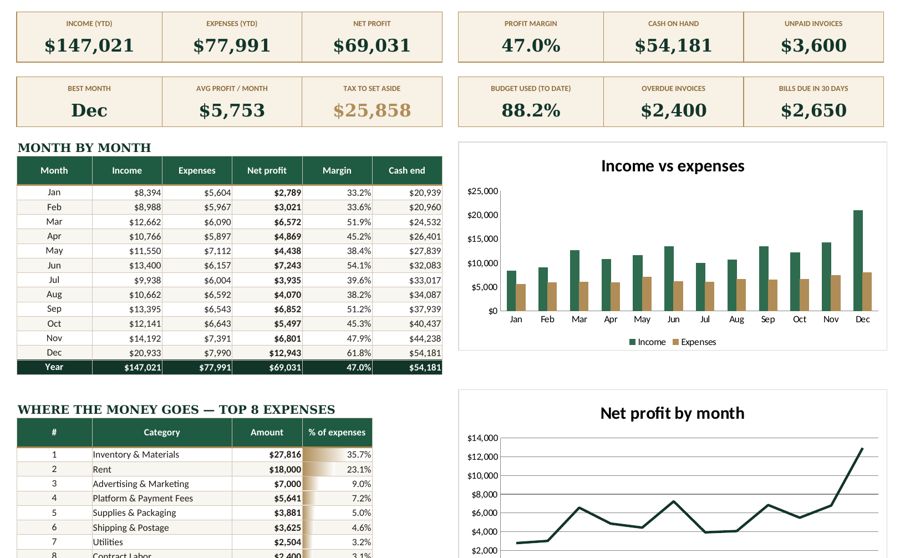
If you want a structured place to log income, expenses and open invoices month by month, the Fyscale bookkeeping template is set up for exactly that, and it works with whichever method you and your tax professional settle on. For the next step, learn how to read a profit and loss statement so the numbers you record turn into decisions.
Tools mentioned in this article
Keep reading
This article is general information for US small businesses, not tax, legal or accounting advice. Check current IRS guidance or ask a qualified professional about your situation.