

Holiday Inventory Planning for Etsy Sellers

For many handmade shops, November and December bring a large share of the year’s orders, and the shops that do best are rarely the ones with the best products. They are the ones that still have stock in the second week of December. Holiday inventory planning for Etsy sellers comes down to four numbers: how many you expect to sell, how much buffer you need, how many you can make per week, and how much cash the materials will tie up. This guide shows you how to work out each one, with a full example you can copy into a spreadsheet tonight.
Start with last year’s sales, not a feeling
Pull your orders for November 1 through December 31 of last year and count units sold per product. Your Etsy order export or your inventory spreadsheet is the source. If a product sold out last year, note the date; the true demand was higher than what you recorded.
If you are new or a product is new, use a recent normal month and a conservative multiplier, and plan to make that item to order rather than gambling on stock.
Adjust for this year
Ask three questions for each product:
- Is the shop growing? If your September and October sales are up compared with last year, a similar uplift is a reasonable starting assumption.
- Did anything change? New photos, a price change, better reviews or a new listing can all move demand. Be honest in both directions.
- Is it a gift item? Products that work as gifts tend to see a bigger holiday lift than practical, everyday items.
Write the assumption down next to the number. If you are wrong, you want to know which assumption was wrong.
Add safety stock
Forecasts miss. Safety stock is the extra you hold so a good week does not turn into “sold out.” A practical range for small makers is 10–20% above forecast for proven bestsellers and 0–10% for slower or riskier items. Holding too much of a seasonal product is a real cost: leftover holiday-themed items may sit until next year.
Match the plan to your production capacity
This is where most holiday plans break. Count your realistic weekly output, including packing, photography for new listings and customer messages, not your best-ever week. Then divide units to make by weekly capacity. If the answer pushes finished stock past early December, you need to start earlier, simplify the range, or switch some items to made-to-order with a longer processing time.
Also check lead times on materials. If your wax, fabric or packaging takes three weeks to arrive, the order goes in before production week one, not during it.
A worked example: a small candle shop
Juniper Candle Co. sells three products and plans holiday stock on October 25.
| Product | Last Nov–Dec units | Growth assumption | Forecast | Safety stock | Target | In stock now | Units to make |
|---|---|---|---|---|---|---|---|
| 8 oz soy candle | 180 | +15% | 207 | 15% → 31 | 238 | 40 | 198 |
| Wax melts | 90 | +10% | 99 | 10% → 10 | 109 | 25 | 84 |
| Gift set (new) | none | conservative | 40 | none | 40 | 0 | 40 |
| Total | 322 |
How the numbers work, for the candle: 180 × 1.15 = 207 forecast. Safety stock 207 × 15% = 31.05, rounded to 31. Target 207 + 31 = 238. Already in stock 40, so make 238 − 40 = 198. For the wax melts: 90 × 1.10 = 99; 99 × 10% = 9.9, rounded to 10; target 109; 109 − 25 = 84. Total to make: 198 + 84 + 40 = 322 units.
Production time. The owner can realistically finish 60 units a week. 322 ÷ 60 = 5.37, so about five and a half weeks. Starting October 26, most stock is finished in early December, which is tight for the late rush. The plan: make the soy candle first (198 ÷ 60 = 3.3 weeks, done by mid-November), then the wax melts, and list the new gift set as made-to-order so it does not compete for early production time.
Materials budget.
| Product | Units to make | Material cost per unit | Materials total |
|---|---|---|---|
| 8 oz soy candle | 198 | $6.50 | $1,287.00 |
| Wax melts | 84 | $2.10 | $176.40 |
| Gift set | 40 | $11.00 | $440.00 |
| Total | $1,903.40 |
Check: $1,287.00 + $176.40 + $440.00 = $1,903.40.
That $1,903.40 leaves the bank weeks before the sales come back in. Put it into a 13-week cash flow forecast so you can see whether the materials order, ad spend and payout timing fit together. Profit can look great on paper while the bank account is empty in mid-November; cash flow vs profit explains why.
Check your margins before you scale up
Making 322 units of something with a thin margin just means working harder for little. Before you commit, confirm each product’s price covers materials, your time, packaging, shipping and Etsy’s fees (a 6.5% transaction fee on the item price plus shipping, payment processing, and possibly Offsite Ads on attributed sales). Etsy fees explained and how to price handmade products walk through the math.
Holiday operations checklist
- Update processing times on listings to reflect your real workload, and make made-to-order items clearly labeled.
- Publish your last order dates. Check the current holiday shipping deadlines posted by USPS, UPS or FedEx, add your processing time, and put the result in your shop announcement and listings.
- Stock up on packaging (boxes, mailers, tissue, labels, tape). Running out of mailers stops shipping as surely as running out of product.
- Track stock weekly, ideally every few days in December. Compare actual sales with the forecast and shift production toward what is selling.
- Set a reorder point for your top seller: the stock level at which you start another batch, based on weekly sales and how long a batch takes.
- Plan for after December. Decide in advance what to do with leftovers: bundle them, discount them in January, or reposition non-seasonal items.
The bottom line
- Forecast from last year’s Nov–Dec units, adjusted for this year’s trend.
- Add 10–20% safety stock to proven bestsellers, little or none to risky items.
- Divide units to make by realistic weekly capacity and start early enough to finish by early December.
- Make bestsellers first; use made-to-order for new or uncertain products.
- Budget the materials cash and check it against your cash flow forecast.
- Review stock weekly and shift production toward what is actually selling.
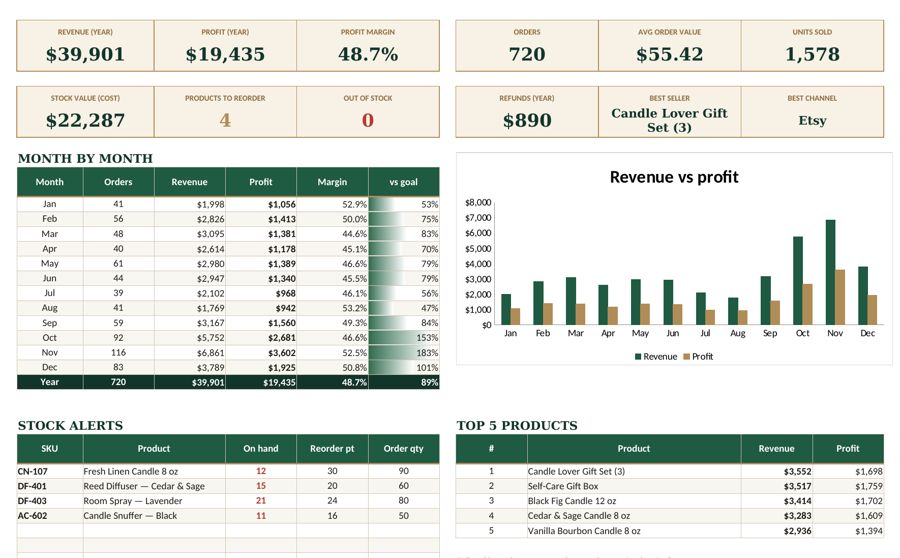
If you would rather not build these formulas yourself, the Fyscale Etsy seller inventory template tracks stock, units sold and reorder levels per product in one sheet, so the weekly check takes minutes.
Tools mentioned in this article
Keep reading



This article is general information for US small businesses, not tax, legal or accounting advice. Check current IRS guidance or ask a qualified professional about your situation.