

Economy Grows 3.4% in Third Quarter as September PCE Inflation Reaches 3.6%

The U.S. economy grew at a 3.4% annual rate in the third quarter of 2026, up from 2.2% in the second quarter, the Bureau of Economic Analysis (BEA) reported on Thursday, Oct. 29. A companion report released the same morning showed price pressure building as the quarter ended: the personal consumption expenditures (PCE) price index rose 0.5% in September and 3.6% from a year earlier, while inflation-adjusted consumer spending barely moved.
What happened
- Growth: Real GDP rose at a 3.4% annual rate from July through September (0.8% not annualized), according to BEA’s advance estimate. Higher investment, consumer spending and government spending drove the gain, partly offset by a drop in exports. Imports, which are subtracted from GDP, increased.
- Underlying demand: Real final sales to private domestic purchasers, a measure of consumer and business demand that leaves out trade, inventories and government, rose at a 4.9% rate, up from 4.6% in the second quarter.
- Nominal growth: GDP in current dollars increased at a 5.6% rate.
- September prices: The PCE price index, the Federal Reserve’s preferred inflation gauge, rose 0.5% for the month and 3.6% over 12 months. Excluding food and energy, core PCE rose 0.3% for the month and 3.1% from a year earlier.
- September income and spending: Personal income and disposable income each rose 0.2%. Consumer spending rose 0.5% in dollar terms, but after adjusting for prices it was essentially flat, up less than 0.1%. The personal saving rate was 3.8%.
The two reports point in slightly different directions. Across the full quarter, demand was strong. By September, households were spending more dollars to buy about the same amount of goods and services, and spending was growing faster than income.
The data arrived one day after the Federal Reserve held its benchmark rate at a 3.75% to 4% range and said in its statement that inflation “remains elevated.”
Why it matters for small businesses
- Demand is still there, but more price-sensitive. Strong quarterly growth suggests customers kept buying through the summer. Flat real spending in September is an early sign that higher prices are starting to eat into volume. Heading into the holiday season, shoppers may compare prices more closely or trade down.
- Thinner household cushions. A 3.8% saving rate, with income growing more slowly than spending, leaves less room for big-ticket or impulse purchases if prices keep rising.
- Borrowing costs are unlikely to fall soon. With PCE inflation at 3.6%, well above the Fed’s 2% goal, and growth running strong, these reports give little support for lower rates. That matters for credit cards, lines of credit and other variable-rate loans.
- Supplier costs. If your vendors face the same inflation, expect more price-increase notices for materials, packaging and shipping.
What you can do now
- Recheck margins at today’s costs. Update material, packaging and shipping costs, then recalculate gross margin for each product. Our guide to gross margin vs markup walks through the math.
- Price for value, not only cost. If you raise prices, consider bundles or tiered options so budget-minded buyers still have a lower-priced way in.
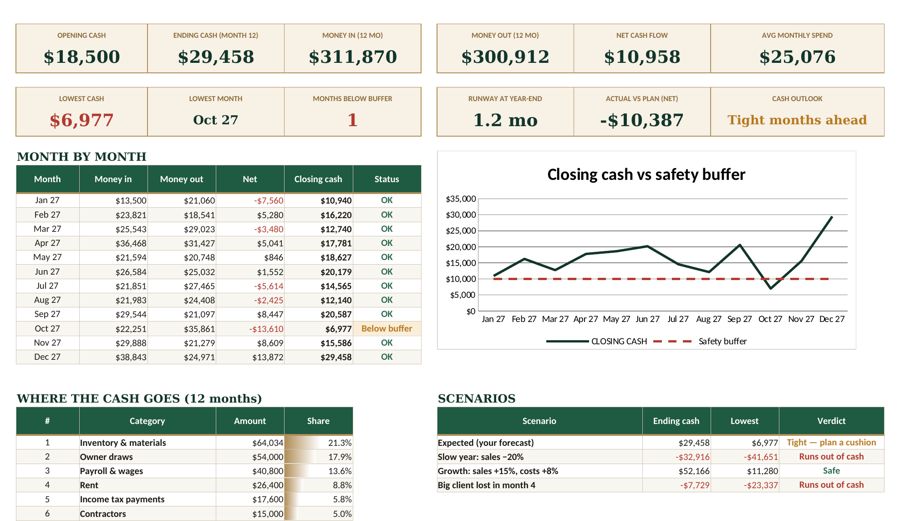
- Run a short cash forecast. A 13-week cash flow forecast shows whether holiday inventory purchases and a slower January fit together.
- Review variable-rate debt. List balances tied to the prime rate and estimate the payment if rates rise another quarter point.
- Track volume, not just revenue. Watch units sold and order count alongside sales dollars. Higher revenue on fewer orders can be an early sign of price resistance.
This brief is general information, not financial, tax or investment advice. Figures are from BEA’s advance estimate and may be revised.
Sources
Tools mentioned in this article
More news



Fyscale news briefs summarize public information from the sources listed above; read our editorial policy. This article is general information for US small businesses, not tax, legal or accounting advice. Check current IRS guidance or ask a qualified professional about your situation.