

A Weekly Planning Routine for Solo Business Owners

It’s Monday at 9 a.m. You open your laptop, see 43 unread emails, three orders to ship and a client asking for “a quick change,” and by lunch you’ve been busy for hours without touching the one task that would actually grow your business.
A weekly planning routine is the fix. It’s a short, repeatable session, about 45 minutes once a week plus five minutes each morning, where you look back, check your money, choose what matters, and give it a place on your calendar. It’s designed for solo business owners, freelancers and makers who wear every hat and don’t have a manager telling them what comes first.
This isn’t about squeezing more into your week. It’s about deciding what your week is for, before everyone else decides for you.

Why a weekly planning routine matters more than you think
A daily to-do list is too short-sighted. A yearly goal is too far away. The week is the sweet spot: long enough to finish something meaningful, short enough to adjust when life happens.
When you run your business solo, there’s no meeting that forces you to step back. Without a routine, the urgent stuff (messages, orders, small fires) always wins over the important stuff (a new product, a pricing review, your marketing). A weekly session gives the important stuff a protected slot.
It also connects your calendar to your money. When you check cash, invoices and deadlines every week, nothing sneaks up on you in a bad way.
Key idea: If you don’t plan your week, your inbox will plan it for you.
How to build a weekly planning routine step by step
Pick one fixed time. Friday afternoon works well because the week is fresh in your mind, but Sunday evening or Monday morning is fine. Keep it the same each week.
- Review last week (10 minutes). Open last week’s plan. What got done? What slipped, and why? Write down one win, even a small one. Wins keep you going.
- Check your numbers (5 minutes). Look at your bank balance, sales or invoices sent, payments due to you and bills due from you. If you keep a 13-week cash flow forecast, update this week’s row.
- Brain dump (5 minutes). List everything on your mind: client tasks, orders, ideas, errands, admin. Get it out of your head and onto one page.
- Choose three outcomes (5 minutes). From that list, pick the three results that would make the week a success. Not “work on website” but “publish new About page.” The Eisenhower matrix helps you sort urgent from important.
- Time-block your calendar (10 minutes). Give each outcome a real slot, ideally in your best-energy hours. Then add recurring blocks for orders, client work and messages.
- Schedule one money hour. Put bookkeeping, invoicing and receipt filing in a single weekly block. Our small business bookkeeping guide shows what to cover.
- Leave a buffer. Keep about 10% of your working hours unplanned. Something always comes up.
- Do a 5-minute daily check. Each morning, glance at the week’s plan, confirm today’s top task and move anything that has to shift.

Example: a maker’s 35-hour week
Take Leo, a woodworker who sells cutting boards online and at a weekend market, a typical example. He has about 35 working hours a week. After his Friday session, his plan looks like this:
| Block | Hours | Share of week | What goes in it |
|---|---|---|---|
| Making and product work | 18 | 51.4% | Building boards, finishing, photos for new listings |
| Orders and customers | 6 | 17.1% | Packing, shipping, answering messages |
| Marketing | 5 | 14.3% | Two Pinterest pins, one email, market prep |
| Admin and money | 3 | 8.6% | Bookkeeping, invoices, the weekly review itself |
| Buffer | 3 | 8.6% | Surprise repairs, late supplies, a slow day |
| Total | 35 | 100% |
His three outcomes this week: finish 12 holiday boards, list the new walnut design, and send his wholesale price sheet to one local shop.
Notice the shape. More than half of Leo’s time goes to the work that earns money, but admin and marketing have their own blocks instead of spilling into evenings. And the buffer means a late lumber delivery doesn’t wreck the whole plan.
You’ll adjust the split to your business. A freelance designer might have 20 hours of client work and 5 of sales. The principle stays the same: every type of work gets a home.
Common mistakes to avoid
- Planning a perfect week. If your plan only works when nothing goes wrong, it won’t work. Plan for about 90% of your hours.
- Picking ten priorities. Three outcomes is plenty. More than that and none of them get your best energy.
- Skipping the review. Looking back is where you learn. Without it, you’ll repeat the same overloaded week.
- Ignoring money in your plan. A weekly look at cash and invoices takes five minutes and prevents most nasty surprises.
- Treating the plan as fixed. It’s a guide, not a contract. Move blocks when you need to, just do it on purpose.
- Planning in your head. Write it down, on paper or in a spreadsheet. A plan you can see is a plan you’ll follow.
Key idea: Three clear outcomes beat a list of twenty good intentions.
Your 15-minute action plan
Start this week, even if it’s mid-week:
- [ ] Choose your weekly planning time and add it to your calendar as a repeating event.
- [ ] Write down one win from the last seven days.
- [ ] Check your bank balance and list any payments due in or out this week.
- [ ] Brain dump every task on your mind onto one page.
- [ ] Circle three outcomes that would make this week a success.
- [ ] Block time on your calendar for the first of those outcomes.
FAQ
What is the best day for weekly planning?
The best day is the one you’ll stick with. Friday afternoon is popular because last week is fresh and you start Monday with a plan. Sunday evening or early Monday works too if Fridays are hectic.
How long should weekly planning take?
About 30–45 minutes once you’ve done it a few times. The first sessions may take longer while you set up your template. Add a five-minute daily check to keep the plan on track.
What should a weekly plan include for a small business?
A short review of last week, a quick money check, your three main outcomes, time blocks for recurring work such as orders and admin, and some buffer time. Keep it simple enough to use every week.
Should I use paper or a spreadsheet for weekly planning?
Either works. Paper is quick and satisfying. A spreadsheet makes it easier to see past weeks, track hours and connect your plan to tasks and deadlines.
The bottom line
A weekly planning routine is a small habit with a big payoff. In under an hour a week, you trade reacting for choosing. You’ll finish the work that moves your business forward, and you’ll end more weeks feeling proud instead of drained.
Start with one session this week. Keep it short, keep it honest, and keep three outcomes at the center. If tax deadlines are part of your week, the IRS estimated taxes page is a good one to bookmark.
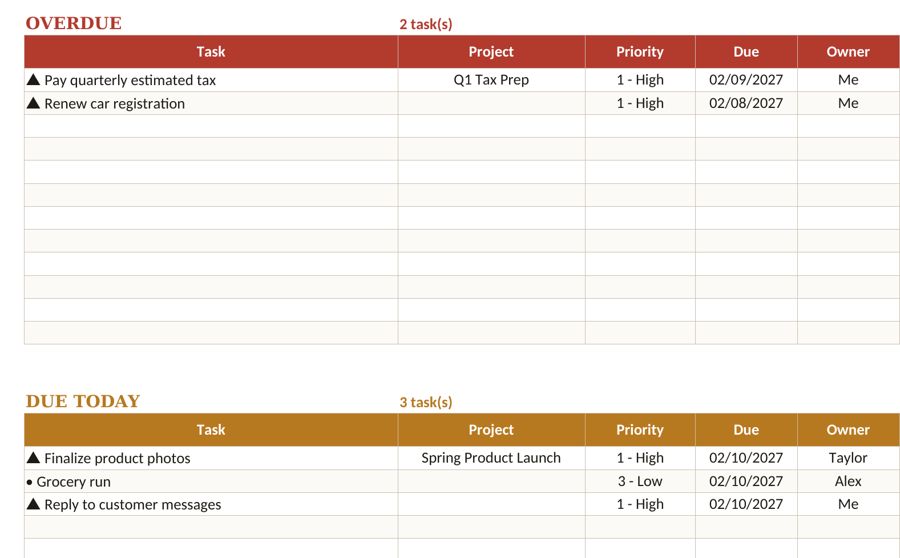
If you’d like a ready-made home for your plan, the Fyscale Task & To-Do Tracker includes a weekly planner and priority matrix you can fill in as you go.
Tools mentioned in this article
Keep reading



This article is general information for US small businesses, not tax, legal or accounting advice. Check current IRS guidance or ask a qualified professional about your situation.