

How to Create a Monthly Budget for Your Small Business
A small business budget is not about restricting yourself. It is a plan for where each dollar goes before the month starts, so taxes, bills and your own pay are covered on purpose instead of by luck. If you have been running your business from your bank balance, a simple monthly budget is the single biggest upgrade you can make. Here is how to build one in about an hour, with a worked example you can copy.
Why a monthly small business budget matters
Without a budget, most owners make decisions by glancing at the bank account. The problem is that the balance mixes money that is already spoken for (sales tax, income tax, next week’s bills) with money that is truly available. A budget separates the two.
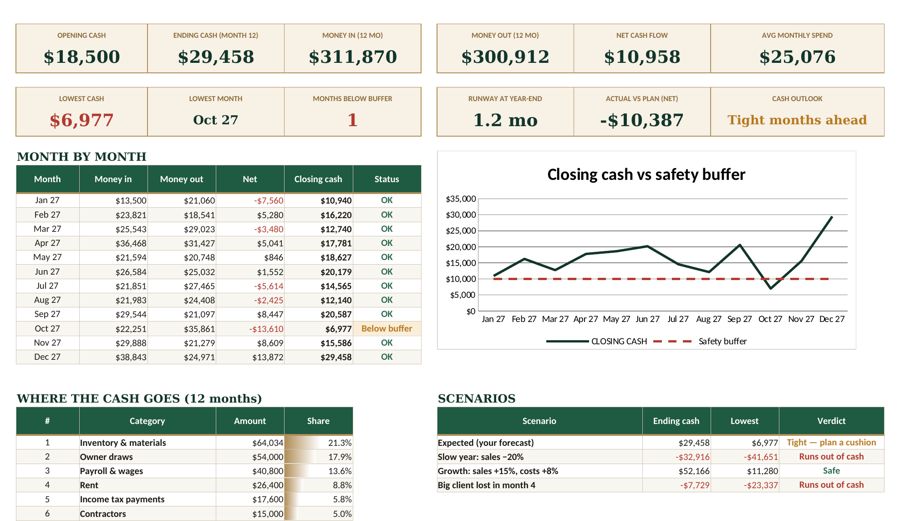
A budget also gives you a yardstick. At the end of each month you can compare plan to reality, spot leaks early, and decide what to change. It works hand in hand with a short-term cash forecast: the budget says what should happen over the month, and a 13-week cash flow forecast shows when cash actually moves.
Step 1: Set a realistic revenue baseline
Do not budget from your best month. Use the average of your last six months, then trim it for safety.
Example: Lena runs a small printables and custom stationery shop. Her last six months of revenue were:
| Month | Revenue |
|---|---|
| April | $7,800 |
| May | $8,400 |
| June | $6,900 |
| July | $9,100 |
| August | $8,200 |
| September | $7,600 |
| Total | $48,000 |
Six-month average: $48,000 ÷ 6 = $8,000. She budgets at 90% of that, $7,200, so a slower month does not break the plan. If your business is seasonal, use the same month from last year as a cross-check.
Step 2: List your fixed and variable costs
Pull real numbers from your bank statements and books, not memory. Group them into categories you already use; our list of small business expense categories is a good starting point.
- Variable costs rise and fall with sales: materials, packaging, marketplace and payment fees, shipping supplies.
- Fixed costs stay about the same: software, insurance, phone and internet, regular contractor help, marketing you commit to.
Express variable costs as a percentage of revenue, so the budget adjusts automatically if sales change.
Step 3: Build the budget
Here is Lena’s monthly budget on $7,200 of planned revenue:
| Line | Amount |
|---|---|
| Planned revenue | $7,200 |
| Materials and supplies (30% of revenue) | $2,160 |
| Marketplace and payment fees | $600 |
| Software and subscriptions | $180 |
| Marketing | $400 |
| Insurance | $120 |
| Phone and internet (business share) | $90 |
| Office and shipping supplies | $150 |
| Part-time contractor | $500 |
| Total expenses | $4,200 |
| Profit before tax | $3,000 |
Check: $2,160 + $600 + $180 + $400 + $120 + $90 + $150 + $500 = $4,200, and $7,200 − $4,200 = $3,000.
Step 4: Give your profit a job
Profit is not spending money until you decide what it is for. Lena splits her $3,000 like this:
| Use of profit | Share | Amount |
|---|---|---|
| Tax set-aside | 25% | $750 |
| Owner’s pay | — | $1,750 |
| Cash buffer savings | — | $500 |
| Total | $3,000 |
The tax percentage depends on your income, state and situation. Our guide on how much to set aside for taxes explains how to pick a number. Move the tax amount to a separate savings account each time you get paid, so it is never “accidentally” spent.
Paying yourself a fixed amount, rather than whatever is left, is what turns a busy business into a sustainable one. It also makes your personal budget far easier.
Step 5: Compare budget vs actual every month
At the start of each month, spend 20 minutes comparing last month’s plan to what really happened:
- Enter actual revenue and expenses next to each budget line.
- Calculate the difference in dollars and percent.
- Flag any line that is off by more than about 10%.
- Ask why: a one-time cost, a price increase, or a habit that needs to change?
- Adjust next month’s budget only if the change is likely to stick.
Remember that a budget built on profit can still feel tight if customers pay late or you buy inventory ahead of a busy season. That is the classic gap between cash flow and profit, and it is why the cash buffer line matters.
Common budgeting mistakes
- Budgeting from your best month. Use an average and a safety margin.
- Leaving out annual costs. Divide yearly renewals (domain, insurance, software) by 12 and include them monthly.
- No owner’s pay line. If you are not in the budget, you are paid last, or not at all.
- Ignoring taxes until April. Set them aside every month.
- Never revisiting the plan. A budget you do not compare against reality is just a wish list.
Bottom line
A good small business budget fits on one page:
- [ ] Revenue baseline from a six-month average, trimmed for safety
- [ ] Variable costs as a percentage of revenue
- [ ] Fixed costs from real statements, including annual costs divided by 12
- [ ] A tax set-aside, owner’s pay and a cash buffer line
- [ ] A monthly budget vs actual review
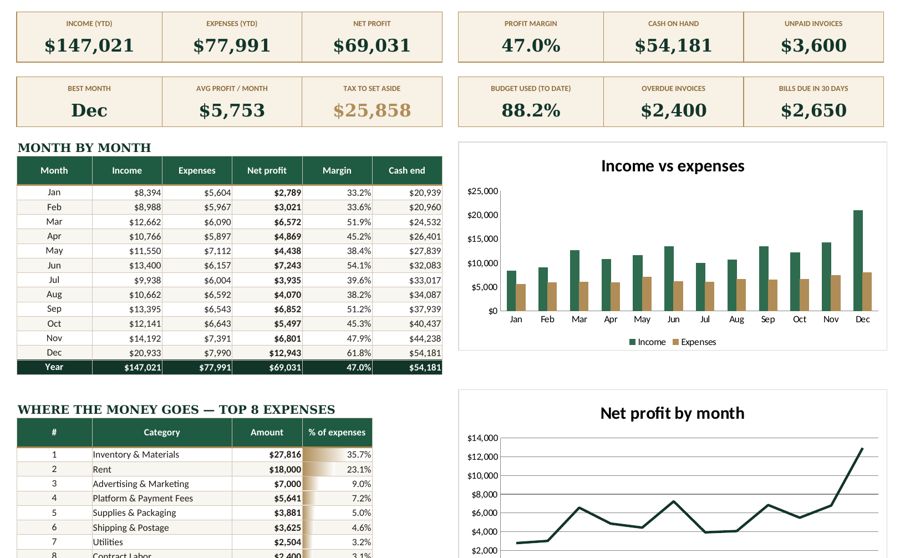
If you want the formulas done for you, the Fyscale bookkeeping and cash flow templates include a monthly budget tab that compares plan to actual automatically.
Tools mentioned in this article
Keep reading



This article is general information for US small businesses, not tax, legal or accounting advice. Check current IRS guidance or ask a qualified professional about your situation.