

Invoice vs Receipt vs Statement: What Is the Difference?
A client emails on a Friday afternoon: “Can you send me a receipt for the invoice?” Then, a week later, another asks for “a statement.” You pause. Aren’t those all the same piece of paper with a different name?
They’re not, and knowing the difference between an invoice vs receipt vs statement makes you look more professional and get paid with less back-and-forth. In short: an invoice asks for payment, a receipt confirms payment, and a statement summarizes everything on an account over a period. This guide is for freelancers, makers and small business owners who bill customers and want a simple, confident system. Once you see how the three fit together, your paperwork stops being a chore and starts working like a quiet assistant.

What is the difference between an invoice, a receipt and a statement?
| Invoice | Receipt | Statement | |
|---|---|---|---|
| Purpose | Requests payment | Confirms payment was received | Summarizes activity on an account |
| When you send it | After (or before) delivering work or goods | Right after payment | Monthly or on request |
| Covers | One sale or project | One payment | Many invoices and payments over a period |
| Key number | Amount due | Amount paid | Balance owed |
| Typical user | Freelancers, B2B sellers, service businesses | Every business, especially retail and online sellers | Businesses with repeat clients or open accounts |
A simple way to remember it: invoice = “please pay,” receipt = “thank you, paid,” statement = “here’s where we stand.”
Key idea: Each document answers one question for your customer, so send the one that answers the question they’re asking.
What each document should include
Invoice
An invoice is a request for payment with clear terms. Include:
- Your business name and contact details, plus the customer’s name
- A unique invoice number and the invoice date
- A description of the work or products, with quantities and prices
- Subtotal, any tax, and the total amount due
- Payment terms and due date (for example, Net 15 or Net 30)
- How to pay: accepted methods and any payment link
Our step-by-step guide on how to create an invoice walks through each field, and Net 30 payment terms explains what those terms really mean for your cash.
Receipt
A receipt is proof that money changed hands. Include:
- Your business name and the customer’s name
- A receipt number and the payment date
- What was paid for (or the invoice number it settles)
- The amount paid and the payment method
- Any balance still owing, if it was a partial payment
Many payment apps and marketplaces send receipts automatically. If you take cash, checks or bank transfers, you’ll usually need to send your own.
Statement
A statement is a running summary of one customer’s account. Include:
- The statement period (for example, October 1–31)
- Opening balance
- Each invoice issued and each payment received in the period
- Closing balance, with what’s current and what’s overdue
Statements are most useful when a client has several open invoices or pays in installments.
How to use all three step by step
- Agree on the price and terms before work starts, in writing.
- Send an invoice when the work is done, or a deposit invoice before you begin.
- Record the payment in your books the day it arrives.
- Send a receipt the same day, referencing the invoice number.
- Send a statement at month-end to any client with more than one open item.
- File copies of all three. The IRS recordkeeping guidance explains why supporting documents matter, and our guide on how long to keep business records covers retention.

Example: one project, all three documents
Take Maya, a typical freelance designer. She agrees to a $2,400 brand project with a 50% deposit, plus a $300 add-on later in the month.
| Date | Document | Detail | Amount |
|---|---|---|---|
| Oct 2 | Invoice #1041 | 50% deposit on brand project | $1,200 due |
| Oct 4 | Receipt #R-1041 | Deposit paid by bank transfer | $1,200 paid |
| Oct 20 | Invoice #1042 | Final 50% of brand project | $1,200 due |
| Oct 27 | Invoice #1043 | Social media template add-on | $300 due |
| Oct 31 | Statement | October summary for the client | $1,500 balance |
The October statement reads:
| Item | Charges | Payments | Balance |
|---|---|---|---|
| Opening balance (Oct 1) | $0 | ||
| Invoice #1041 | $1,200 | $1,200 | |
| Payment (Oct 4) | $1,200 | $0 | |
| Invoice #1042 | $1,200 | $1,200 | |
| Invoice #1043 | $300 | $1,500 | |
| Closing balance (Oct 31) | $2,700 | $1,200 | $1,500 |
Total charges of $2,700 minus $1,200 paid leaves $1,500 owed. When the client pays on November 5, Maya sends one receipt covering invoices #1042 and #1043. Her client sees exactly what’s open, and Maya doesn’t have to chase anything by memory.
Common mistakes to avoid
- Calling an invoice a receipt. A document that says “Receipt” before payment confuses your customer and your books.
- Reusing invoice numbers. Every invoice and receipt needs its own number so payments match cleanly.
- Skipping receipts for cash or transfers. Customers often need them for their own records, and they help you too.
- Forgetting the balance on partial payments. A receipt for $500 against a $1,500 invoice should show $1,000 still due.
- Never sending statements. For repeat clients, a monthly statement quietly reminds them of overdue items without a single awkward email.
Your 15-minute action plan
- [ ] Check that your invoice template has a number, date, terms and due date
- [ ] Create a simple receipt template that references the invoice number
- [ ] List every client with more than one open invoice
- [ ] Send each of them a statement for this month
- [ ] Set a monthly reminder to send statements on the last business day
- [ ] Make one folder for invoices, receipts and statements
FAQ
Is an invoice the same as a receipt?
No. An invoice asks for payment and shows the amount due, while a receipt confirms that payment was received. They often contain similar details, but they serve opposite moments in the sale.
Can an invoice be used as a receipt?
You can mark an invoice “Paid” with the payment date and method, and many small businesses do. A separate receipt is clearer, especially for partial payments or when a customer asks for proof of payment.
When should I send a statement instead of an invoice?
Send a statement when a customer has several invoices or payments in a period and needs a single summary of what’s open. It doesn’t replace invoices; it summarizes them.
The bottom line
Three documents, three jobs: ask, confirm, summarize. Set up one clean template for each and your customers will always know what they owe, what they’ve paid and where things stand. Start by checking your invoice template today; that single fix makes the other two easy.
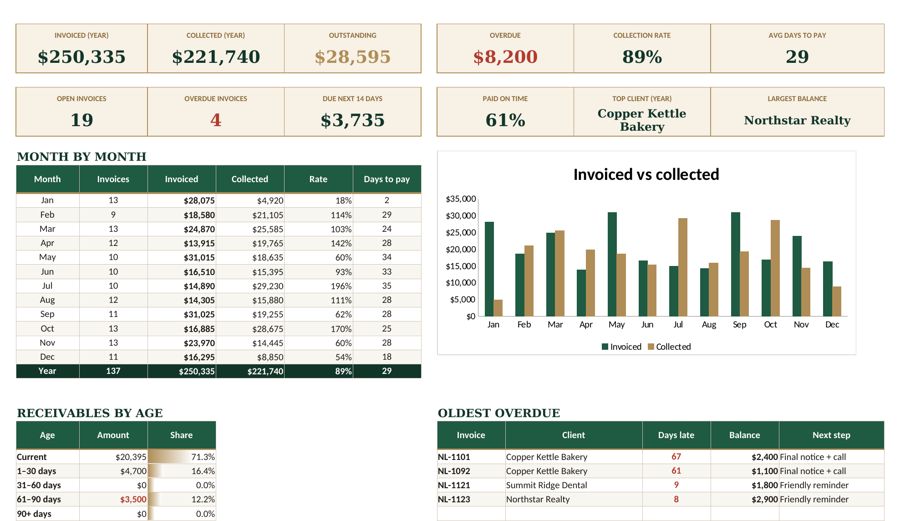
If you’d like all three ready to go, the Fyscale invoice template tracks invoice numbers, payments and balances in one place, so receipts and month-end statements take minutes instead of an afternoon.
Tools mentioned in this article
Keep reading
This article is general information for US small businesses, not tax, legal or accounting advice. Check current IRS guidance or ask a qualified professional about your situation.