

How to Handle Late Payments From Clients
Almost every freelancer and service business deals with a late payment from clients sooner or later. Usually it isn’t malice: an invoice landed in the wrong inbox, an approval stalled, or the client is juggling their own cash. But a few late invoices in the same month can squeeze your ability to pay rent, contractors and taxes. The good news is that most late payments are fixable with a clear process: tighten the terms before work starts, follow up on a schedule, escalate calmly, and keep your own cash flow protected while you wait.
Step 1: Prevent late payments before the work starts
The best collection work happens before you send the first invoice.
- Put payment terms in writing. Your proposal or contract should state the due date (for example, “due within 15 days of invoice”), accepted payment methods and any late fee.
- Collect a deposit. For projects, 30–50% up front is common in many creative and consulting fields. It filters out clients who weren’t ready to pay.
- Bill in milestones. A $9,000 project billed as three $3,000 milestones means you’re never more than $3,000 exposed.
- Find out who pays. Ask for the name and email of the person in accounts payable and whether they need a purchase order or vendor form.
- Make paying easy. Include a payment link, bank details and a clear invoice number. Our professional invoice checklist covers every field to include.
If you offer longer terms, read up on Net 30 payment terms first so you understand the cash flow trade-off.
Step 2: Follow up on a fixed schedule
Decide your follow-up cadence once, then run it every time without second-guessing. A schedule removes the awkwardness because it isn’t personal; it’s just your process.
| When | Action | Tone |
|---|---|---|
| 3 days before due date | Friendly reminder with invoice attached | Helpful |
| Due date | “Due today” note with payment link | Neutral |
| 3–5 days late | First overdue email; ask if anything is blocking payment | Polite, direct |
| 10–14 days late | Second email plus a phone call; mention late fee per terms | Firm |
| 21–30 days late | Formal notice: pause work, state the final date and next steps | Formal |
| 30+ days late | Final demand, then decide on collections, small claims or write-off | Business-only |
For ready-to-send wording at each stage, use our unpaid invoice follow-up email templates.
Step 3: Find out why the payment is late
A two-minute phone call often solves what three emails couldn’t. Common reasons and what to do:
- Invoice never reached the right person. Resend it to accounts payable and copy your contact.
- Missing paperwork. Some companies need a W-9, a vendor setup form or a PO number before they can pay. Send what’s needed the same day.
- Dispute about the work. Separate the disputed part from the rest. Ask them to pay the undisputed amount now while you sort out the remainder.
- Cash trouble on their side. Offer a short payment plan in writing (for example, two payments two weeks apart) rather than waiting indefinitely.
Step 4: Apply late fees fairly and legally
A late fee only works if it was agreed in advance. Adding a surprise fee to an overdue invoice tends to start an argument, not a payment.
- State the fee in your contract and on every invoice (for example, “1.5% per month on balances more than 30 days past due”).
- Rules on late fees and interest vary by state, so check what’s allowed where you and your client are, or ask a local attorney.
- Consider waiving the fee once in exchange for immediate payment. It’s a useful bargaining chip.
Example: You invoiced $4,000 with terms of 1.5% per month after 30 days. The client pays 60 days after the due date, which is two months late. The late fee is $4,000 × 1.5% × 2 = $120, for a total of $4,120. If you offer to waive the $120 for payment this week, many clients will take that deal.
Step 5: Protect your own cash flow while you wait
Late payments hurt most when you’re counting on that money for bills of your own.
- Pause new work for that client once an invoice is 21–30 days late, and say so politely in writing.
- Move your own payment dates where you can, such as asking a supplier for an extra week.
- Keep a cash buffer. Even one month of fixed costs in reserve turns a late invoice from a crisis into an annoyance.
- Forecast it. Put expected payments on a dated forecast so you can see a gap coming. A 13-week cash flow forecast is the simplest way to do this.
- Set aside tax money only from cash received if you’re on the cash method, so an unpaid invoice doesn’t throw off your quarterly estimates.
Step 6: Know your last-resort options
If a client is 45–60+ days late and has stopped responding, you have a few choices. Weigh the time and money each will cost against the amount owed.
- Final demand letter. A formal letter stating the amount, the original due date and a final deadline. Sometimes this alone works.
- Collections agency. They typically keep a percentage of what they recover, so you won’t get the full amount.
- Small claims court. Limits and filing fees vary by state; for many small invoices it’s a practical route without hiring a lawyer.
- Write it off. Sometimes the cleanest decision is to stop chasing, stop working with the client and move on. Ask your tax professional how an uncollectible invoice should be handled on your books and return; it depends on your accounting method.
A simple late-payment tracker
You can run this whole process from one table. Add a row for each open invoice:
| Invoice # | Client | Amount | Due date | Days late | Last contact | Next action | Next action date |
|---|---|---|---|---|---|---|---|
| 1042 | North Peak Co. | $4,000 | Oct 1 | 28 | Oct 24 call | Formal notice | Oct 30 |
| 1047 | Lane Studio | $1,250 | Oct 15 | 14 | Oct 27 email | Phone call | Oct 31 |
Sort by “days late” every Monday and work from the top down.
Bottom line checklist
- [ ] Payment terms, late fee and deposit are written into every contract
- [ ] Invoices go to the person who actually pays, with a payment link
- [ ] A fixed follow-up schedule runs for every overdue invoice
- [ ] You call before you escalate, and ask what’s blocking payment
- [ ] Late fees are agreed in advance and checked against local rules
- [ ] New work pauses once an invoice is about 30 days late
- [ ] Expected payments are on your cash flow forecast
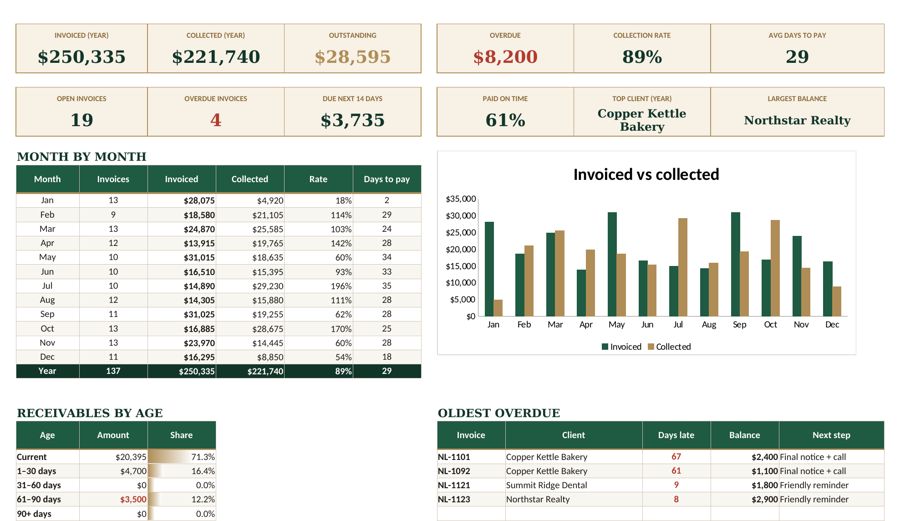
If you’d like a tidier way to send invoices and see who’s overdue at a glance, the Fyscale invoice template tracks invoice numbers, due dates and payment status in one place.
Tools mentioned in this article
Keep reading
This article is general information for US small businesses, not tax, legal or accounting advice. Check current IRS guidance or ask a qualified professional about your situation.