

How to Calculate the Break-Even Point for Your Small Business
Every small business owner eventually asks the same question: how much do I need to sell just to cover my costs? A break-even point calculation answers it with one number. Once you know that number, pricing, goal-setting and “should I hire help?” decisions get a lot less stressful. This guide walks through the formulas, a worked example for a product seller, and the common mistakes that make break-even numbers misleading.
What the break-even point means
Your break-even point is the level of sales where total revenue equals total costs. Below it, you lose money. Above it, every extra sale contributes to profit.
To calculate it, you need three inputs:
- Fixed costs: expenses that stay roughly the same each month no matter how much you sell. Think software subscriptions, rent, insurance, website hosting and your own base pay if you take one.
- Price per unit: what the customer pays for one item or one service package.
- Variable cost per unit: costs that rise with each sale, such as materials, packaging, marketplace fees and payment processing.
The break-even point calculation formulas
Contribution margin per unit = Price − Variable cost per unit
Break-even units = Fixed costs ÷ Contribution margin per unit
Contribution margin ratio = Contribution margin ÷ Price
Break-even revenue = Fixed costs ÷ Contribution margin ratio
Contribution margin is the part of each sale left over to pay fixed costs. Once fixed costs are covered, it becomes profit.
Worked example: a candle shop on Etsy
Maya sells hand-poured candles on Etsy for $40 each. Her monthly fixed costs are $3,000 (studio space, software, insurance, photography props and a modest owner’s pay).
Her variable costs per candle:
| Variable cost | Amount |
|---|---|
| Wax, wick, fragrance, jar | $9.20 |
| Box and packing materials | $2.75 |
| Etsy transaction fee (6.5% of $40) | $2.60 |
| Payment processing (3% of $40 + $0.25) | $1.45 |
| Total variable cost | $16.00 |
(For simplicity, this example assumes shipping is charged separately and covers itself. Remember that Etsy’s 6.5% transaction fee also applies to shipping you charge. Our guide to Etsy fees explained covers every fee in detail.)
Now the math:
- Contribution margin = $40 − $16 = $24 per candle
- Break-even units = $3,000 ÷ $24 = 125 candles a month
- Contribution margin ratio = $24 ÷ $40 = 60%
- Break-even revenue = $3,000 ÷ 0.60 = $5,000 a month
Check: 125 candles × $40 = $5,000. The two methods agree.
How to plan for a profit target
Break-even is the floor, not the goal. To find the sales you need for a specific profit, add the target to fixed costs:
Units for target profit = (Fixed costs + Target profit) ÷ Contribution margin
If Maya wants $1,800 of profit a month on top of her costs: ($3,000 + $1,800) ÷ $24 = 200 candles a month.
That number is far more useful than a vague “sell more.” She can now ask whether 200 a month is realistic with her current traffic and conversion rate, or whether she needs to change the price or costs.
How a price change moves the break-even point
Small price changes have a big effect because they flow straight into contribution margin.
Suppose Maya raises her price to $44. Her fees rise slightly too: the transaction fee becomes $2.86 and processing becomes $1.57 (3% of $44 + $0.25). Total variable cost is now $9.20 + $2.75 + $2.86 + $1.57 = $16.38.
- New contribution margin = $44 − $16.38 = $27.62
- New break-even = $3,000 ÷ $27.62 ≈ 108.6, so 109 candles a month
A 10% price increase cut the number of candles she needs to sell to break even by 16 (from 125 to 109). That is why pricing is often the fastest lever, and why it pays to price on purpose. Our guide on how to price handmade products goes deeper into setting a price that covers your time.
Break-even for service businesses
If you sell services, use hours or projects as the “unit.”
Example: a freelance designer has $2,400 of monthly fixed costs (software, equipment, insurance, health coverage and a base draw). She bills $85 an hour, and about $5 of each hour goes to variable costs such as payment processing and stock assets. Contribution margin is $80 an hour, so she breaks even at $2,400 ÷ $80 = 30 billable hours a month.
Billable hours are not the same as working hours, so compare that number honestly with how much client work you can actually book.
Common break-even mistakes
- Forgetting fees. Marketplace, payment and ad fees are variable costs. Leaving them out makes break-even look lower than it is.
- Ignoring your own pay. If you include no owner’s pay in fixed costs, “breaking even” can still mean working for free.
- Mixing products with very different margins. If you sell several products, either calculate break-even for each, or use a weighted average contribution margin based on your real sales mix.
- Treating it as permanent. Recalculate whenever prices, costs or your product mix change. Material and shipping costs rarely stay still for long.
- Using guessed numbers. Pull fixed costs from your actual books. Your profit and loss statement is the best source.
Bottom line
A break-even point calculation takes ten minutes and gives you a number you can plan around:
- [ ] List monthly fixed costs from your real books, including owner’s pay.
- [ ] Add up every variable cost per unit, including fees.
- [ ] Calculate contribution margin, break-even units and break-even revenue.
- [ ] Add a profit target and see what it takes to reach it.
- [ ] Test a few price changes before deciding.
- [ ] Recalculate every quarter, or whenever costs change.
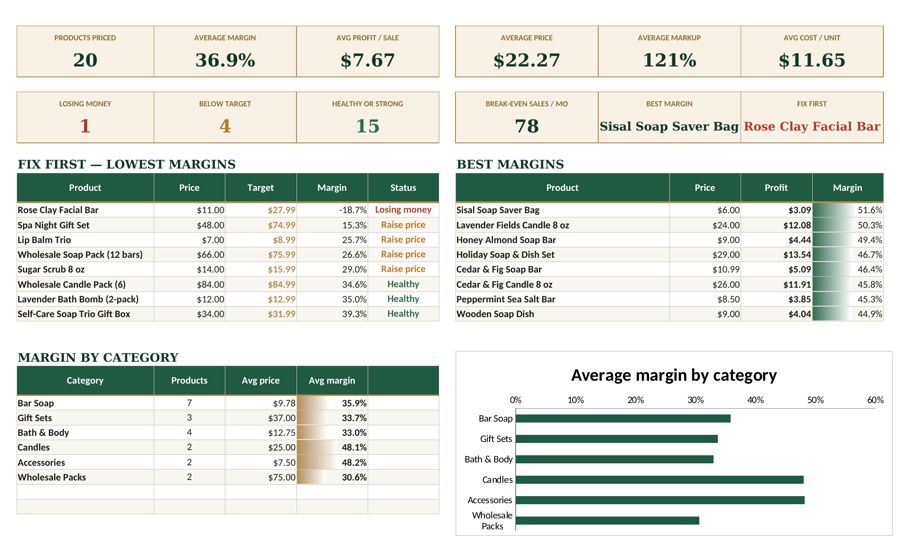
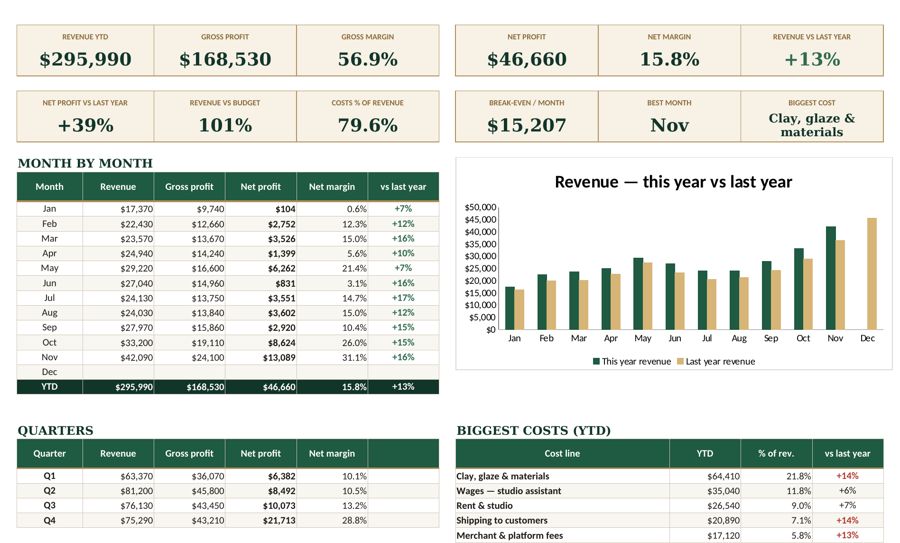
If you would rather not rebuild these formulas by hand, the Fyscale pricing calculator and profit and loss templates do the math for you as you update prices and costs.
Tools mentioned in this article
Keep reading



This article is general information for US small businesses, not tax, legal or accounting advice. Check current IRS guidance or ask a qualified professional about your situation.