

Black Friday and Cyber Monday Checklist for Etsy Sellers
Black Friday and Cyber Monday are the busiest shopping days of the year, and for many small shops they set the tone for the whole holiday season. This Black Friday checklist for Etsy sellers walks you through the four weeks before the big weekend: deciding a discount you can afford, preparing stock and listings, getting shipping right, and planning your marketing. In 2026, Thanksgiving falls on Thursday, November 26, so Black Friday is November 27, Small Business Saturday is November 28, and Cyber Monday is November 30.
Four weeks out: decide your offer with real numbers
Before you pick “25% off everything,” check what each sale actually leaves you after Etsy fees and costs. Etsy charges a 6.5% transaction fee on the item price plus shipping, US payment processing of 3% + $0.25, and a $0.20 listing fee each time an item sells and auto-renews. (Offsite Ads fees apply only to sales attributed to those ads.) Our full breakdown is in Etsy fees explained.
Worked example: a candle priced at $40 with free shipping. Materials and packaging cost $9 and the shipping label costs $5.
| Full price | 20% off | |
|---|---|---|
| Sale price | $40.00 | $32.00 |
| Transaction fee (6.5%) | $2.60 | $2.08 |
| Processing (3% + $0.25) | $1.45 | $1.21 |
| Listing renewal | $0.20 | $0.20 |
| Materials + packaging | $9.00 | $9.00 |
| Shipping label | $5.00 | $5.00 |
| Profit per sale | $21.75 | $14.51 |
A 20% discount cuts profit per candle by $7.24, which is about a third. To earn the same total profit, you’d need to sell about 1.5 times as many candles ($21.75 ÷ $14.51 ≈ 1.50). That’s often realistic over Black Friday weekend, but it’s worth knowing before you commit. (Figures exclude sales tax and any Offsite Ads fees.) If you want to understand the math behind discount sizes, read margin vs markup.
Offer ideas that protect margin:
- Discount a few hero items instead of the whole shop.
- Use a spend threshold (“15% off orders over $50”) to lift order value.
- Bundle two related items at a small discount rather than discounting each one.
- Offer a free gift or upgrade with a low cost to you instead of a price cut.
Three weeks out: stock and supplies
- [ ] Count current stock for every listing and update quantities on Etsy.
- [ ] Estimate weekend demand from last year’s sales or your recent best weeks; plan stock for your top 10 items first.
- [ ] Order materials and packaging now. Supplier delays in late November are common.
- [ ] Decide what happens when an item sells out: restock, switch to made-to-order with a longer processing time, or end the sale on that item.
- [ ] For digital products, test every download link and file once more.
Our holiday inventory planning guide covers how to estimate quantities so you don’t sell out on Saturday or sit on boxes in January.
Two weeks out: listings and shop polish
- [ ] Refresh titles and tags on your sale items with gift-focused phrases shoppers actually search for (for example, “gift for coworker,” “stocking stuffer”).
- [ ] Update your first photo on hero listings so the product is clear at thumbnail size.
- [ ] Add or update a holiday shop announcement with your sale dates and shipping cutoffs.
- [ ] Set up your sale in Shop Manager with clear start and end dates and double-check which listings are included.
- [ ] Review processing times. Be honest; a realistic time beats a late order and a bad review.
- [ ] Check your shop policies for returns, exchanges and personalization errors.
Ten days out: shipping plan
- [ ] Look up carrier holiday shipping deadlines for your services and post your own “order by” dates, a few days earlier to give yourself slack.
- [ ] Recheck shipping profiles and package weights; holiday surcharges can make old settings undercharge.
- [ ] Stock up on boxes, mailers, labels and tape.
- [ ] Decide your packing routine: a daily ship cutoff time and a simple checklist for each order (item, insert, note, label).
- [ ] If you offer gift wrap or gift notes, make sure you’ve priced the time and materials into the add-on.
One week out: marketing
You don’t need a big budget. Plan a handful of simple touchpoints:
- Email or message your past buyers (where you have permission) with the sale dates and your top items.
- Post a short countdown on your social channels: a teaser a week out, a “starts tomorrow” post, and reminders on Saturday and Monday. Our guide to planning a month of social media content makes this a one-afternoon job.
- Pin your hero items to Pinterest with gift-focused titles.
- Highlight Small Business Saturday in your announcement and posts; it suits handmade and independent shops.
The weekend itself: Nov 27–30
- [ ] Check that sale prices show correctly on Friday morning.
- [ ] Answer messages at set times (for example, 9 a.m., 1 p.m., 7 p.m.) so you stay responsive without living in the app.
- [ ] Update stock counts every evening.
- [ ] Track daily orders, revenue and top sellers in one simple table.
- [ ] Watch for items about to sell out and adjust quantities or processing times.
| Day | Orders | Revenue | Top item | Notes |
|---|---|---|---|---|
| Fri Nov 27 | ||||
| Sat Nov 28 | ||||
| Sun Nov 29 | ||||
| Mon Nov 30 |
The week after: wrap up and learn
- [ ] Ship everything within your stated processing times.
- [ ] Send a short thank-you message with orders, without asking for a review in a way that breaks Etsy’s rules.
- [ ] Compare actual profit per item to your plan. Did the discount bring enough extra sales?
- [ ] Note which items sold out and when, so next year’s stock plan starts with real data.
- [ ] Put leftover stock into a December gift guide or a bundle.
Bottom line
- Black Friday 2026 is Nov 27; Cyber Monday is Nov 30.
- Do the discount math after Etsy fees and costs before you choose your offer.
- Secure stock and packaging three weeks out.
- Post realistic processing times and “order by” dates.
- Plan a few simple marketing touchpoints, then track results daily.
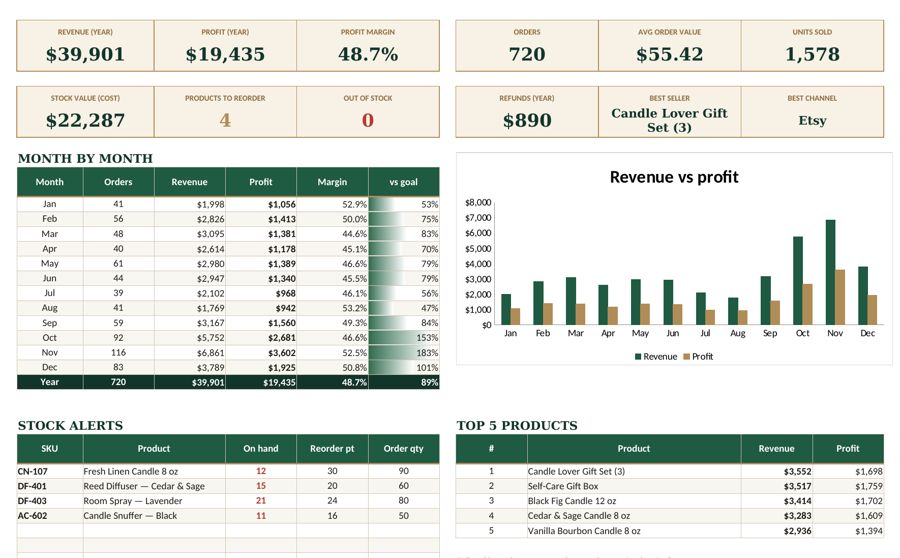
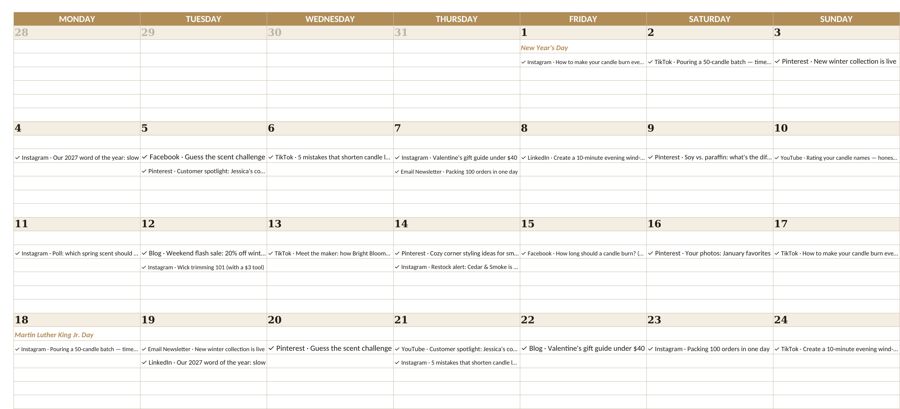
To keep stock counts, reorder needs and weekend sales in one view, the Fyscale shop inventory template is built for small product sellers, and the content planner helps you map your countdown posts in advance.
Tools mentioned in this article
Keep reading
This article is general information for US small businesses, not tax, legal or accounting advice. Check current IRS guidance or ask a qualified professional about your situation.