

What to Do When Cash Is Tight: Short-Term Fixes That Work

It’s Sunday night and you’re doing the math on the back of an envelope. Rent is due Friday, a supplier bill lands the same week, and the two clients who owe you money haven’t paid yet. Your stomach knows the answer before the calculator does.
If that sounds familiar, you’re not failing; you’re facing one of the most common small business cash flow problems, and it usually has a fix. A short-term cash squeeze can often be solved with a handful of practical moves, if you act early and in the right order. This guide is for owners, freelancers and shop sellers who need a calm plan this week: how to size the gap, which fixes to try first, which “fixes” can make things worse, and how to stop the same squeeze from coming back.

Why small business cash flow problems happen
Cash squeezes rarely come from one big disaster. Usually a slow month, a couple of late invoices and a big bill land at the same time. Profit and cash also move on different clocks: you can be profitable on paper while your money sits in unpaid invoices or on inventory shelves. Our guide to cash flow vs profit explains why.
Key idea: A cash squeeze is a timing problem first, and timing problems respond to early, honest action.
How to fix a cash squeeze step by step
Step 1: Size the gap before you do anything
Panic leads to bad decisions, like taking expensive financing for a gap that a phone call could have closed. Start with a simple four-week view:
Cash gap = Cash in the bank + Expected cash in − Bills due
List only cash you’re confident will arrive (signed invoices with reliable clients, marketplace payouts on their normal schedule), and every bill with its due date: rent, payroll or contractor payments, suppliers, loan payments, card minimums, software and estimated taxes. A weekly view is better than a monthly one because it shows when the low point hits. Our 13-week cash flow forecast guide walks you through building one.
Step 2: Bring cash in faster
- Chase overdue invoices today. Call rather than email. Ask what’s blocking payment and whether a partial payment is possible this week. Our guide on handling a late payment from clients has a full escalation plan.
- Invoice immediately. Send invoices for finished work today, not at month-end.
- Ask for deposits on new work. A 30–50% deposit on upcoming projects brings cash forward.
- Offer a small early-payment incentive on large open invoices, but only where the cost makes sense.
- Sell slow-moving stock. A clearance bundle at or near cost turns idle inventory into cash.
- Pre-sell. Offer a limited pre-order, gift cards or a service package paid upfront.
Step 3: Slow cash out, carefully and honestly
- Talk to suppliers before a bill is late. Asking for an extra two weeks before the due date usually goes much better than apologizing after.
- Move payment dates. Many lenders, landlords and vendors can shift a due date if you ask.
- Pause non-essential spending like new equipment, nice-to-have tools and ads that don’t clearly pay back.
- Cut unused subscriptions. A quick business subscription audit often finds money in an hour.
- Prioritize what you pay. Payroll, taxes, rent and suppliers you can’t operate without come first.
What not to delay: payroll taxes and sales tax you’ve collected from customers. That money isn’t yours to borrow, and penalties stack up quickly. The SBA’s manage your business guide covers finances, taxes and other running-the-business basics.
Step 4: If you still need a bridge, compare options carefully
If the gap is still there after Steps 2 and 3, compare financing by total cost and repayment schedule, not just the headline rate.
| Option | Watch out for |
|---|---|
| Existing business line of credit | Usually one of the cheaper options if you already have one |
| Business credit card | High interest if you can’t repay quickly |
| Short-term small business loan | Fees, prepayment terms, personal guarantees |
| Merchant cash advance or revenue-based financing | Can be very expensive once fees are converted to an annual cost; daily or weekly withdrawals can deepen the squeeze |
| Personal savings | Record it properly as an owner contribution, not as income |
Borrowing to cover a one-time timing gap can be reasonable. Borrowing to cover a business that loses money every month just delays the problem.

Example: a four-week rescue plan
Take Dana, a typical owner of a small marketing studio. She has $3,000 in the bank, expects $5,000 in reliable payments over the next four weeks, and has $9,500 in bills due.
Cash gap: $3,000 + $5,000 − $9,500 = −$1,500
| Action | Cash effect |
|---|---|
| Starting gap | −$1,500 |
| Collects a $2,000 overdue invoice, offering a 2% discount for payment this week ($40 discount) | +$1,960 |
| Supplier agrees to move a $1,200 bill two weeks later | +$1,200 |
| Cancels unused subscriptions | +$70 |
| Sells leftover print stock as a clearance bundle | +$600 |
| New position after four weeks | +$2,330 |
Check: −$1,500 + $1,960 + $1,200 + $70 + $600 = $2,330. Dana closes the gap without borrowing. The delayed $1,200 bill still has to be paid two weeks later, so it goes onto her forecast for that week. Four phone calls and one clearance post turned a scary Sunday into a plan.
Find the root cause so it doesn’t repeat
- Profitable but cash-poor? Long payment terms and inventory can trap cash.
- Seasonal dip? Build a reserve during strong months to cover the slow ones.
- Prices too low? If margins are thin, a busy month can still leave you short.
- One big client? Heavy reliance on one payer means one late payment can sink the month.
- Taxes catching you off guard? Move a set percentage of every payment into a separate tax account.
Common mistakes to avoid
- Waiting until the bill is overdue to talk to suppliers or lenders.
- Grabbing the fastest financing without converting its fees to a true cost.
- Delaying payroll taxes or collected sales tax to cover other bills.
- Fixing the symptom only, then facing the same squeeze next quarter.
Your 15-minute action plan
- [ ] Write down today’s bank balance and every bill due in the next four weeks
- [ ] List only the incoming cash you’re confident about, by week
- [ ] Calculate your cash gap for each week
- [ ] Call (not email) the client with your largest overdue invoice
- [ ] Send any invoices for finished work today
- [ ] Email one supplier now if a bill needs a new date
FAQ
What is the most common cause of cash flow problems in a small business?
Timing is the usual culprit: money comes in later than bills go out, often because of late-paying customers, inventory purchases or seasonal swings. Thin margins and weak forecasting make that timing gap worse.
How can I fix cash flow problems fast?
Start by collecting overdue invoices, billing finished work immediately and asking suppliers for new due dates before bills are late. Then cut non-essential spending and sell idle stock before considering financing.
Is it a bad idea to borrow to fix a cash flow gap?
Borrowing can be reasonable for a one-time timing gap if you understand the total cost and repayment schedule. If the business loses money every month, a loan only delays the problem.
The bottom line
A cash squeeze feels personal, but it’s just math, and math can be worked. Size the gap tonight, make your first phone call tomorrow morning, and you’ll likely find the gap shrinking faster than you feared. Then build the small reserve that makes next time easier.
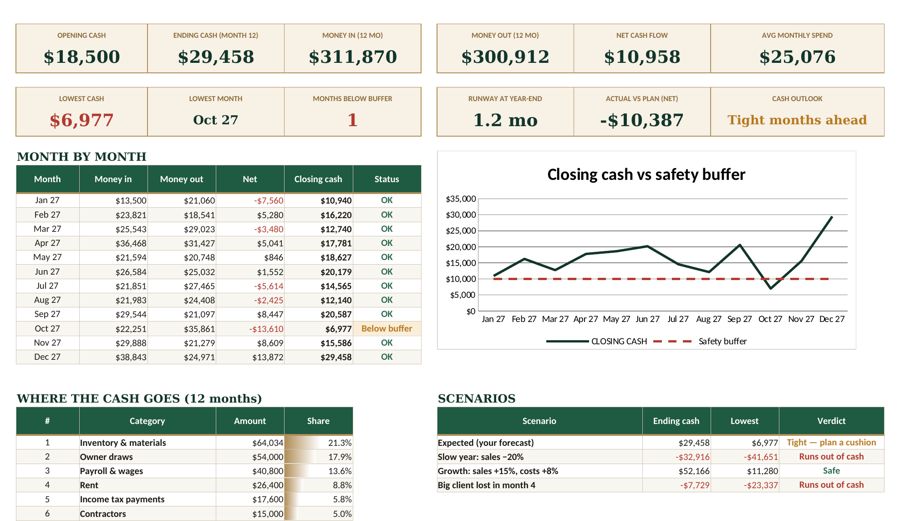
To see the next cash squeeze weeks before it arrives, the Fyscale cash flow forecast template lays out expected inflows and bills week by week and flags any week where your balance dips below your safety level.
Tools mentioned in this article
Keep reading



This article is general information for US small businesses, not tax, legal or accounting advice. Check current IRS guidance or ask a qualified professional about your situation.