

Reorder Point Formula: Never Run Out of Bestsellers

It’s the second week of December. Your best-selling mug just hit zero, orders are still rolling in, and your supplier says the next batch is ten days out. Every one of those days is a sale you won’t make and a buyer who might not come back.
The reorder point formula prevents that moment. It tells you the exact stock level at which to place your next order, so new supplies arrive before you run out. It’s for Etsy sellers, makers and small product shops who are tired of guessing. It takes three numbers, works in any spreadsheet, and is especially useful heading into the holiday rush. Instead of a nagging worry, restocking becomes a calm, automatic decision.

What is the reorder point formula?
Reorder point = (Average daily sales × Lead time in days) + Safety stock
- Average daily sales: how many units you typically sell per day.
- Lead time: how many days pass between placing an order (or starting production) and having sellable stock on your shelf.
- Safety stock: a buffer for days when sales spike or supplies arrive late.
When your on-hand stock drops to the reorder point, you reorder. Not the day you notice it’s low, and not when it hits zero.
Key idea: The best time to reorder is while the shelf still looks full enough to feel comfortable.
How to calculate your reorder point step by step
Step 1: Find your average daily sales
Use a recent, typical period, such as the last 30 or 60 days:
Average daily sales = Units sold in the period ÷ Days in the period
If you sold 180 units of a mug in the last 30 days, that’s 180 ÷ 30 = 6 units per day. Avoid periods that include a one-off spike (like a viral post) unless you expect it to repeat. A simple Etsy inventory spreadsheet with a units-sold column makes this a two-second calculation.
Step 2: Measure your real lead time
Lead time is the full time until stock is ready to sell, not just shipping. Include supplier processing, shipping or freight, your time to receive, check, label and list it, and, for handmade items, your production time once materials arrive. If your supplier says “5–7 days” but it’s usually 10 by the time boxes are unpacked and on the shelf, use 10.
Step 3: Add safety stock
Safety stock protects you against the two things that go wrong: sales run faster than average, or supplies arrive later than expected.
Simple method: a fixed number of days of average sales, for example 5 days. Safety stock = Average daily sales × Buffer days
Max-minus-average method: uses your worst realistic case. Safety stock = (Max daily sales × Max lead time) − (Average daily sales × Average lead time)
The simple method is fine for most small shops. Use the second for high-volume bestsellers where running out really hurts.
Step 4: Decide how much to order
The reorder point tells you when to order; you still need to decide how much:
Order quantity = Average daily sales × Days of stock you want to cover
If you want each order to cover 30 days, order 6 × 30 = 180 mugs. Adjust for supplier minimums, bulk discounts, storage space and cash. Ordering more than you can sell in a reasonable time just moves cash from your bank account to your shelves.

Example: a bestselling mug
- Average daily sales: 6 units
- Average lead time: 10 days
- Busiest realistic day: 9 units; slowest realistic delivery: 14 days
Base demand during lead time: 6 × 10 = 60 units.
Option A, simple safety stock (5 days): 6 × 5 = 30 units. Reorder point = 60 + 30 = 90 units.
Option B, max-minus-average safety stock: (9 × 14) − (6 × 10) = 126 − 60 = 66 units. Reorder point = 60 + 66 = 126 units.
Option B is more cautious and ties up more cash in stock. If this mug is your top seller and a stockout would cost you rankings in December, the extra buffer may be worth it. If cash is tight, Option A with close weekly monitoring is a reasonable middle ground.
Adjusting for the holiday season
Average daily sales from September will understate November and December demand. Before the rush, estimate holiday demand from last year’s same weeks (or a multiplier from your own history), recalculate the reorder point with the higher daily sales figure, and expect longer lead times from suppliers and carriers in Q4.
Holiday example: if the mug’s sales double to 12 per day and lead time stretches to 14 days, base demand during lead time becomes 12 × 14 = 168 units. With 5 days of safety stock (12 × 5 = 60), the reorder point is 228 units, more than double the regular 90.
For more on preparing stock for the season, see holiday inventory planning for Etsy sellers and the stock section of our Black Friday checklist for Etsy sellers.
Set it up in a spreadsheet
| Item | On hand | Avg daily sales | Lead time (days) | Safety stock | Reorder point | Status |
|---|---|---|---|---|---|---|
| Mug – Sage | 95 | 6 | 10 | 30 | 90 | OK |
| Mug – Navy | 72 | 4 | 10 | 20 | 60 | OK |
| Coaster set | 40 | 3 | 14 | 15 | 57 | Reorder |
The formulas are straightforward:
- Reorder point:
= AvgDailySales * LeadTime + SafetyStock - Status:
= IF(OnHand <= ReorderPoint, "Reorder", "OK")
Check the Status column once or twice a week, and more often in Q4.
Common mistakes to avoid
- Using supplier quoted time instead of real lead time. Track actual arrival dates.
- Never updating averages. Recalculate monthly; demand changes with seasons and listing changes.
- Same buffer for everything. Give bestsellers more safety stock and slow movers less.
- Forgetting materials for handmade items. Set reorder points for key materials (clay, wax, fabric) too, not just finished goods.
Your 15-minute action plan
- [ ] Pick your top three bestsellers
- [ ] Calculate average daily sales for each from the last 30 days
- [ ] Write down your real lead time, from order to sellable stock
- [ ] Add 5 days of safety stock and calculate each reorder point
- [ ] Compare each reorder point with what’s on your shelf today
- [ ] Add a Status column so low stock flags itself
FAQ
What is a good safety stock for a small shop?
Five days of average sales is a practical starting point for most small shops. Give your top sellers more, especially in Q4, and slow movers less.
How often should I recalculate my reorder point?
Recalculate monthly, and again before any season that changes demand, such as the holidays. Also update it whenever a supplier’s real lead time changes.
What’s the difference between a reorder point and a reorder quantity?
The reorder point is the stock level that tells you when to order. The reorder quantity is how much you order, often enough to cover a set number of days of sales.
The bottom line
You don’t need fancy inventory software to stop running out. Three numbers and one spreadsheet column are enough to turn restocking from a scramble into a routine. Start with your single best seller today, and you’ll head into the holidays with one less thing to worry about.
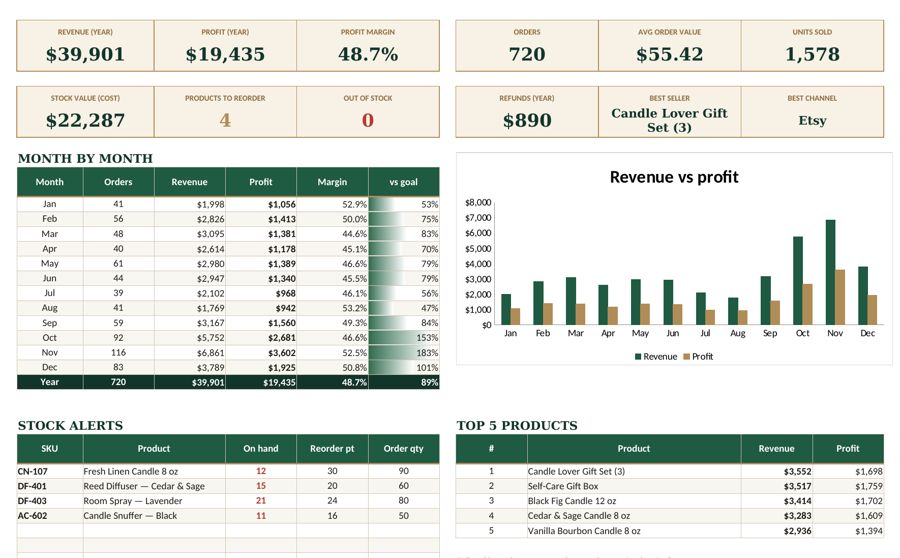
The Fyscale shop inventory template includes reorder point and status columns, so the items you need to restock rise to the top automatically.
Tools mentioned in this article
Keep reading



This article is general information for US small businesses, not tax, legal or accounting advice. Check current IRS guidance or ask a qualified professional about your situation.