

Content Pillars: How to Plan Social Media for a Small Business

It’s 8:45 p.m. and you promised yourself you’d post today. You open the app, stare at the blank caption box, scroll for “inspiration,” and twenty minutes later you’ve posted nothing, or a rushed photo you don’t love.
Content pillars end that nightly blank stare. They’re the 3 to 5 core topics your small business posts about again and again, chosen because they matter to your customers and support your sales. Instead of asking “What should I post?” every day, you ask “Which pillar is today?” This guide is for small business owners, makers and freelancers who run their own social media between everything else. You’ll learn how to pick your pillars, set the right mix and turn them into a simple weekly rhythm. This isn’t about posting more. It’s about posting with a plan, so every post pulls its weight.

What are content pillars?
Content pillars are the few big themes that hold up all your social media content. Every post you make fits under one of them. For a small business, good pillars do three jobs at once:
- Help your customer with a real question or problem
- Build trust in you, your process and your quality
- Lead to a sale without every post being a sales pitch
Most small businesses do well with four pillars like these:
| Pillar | What it covers | Example post |
|---|---|---|
| Teach | Tips, how-tos, answers to common questions | “3 ways to make your candle burn evenly” |
| Behind the scenes | Your process, workspace, packing, materials | A 15-second clip of pouring wax |
| Product | New items, bestsellers, offers, restocks | “The fall scent is back this Friday” |
| Community | Customer photos and reviews (with permission), values, local events | A buyer’s photo of their gift table |
Key idea: Pillars turn “What should I post?” into “Which pillar is today?”, and that one question is much easier to answer.
How to create content pillars step by step
- Pick one goal for the next 90 days. More shop visits, more email sign-ups or more inquiries. Your pillars should all point toward it.
- List your customers’ questions. Look through messages, reviews and comments. Write down 10–20 things people ask or worry about before they buy.
- Group the list into 3–5 themes. Questions about use and care become “Teach.” Questions about how it’s made become “Behind the scenes.” Keep only themes you can talk about for months.
- Add your sales pillar on purpose. Product posts are welcome; they just shouldn’t be every post.
- Set your mix. A practical starting point: roughly a third teaching, a quarter behind the scenes, a quarter product and the rest community.
- Brainstorm five ideas per pillar. That’s 20 posts before you’ve even opened the app.
- Assign pillars to days. For example: Monday teach, Wednesday behind the scenes, Friday product, Sunday community.
- Review monthly. Note which pillar earned the most saves, clicks or sales, and shift the mix toward what works.
If you already have a content plan, pillars slot right into it; our social media content plan guide shows how to lay out the month.

Example: a candle maker’s month of content
Picture Nina, a typical candle maker in Ohio who sells online and at weekend markets. She can realistically post 4 times a week, so 16 posts a month. Her goal for the quarter is more holiday orders.
| Pillar | Posts per month | Share | Post ideas |
|---|---|---|---|
| Teach | 5 | about 31% | Trimming the wick, first-burn tips, choosing a scent for each room, gift ideas by budget, how to reuse the jar |
| Behind the scenes | 4 | 25% | Pouring a batch, testing a new scent, packing a holiday order, her market setup |
| Product | 4 | 25% | Holiday collection launch, bestseller spotlight, restock alert, last day to order for the holidays |
| Community | 3 | about 19% | A customer’s gift photo (shared with permission), a thank-you to her market regulars, a local charity drive |
| Total | 16 | 100% |
Her weekly rhythm: Monday teach, Wednesday behind the scenes, Friday product, and Sunday community, except one Sunday a month that gets an extra teaching post. On a busy week she simply picks the day’s pillar and grabs one idea from the list. Nothing to invent at 8:45 p.m.
Notice that only a quarter of her posts are direct product posts, yet every pillar supports the holiday goal: tips position candles as gifts, process posts justify her price, and community posts show real people buying. When the busy season starts, her Black Friday checklist tasks and her product pillar line up naturally.
Common mistakes to avoid
- Too many pillars. Seven themes means none gets enough posts to stick. Start with four.
- Pillars about you, not your customer. “My studio” is fine, but frame it around what buyers care about: quality, care, the story behind a gift.
- Only selling. If every post is a product post, people stop paying attention. Let teaching and trust do the warm-up.
- Only teaching. The opposite mistake: helpful posts with no clear way to buy. Give each product post a simple next step.
- Forgetting disclosures. If you work with creators or post gifted reviews, follow the FTC’s disclosure guidance for social media.
- Never reviewing. Pillars aren’t permanent. Check monthly and adjust the mix.
Your 15-minute action plan
- [ ] Write down one goal for the next 90 days
- [ ] List 10 questions customers have asked you
- [ ] Group them into 3–5 pillars and name each one
- [ ] Brainstorm five post ideas for each pillar
- [ ] Assign one pillar to each posting day this week
- [ ] Set a monthly reminder to check which pillar performed best
FAQ
How many content pillars should a small business have?
Three to five is the sweet spot for most small businesses. Fewer can feel repetitive, while more spreads your limited time too thin.
What are examples of content pillars?
Common pillars include teaching (tips and how-tos), behind the scenes (process and workspace), product (launches and offers) and community (customer stories, values and local events). The best ones come straight from questions your customers ask.
How often should I post about each content pillar?
Use a mix rather than equal shares. A practical starting point is about a third teaching, a quarter behind the scenes, a quarter product and the rest community, then adjust based on what earns saves, clicks and sales.
The bottom line
You don’t need to be a full-time content creator to show up consistently. Four pillars, a short list of ideas and a weekly rhythm are enough to make social media feel calm instead of chaotic. Pick your pillars tonight, and tomorrow’s post is already half written.
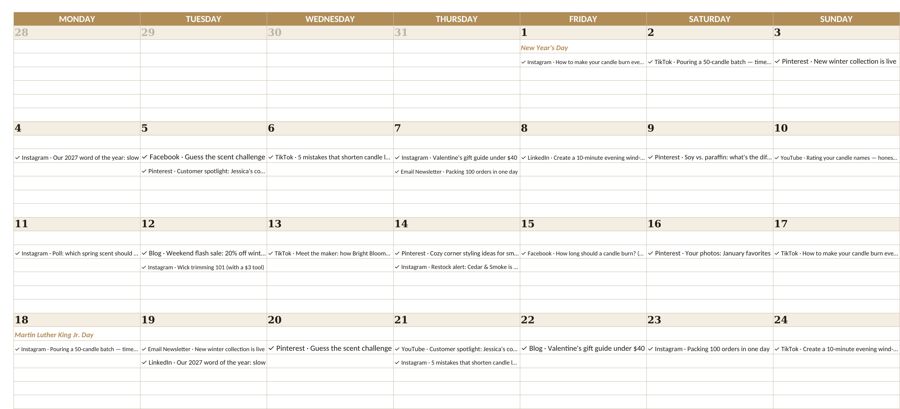
If you want a place to keep your pillars, ideas and posting days together, the Fyscale content planner template gives each pillar its own column and lays out your month at a glance.
Tools mentioned in this article
Keep reading



This article is general information for US small businesses, not tax, legal or accounting advice. Check current IRS guidance or ask a qualified professional about your situation.