

Wholesale Pricing Formula for Makers: Set a Price That Works
The email lands on a Tuesday morning: a boutique owner loves your work and wants to stock it. “Can you send your wholesale price sheet?” Your heart jumps, then sinks. You don’t have one, and you’re not sure whether half your retail price will even cover your costs.
The wholesale pricing formula takes the guesswork out of that moment. In its simplest form: Wholesale price = Cost per unit × 2, and Retail price = Wholesale price × 2. This guide is for makers, Etsy sellers and small product businesses getting ready to sell to shops. You’ll learn how to find your true cost, set a wholesale price that leaves room for profit, check your retail price, and avoid the traps that make wholesale feel like working for free. Done right, wholesale isn’t a discount; it’s a way to grow without chasing every single sale yourself.

What is the wholesale pricing formula?
Wholesale is selling your products in bulk to a retailer, who then sells them to their customers at a higher price. That retailer needs room for their own costs and profit, which is why wholesale prices are typically about half of retail.
| Formula | What it gives you |
|---|---|
| Cost per unit = Materials + Labor + Overhead per unit | What one item really costs you |
| Wholesale price = Cost per unit × 2 | A 50% gross margin for you |
| Retail price = Wholesale price × 2 | Room for the shop’s margin (often called “keystone” pricing) |
| Margin method: Wholesale = Cost ÷ (1 − target margin) | A wholesale price for any margin you choose |
The “×2, ×2” rule is a starting point, not a law. Some products need a higher multiplier because of risk, small batches or a premium position. If the margin vs markup language is new to you, our guide on margin vs markup explains why doubling cost gives a 50% margin.
Key idea: Your wholesale price should still pay you; the retail price is simply what the shop adds on top.
How to set your wholesale price step by step
- Add up materials per unit. Include everything that goes into one item, plus its share of packaging.
- Pay yourself for labor. Time per unit × an hourly rate you’d accept from an employer. Never use $0.
- Add overhead per unit. Studio costs, tools, software and supplies spread across how many units you make in a typical month.
- Calculate cost per unit. Materials + labor + overhead.
- Set wholesale. Multiply by 2, or use the margin method if you want a specific margin.
- Set retail. Multiply wholesale by 2, then compare it with similar products. If the market won’t pay that retail price, you need to lower costs, not just your margin.
- Sell at the same retail price everywhere. Shops won’t stock you if you undercut them on your own website or Etsy shop.
- Write your terms. Minimum order, reorder minimum, lead time and payment terms all go on your price sheet.
For the full picture on costing your time and materials, see how to price handmade products.

Example: pricing a handmade mug for wholesale
Picture Ana, a typical ceramicist who sells mugs on Etsy and just got her first boutique inquiry.
| Cost item | Calculation | Per mug |
|---|---|---|
| Materials (clay, glaze, packaging share) | $3.20 | |
| Labor | 15 minutes at $22/hour | $5.50 |
| Overhead (kiln firing, studio, tools) | $1.80 | |
| Cost per unit | $10.50 | |
| Wholesale price | $10.50 × 2 | $21.00 |
| Retail price | $21.00 × 2 | $42.00 |
If Ana wants a 55% margin instead, the margin method gives $10.50 ÷ (1 − 0.55) = $23.33, which she might round to $23.50.
Now compare the two kinds of sales at $21 wholesale and $42 retail.
One Etsy sale: the buyer pays $42 plus $7 shipping (which covers Ana’s $7 label). Etsy fees on the $49 total: 6.5% transaction fee ($3.19) + 3% + $0.25 payment processing ($1.72) + $0.20 listing fee ≈ $5.11. Ana’s profit: $42 − $10.50 − $5.11 ≈ $26.39.
One wholesale order of 24 mugs: 24 × $21 = $504 in revenue. Profit: 24 × ($21 − $10.50) = $252, or $10.50 per mug.
Per mug, wholesale earns less. But it’s one order, one shipment and one invoice instead of 24 separate listings, conversations and packages, and a shop that reorders every season can become steady, predictable income. That’s the trade wholesale offers: lower margin per unit for volume and less time per sale. Just be sure that $10.50 per mug works for you; if it doesn’t, adjust costs or your multiplier before you send the price sheet.
Common mistakes to avoid
- Halving your current retail price. If your retail price was too low to begin with, halving it can put wholesale below cost. Always start from cost.
- Leaving out your labor. A wholesale price that only covers materials means you’re working for free on every order.
- Undercutting your stockists. Selling for less online than the shop’s shelf price damages the relationship fast.
- No minimum order. Small, scattered orders eat your time. Set a minimum quantity or dollar amount.
- Forgetting payment terms. Decide upfront whether shops pay before shipping or on terms like Net 30, and put it in writing.
- Ignoring capacity. A 200-unit order is only good news if you can make it on time without hurting your other sales.
Your 15-minute action plan
- [ ] Pick your best-selling product
- [ ] Write down materials, labor (time × rate) and overhead per unit
- [ ] Calculate cost per unit, then wholesale (× 2) and retail (× 2)
- [ ] Compare that retail price with three similar products
- [ ] Decide a minimum order and your payment terms
- [ ] Start a one-page price sheet with your first three products
FAQ
What is the standard wholesale pricing formula?
A common starting point is wholesale price = cost per unit × 2, and retail price = wholesale × 2. You can also use wholesale = cost ÷ (1 − target margin) to aim for a specific margin.
What percentage of retail should wholesale be?
Wholesale is often around 50% of the retail price, which gives the shop room for its own costs and profit. Some products and retailers use different ratios, so treat 50% as a starting point.
Should my online price be the same as the retail price in stores?
Generally, yes. Shops expect you not to undercut them, so keeping one consistent retail price across your website, Etsy and stockists protects your wholesale relationships.
The bottom line
That boutique email is a sign your work is ready for a bigger stage. With a clear cost, a wholesale price that pays you and a retail price that holds up everywhere, you can reply with confidence instead of panic. Price your best seller today, and your first price sheet is already one-third done.
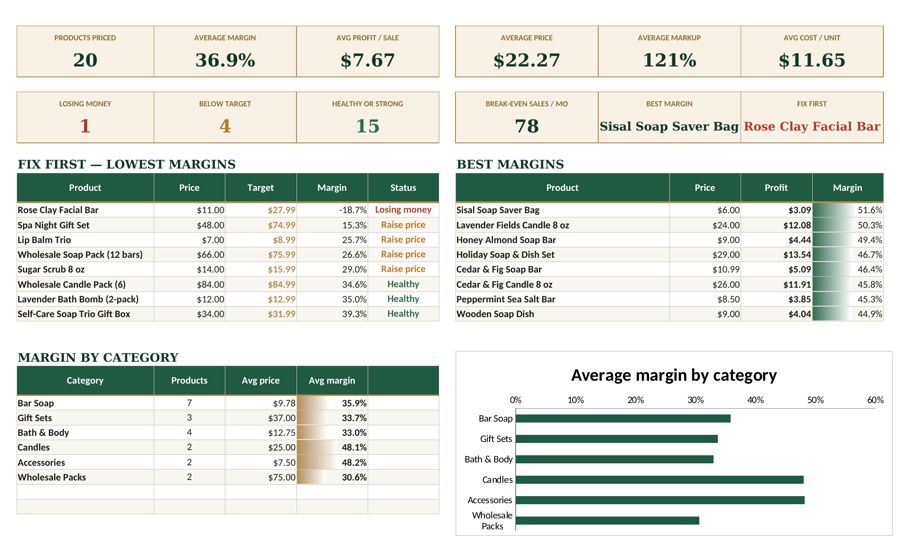
To see your cost per unit, wholesale price and margin side by side, the Fyscale pricing calculator template does the math for each product, so you can test multipliers before you commit.
Tools mentioned in this article
Keep reading


This article is general information for US small businesses, not tax, legal or accounting advice. Check current IRS guidance or ask a qualified professional about your situation.